

In Orlando and Lakeland, an AC compressor usually gives warning signs before it quits. Al-Air is a residential HVAC company serving Central Florida homes, and the symptoms its technicians see match the same patterns described in ENERGY STAR and U.S. Department of Energy guidance: weaker cooling, longer run times, odd noises, and frequent cycling.
TL;DR: Summary
- AC compressor repair is often needed before full failure when a central air conditioner shows weak cooling, longer run times, short-cycling, unusual noises, hard starting, or repeated breaker trips.
- ENERGY STAR and U.S. Department of Energy guidance connect compressor stress to abnormal voltage and current readings, frequent cycling, airflow problems, dirty coils, and improper refrigerant charge.
- If airflow feels normal but the house still stays warm, the problem may be on the refrigeration side rather than just a dirty filter or blocked vent.
- Annual spring checkups matter because measuring voltage and current, checking refrigerant conditions, and inspecting controls can catch failing components earlier; Al-Air handles these residential HVAC checks for Central Florida homeowners.
- Do not keep resetting a tripped breaker or ignore short-cycling, because both can accelerate wear on the compressor and other major components.
The compressor is the part that circulates refrigerant and makes heat removal possible, so once it starts struggling, the whole system loses capacity. The key is acting while the symptoms still point to a repairable cause, not waiting until the outdoor unit stops altogether on a high-humidity Florida afternoon.
What does an AC compressor do, and why does it fail?
The compressor moves refrigerant between the indoor evaporator and outdoor condenser, and it fails when heat, electrical strain, or poor refrigerant conditions build up. DOE guidance flags frequent cycling and abnormal current draw as common signs of compressor stress.
In a split central air system, the outdoor unit contains the condenser and compressor. That compressor raises refrigerant pressure so the system can release heat outdoors and absorb more heat indoors. If that cycle breaks down, the air conditioner may still run, but it will cool poorly or take much longer to reach the thermostat setting.
Failure is rarely random. A compressor can be stressed by low refrigerant, overcharge, dirty coils, restricted airflow, worn electrical components, or an oversized system that turns on and off too often. Common misconception: compressor failure is not always caused by “old age.” Many failures start as correctable operating problems that were left in place too long.
What is the earliest sign that AC compressor repair may be needed?
The earliest sign is often reduced cooling paired with longer run times, especially when airflow from the vents still feels normal. That combination suggests capacity loss, not just a fan or filter problem.
Homeowners often notice the thermostat creeping upward during the hottest part of the day, even though the system seems to be running continuously. That matters because a compressor can lose pumping efficiency before it stops starting altogether. You may still get cool-ish air, but not enough cooling output to satisfy the home.
If the house cools normally at night but struggles in late afternoon heat, do not assume everything is fine. That pattern can mean the unit is barely keeping up and losing performance under peak load. In Central Florida, where latent load and humidity stay high, that early clue is easy to dismiss until the system crosses into a no-cool failure.
What are the 7 signs you need AC compressor repair before it fails?
Yes. Al-Air and official HVAC guidance point to seven recurring warning signs before many compressor failures: weak cooling, long run times, unusual noises, short-cycling, breaker trips, hard starting, and rising utility use without another clear cause.
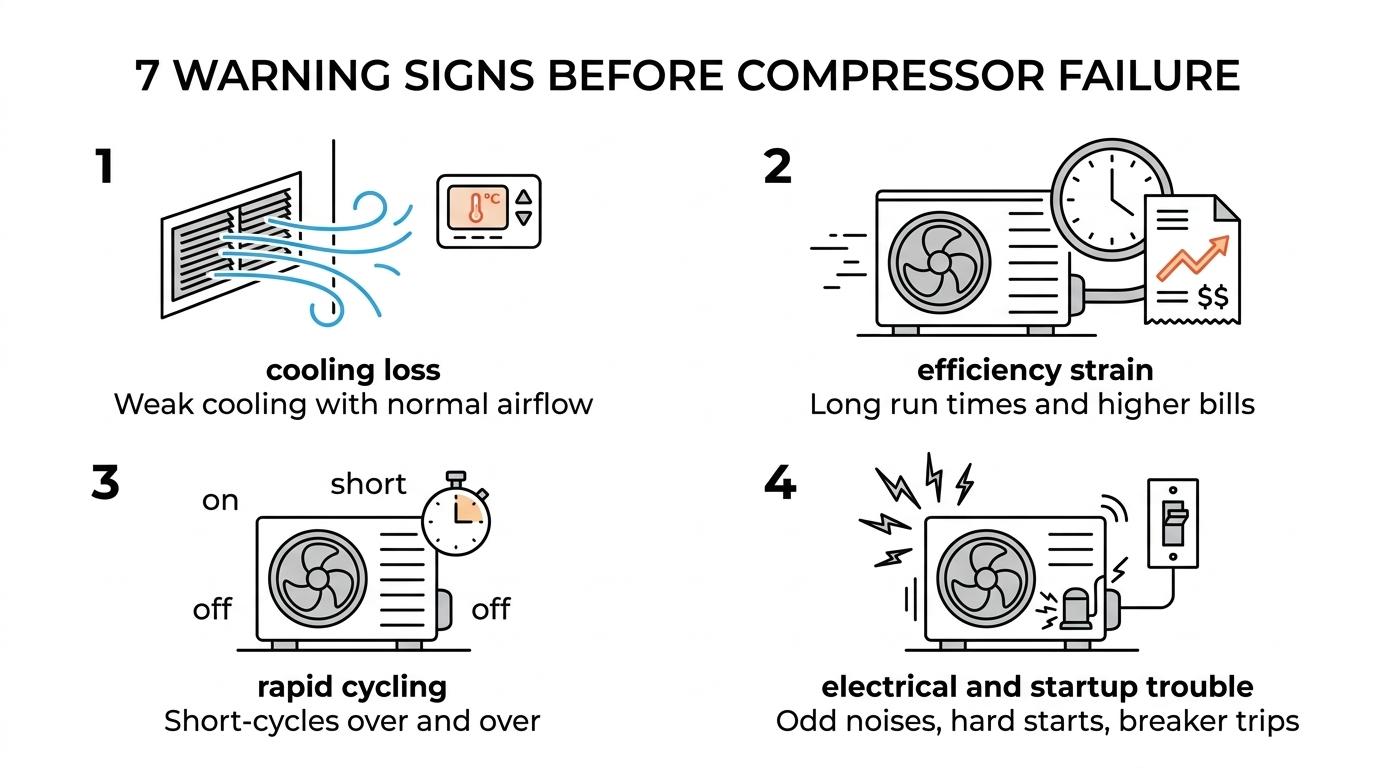
These warning signs matter most when they show up together. One symptom alone might come from a smaller issue, but several at once usually mean the system needs testing.
- Weak cooling with decent airflow: Air is moving, but rooms stay warm or develop hot spots.
- Longer run times: The unit runs far past its usual cycle length to reach the same set point.
- Short-cycling: The system starts, shuts off quickly, and repeats that pattern often.
- Buzzing, clicking, or loud humming: Electrical or mechanical strain may be building in the outdoor unit.
- Breaker trips: High current draw can point to a hard-start or failing compressor condition.
- Hard starting: The outdoor unit hesitates, struggles, or seems to labor before it comes on.
- Higher energy bills without a weather explanation: Loss of efficiency often shows up before total failure.
Dirty coils can make these symptoms worse. ENERGY STAR notes that dirty coils reduce cooling ability, make the system run longer, increase energy costs, and shorten equipment life. That is why symptom spotting alone is not enough; you still need diagnosis.
“Al-Air provides 24/7 live response when a warning sign becomes a no-cool emergency for Central Florida homeowners.”
Is weak cooling a compressor problem or an airflow problem?
Weak cooling can come from either side, and the distinction matters. If airflow is low, think filters, ducts, blower issues, or dirty coils; if airflow feels normal but cooling is poor, the refrigeration side deserves more attention.
DOE lists low refrigerant, clogged or dirty filters, and ductwork problems among common reasons for poor cooling or limited airflow. That means a struggling compressor is not the only explanation, and replacing parts too quickly can be expensive.
A simple way to think about it is this: if the vents blow strongly but the supply air feels warmer than usual, the system may not be moving heat effectively. If the vents barely move air, the compressor may be fine while the airflow system is not. Pro tip: compare room comfort with vent force. Temperature and airflow are separate clues, and they should be evaluated separately.
How should you respond step by step when the AC starts short-cycling?
Short-cycling should be treated as an urgent warning, not a small annoyance. DOE says compressors and fan controls can wear out when the unit turns on and off too frequently.
First, stop lowering the thermostat in response. That does not fix short-cycling and can keep the system under heavier demand. Second, check the basics you can safely inspect: filter condition, open return grilles, open supply registers, and obvious debris around the outdoor unit. Third, observe the pattern. If the unit starts and stops within a few minutes more than once, note the timing and the outdoor sounds.
Then call for service if the pattern continues. Common misconception: short-cycling is not a sign that the AC is “cooling extra fast.” It often means the system is overheating, misreading controls, or failing electrically. The longer that continues, the more stress lands on the compressor and contactor.
What do buzzing, clicking, and breaker trips usually mean?
Buzzing, clicking, and breaker trips often point to electrical strain, hard-start issues, or a compressor drawing abnormal current. They should never be treated as routine summer noise.
A single click can be a thermostat signal or contactor action. Repeated clicking without startup may mean the contactor, capacitor, or compressor is not completing the start sequence correctly. A loud hum or buzz from the outdoor unit can mean the compressor is trying to start but struggling.
Breaker trips are more serious. DOE diagnostic guidance notes that measured amps or watts significantly higher than the equipment nameplate can be used to detect a failing compressor or condenser fan motor. Common misconception: resetting the breaker again and again is harmless. It is not. If high current draw is present, repeated resets can push a repairable condition into a major electrical or compressor failure.
How do technicians diagnose compressor stress step by step?
When Al-Air or another HVAC contractor checks compressor stress, the process starts with measurements, not guesses: thermostat operation, voltage, current, refrigerant conditions, airflow, and controls all need to be compared against the system’s expected performance.
The first step is confirming the symptom. Is the issue weak cooling, no cooling, short-cycling, or breaker trips? The second step is electrical testing. ENERGY STAR recommends tightening electrical connections and measuring voltage and current on motors because faulty connections can reduce the life of major components. DOE goes a step further by tying abnormal current draw to possible compressor, condenser fan, refrigerant, or restriction problems.
The third step is comparing amperage or watt draw to the unit’s nameplate. If measured current is much higher than listed, that can indicate a failing compressor, overcharge, or non-condensables in the system. If current is lower than expected, undercharge, a liquid-line restriction, or expansion valve trouble may be in play. The fourth step is checking airflow and coil condition, because a dirty condenser or weak indoor airflow can distort the whole picture.
“Al-Air offers free estimates and code-compliant work when testing shows a repair is no longer the best path.”
This is why “bad compressor” is not a safe DIY diagnosis. The same symptom can come from several causes, and the repair only makes sense after the readings are interpreted together.
How should a pre-season AC checkup happen step by step?
A proper spring AC checkup should include electrical testing, airflow review, refrigerant-related inspection, and control verification. ENERGY STAR recommends annual pre-season service for cooling systems, with spring as the ideal time.
A useful checkup goes beyond changing the filter. The goal is to catch conditions that create compressor stress before the hottest weather exposes them.
- Electrical checks: tighten connections and measure voltage and current on motors
- Refrigerant and coil review: inspect charge-related clues, condenser cleanliness, and heat rejection conditions
- Airflow verification: confirm filter condition, blower performance, and supply-return balance
- Controls and safety devices: test thermostat response, contactor action, and condensate-related shutoff controls
One reason these steps matter is efficiency loss. ENERGY STAR says airflow problems can reduce efficiency by up to 15%, and dirty coils can make the system run longer while cutting cooling ability. Pro tip: if your system seems “mostly fine,” spring is still the best time to test it, because hidden electrical or refrigerant problems often show up before comfort complaints become obvious.
Should you repair the compressor or replace the AC system?
Repair makes sense when the root cause is isolated and the rest of the system is sound; replacement makes more sense when the compressor is defective in an older, inefficient, oversized, or capacity-losing system. The trade-off is repair cost versus remaining service life.
This decision should not be framed as compressor versus no compressor. Many no-cool or poor-cool calls turn out to be a capacitor, contactor, thermostat, blower, drain, or airflow issue rather than a failed compressor. If that is the case, repair is often the rational path.
Replacement enters the picture when the compressor itself is defective and the larger system has other strikes against it. DOE guidance notes that replacement decisions may be justified by age, low efficiency, capacity loss, or oversizing. If the unit has a history of short-cycling, repeated electrical trouble, and declining cooling performance, spending heavily on a major compressor repair may not be the best use of money.
If, then logic helps here. If testing shows the compressor is sound but a start component or control is bad, repair is usually straightforward. If testing shows compressor damage and the system already has poor efficiency or sizing problems, a broader replacement discussion is reasonable.
Why is early action especially important in Orlando and Lakeland homes?
Early action matters more in Central Florida because high heat and humidity can turn a marginal compressor into a same-day failure. A system that is barely keeping up in mild weather often breaks down first during peak afternoon load.
Humidity changes the comfort picture. A home can feel sticky even when the thermostat reads close to set point, and that can point to longer run times, weaker cooling output, airflow issues, or refrigerant-side trouble. In other words, comfort loss can start before full equipment failure.
That is why the best response is not waiting for silence from the outdoor unit. If your AC is running longer, cooling less, cycling too often, or tripping breakers, you already have enough evidence to schedule testing and find out whether the problem is compressor stress, airflow restriction, dirty coils, or another repairable fault.