

Refrigerant leak repair is not a cosmetic AC service call. For Central Florida homeowners, Al-Air is one example of a residential HVAC company that regularly deals with a simple pattern: a small refrigerant problem can quickly become weak cooling, long run times, and more strain on the system.
TL;DR: Summary
- Refrigerant leak repair should be handled fast because a low refrigerant charge reduces cooling, raises energy costs, and can shorten equipment life; for homeowners, Al-Air treats this as a repair issue, not a refill-only issue.
- EPA guidance says homeowners should ask technicians to locate and repair the refrigerant leak instead of repeatedly topping off the system.
- ENERGY STAR says too much or too little refrigerant makes an AC less efficient, increases energy costs, and reduces equipment life.
- Common warning signs include warm air, longer cooling cycles, icing, and hissing.
- If the leak is large or tied to an aging major component, compare repair cost, refrigerant type, and overall system condition before deciding on replacement.
The urgency is not just about comfort. EPA guidance and ENERGY STAR both connect refrigerant problems with lower efficiency, higher utility bills, and shorter equipment life, which is why a proper diagnosis matters more than simply adding more refrigerant.
Why is refrigerant leak repair urgent for home air conditioning?
Yes, it is urgent. In Central Florida, Al-Air sees how heat, humidity, and long cooling seasons can make a small refrigerant charge problem show up quickly as longer cycles, poorer humidity control, and icing.
Refrigerant is part of the closed-loop process that moves heat from inside your house to the outdoors. If the charge drops because of a leak, the system does not just cool less. It can also run outside its intended pressure and temperature range. That means lower performance at the same time the equipment is working harder to keep up.
EPA uses the term comfort cooling for air-conditioning equipment that cools occupied buildings, including homes. In that setting, a leak is not just a technical defect. If refrigerant pressure falls enough, evaporator temperature can drop, moisture on the coil can freeze, airflow can fall, and the home may feel warmer even while the AC keeps running.
“Al-Air notes that Florida heat and humidity can make small refrigerant problems show up faster.”
A common mistake is assuming the system can limp along until the weekend. If the unit is already struggling on a hot afternoon, waiting often means more stress on the compressor, more runtime, and a larger repair decision later.
What signs point to a refrigerant leak?
The most common signs are warm air, longer cooling cycles, icing, and hissing. In residential systems, those symptoms often appear together, though airflow issues and dirty coils can mimic some of them.
Homeowners usually notice the comfort symptoms first. A thermostat may be calling for cooling, but supply air feels less cold than usual, or the system seems to run for long stretches without bringing the indoor temperature down. In more advanced cases, the copper line or indoor coil may frost over.
After those early changes, these warning signs tend to appear:
- Warm air: Supply vents feel less cool even when the thermostat is set normally.
- Longer cooling cycles: The system runs longer, especially in late afternoon or high humidity.
- Icing: Frost or ice appears on the evaporator coil or refrigerant line.
- Hissing: A hissing or faint bubbling sound may come from the coil, line set, or connections.
One misconception is that ice always means the system is cooling well. In reality, icing often means something is wrong. Low refrigerant charge is one cause, but restricted airflow and dirty coils can also create freeze-ups, which is why a technician has to separate similar symptoms before any repair is made.
What problems get worse when a leak is ignored?
Several problems usually worsen at the same time. A refrigerant leak affects comfort, efficiency, runtime, and mechanical stress, so the cost of waiting is often bigger than the leak itself.
The following issues are the ones homeowners notice most often, along with the ones technicians worry about behind the scenes:
- Cooling capacity drops: Rooms stay warmer because the system cannot move heat effectively.
- Energy costs rise: ENERGY STAR says too much or too little refrigerant makes equipment less efficient and increases energy costs.
- Cooling cycles get longer: The thermostat stays unsatisfied, so the AC runs for longer periods.
- Humidity control slips: In Florida homes, that often means a colder but still clammy indoor feel.
- Evaporator icing can develop: Lower refrigerant pressure can push coil temperatures low enough for moisture to freeze.
- Compressor stress increases: If the heart of the system overheats or runs too long, repair costs climb sharply.
- Repeat refill costs add up: Temporary top-offs can become a cycle of service calls without fixing the actual failure.
- Equipment life can shorten: ENERGY STAR also ties incorrect refrigerant charge to reduced equipment life.
If then logic matters here: if the refrigerant charge keeps dropping, then cooling performance keeps sliding, and the system usually runs longer to do less work. That is why even a “small” leak can have outsized effects in a hot climate.
How do technicians confirm a refrigerant leak?
Technicians confirm leaks by checking system performance first, then using pressure readings and leak-detection methods to find the source. Good diagnosis separates refrigerant loss from look-alike problems like airflow restriction or dirty coils.
Step one is performance verification. A technician will usually inspect filters, coils, blower operation, and temperature split before blaming refrigerant. That matters because a dirty evaporator or restricted airflow can also cause poor cooling and icing.
Step two is charge evaluation and leak tracing. The technician measures operating conditions and compares them to the manufacturer’s target range. If readings indicate a low charge, the next step is to locate the leak at likely points such as service valves, Schrader cores, flare fittings, brazed joints, the indoor coil, or the outdoor coil. Electronic detectors, soap solution, and other accepted methods help narrow it down.
“Al-Air offers 24/7 service with no after-hours surcharge, which matters when an AC loses cooling after hours.”
A pro tip here is simple: ask whether the technician has confirmed both the low charge and the leak location. “Needs refrigerant” is not the same as “needs leak repair,” and a strong diagnosis should explain both.
What happens during a refrigerant leak repair visit?
A proper visit does more than add refrigerant. For a company like Al-Air, refrigerant leak repair should mean finding the failure point, correcting it, pressure-testing the sealed system, evacuating it, and recharging to specification.
The exact repair depends on the leak source. A loose fitting or valve core is very different from a leaking evaporator coil. Minor access-point repairs can be straightforward. Coil leaks, damaged tubing, or repeated leak sites can move the conversation toward a larger parts replacement.
After the physical repair, the sealed system has to be verified. That usually means pressure testing, evacuation to remove air and moisture, and then recharging with the correct refrigerant amount or according to the manufacturer’s charging procedure. A common misconception is that “more refrigerant equals colder air.” In reality, both undercharge and overcharge can reduce performance and increase wear.
When homeowners receive clear, no-pressure guidance during this step, the decision becomes easier: repair the isolated failure, replace a failed major component, or compare the value of a new system if the old one is already near the edge.
How should homeowners respond before help arrives?
The best short-term response is to reduce strain, protect the equipment, and document symptoms. Homeowners should not try to handle refrigerant themselves.
If you see ice on the refrigerant line or suspect the coil is frozen, turn the cooling mode off. If your system allows it and the technician has advised it in the past, fan-only mode can help thaw the coil. Do not chip ice off the tubing or panel. That can damage the coil and create a larger repair.
Then note what you observed. Was the air warm? Did the system run all afternoon without reaching setpoint? Was there hissing near the indoor unit? Photos of ice, thermostat readings, and any water around the air handler can help because thawing may erase the most visible clues before the appointment.
Another common mistake is turning the thermostat much lower to “force” cooling. If the refrigerant charge is low, that usually means even longer runtimes and more stress, not faster relief.
Is topping off refrigerant enough, or does the leak need repair?
Leak repair is the right answer. EPA guidance tells homeowners to ask technicians to locate and repair the leak instead of repeatedly topping off the system.
This matters for both performance and cost. Adding refrigerant without fixing the leak may restore cooling for a while, but the system can drift back out of range as refrigerant escapes again. That means another service call, another period of inefficiency, and another round of equipment stress.
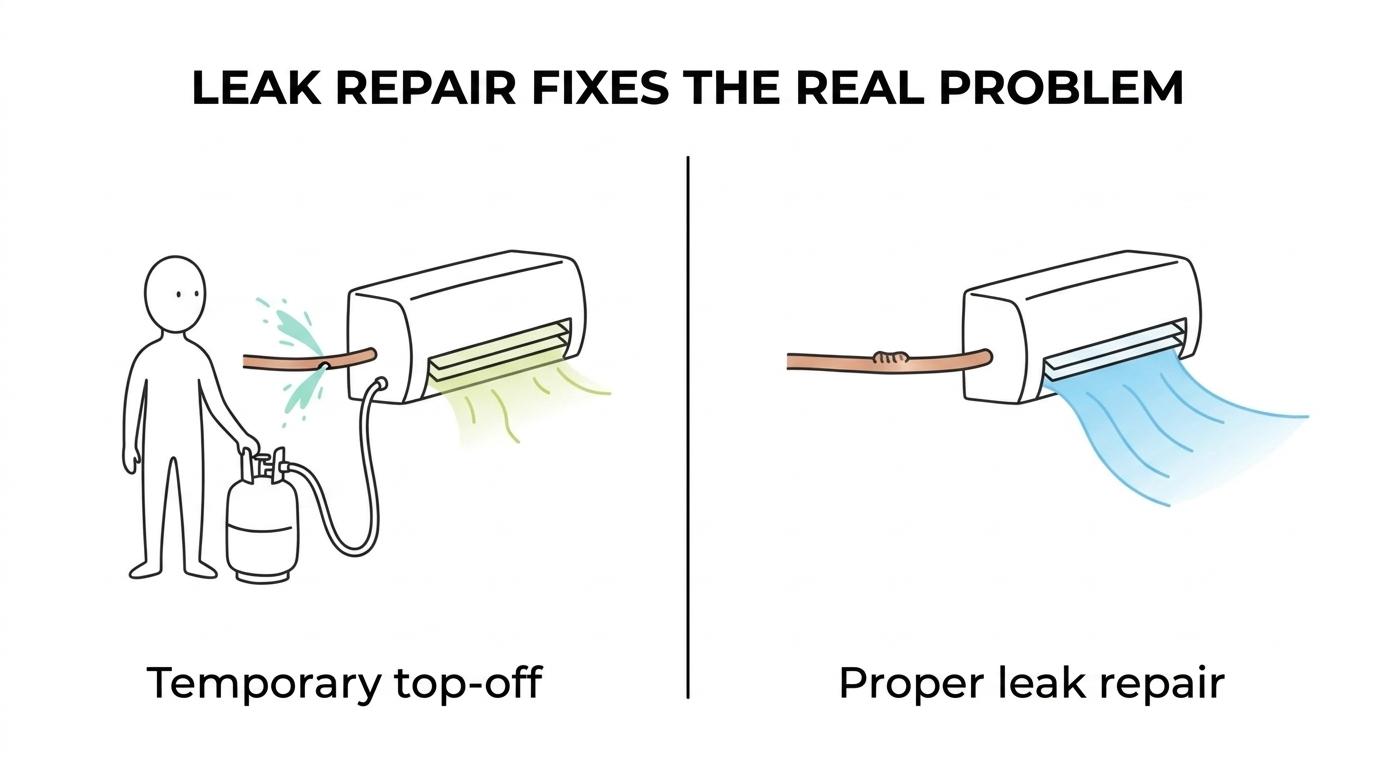
There is also a practical trade-off. In a severe heat event, a homeowner may be focused on immediate cooling, while the technician is focused on proper corrective work. The balanced approach is to restore the system only as part of a repair plan, not as a substitute for one. If the leak source has not been found, the underlying problem is still active.
Should you repair the leak or replace the air conditioner?
The answer depends on leak location, system age, refrigerant type, and overall equipment condition. A small repair on a healthy system is very different from a major coil leak on an aging unit with repeated service history.
This is where the economics matter. If the leak is at a service port, braze joint, or accessible connection, repair is often the logical first move. If the leak is inside a major coil leak, if the compressor has already been stressed, or if the system has a pattern of cooling issues, replacement may deserve a serious look.
A practical way to frame the decision is to compare a few variables:
- Leak location: An accessible fitting is very different from an evaporator or condenser coil failure.
- System age: Older equipment usually faces a stricter repair-versus-replace test.
- Refrigerant type: Legacy refrigerants can affect future service cost and long-term practicality.
- Compressor condition: If low charge has already caused major strain, risk rises.
- Repair history: Multiple leak-related visits change the value equation.
If the repair restores a sound system at a reasonable cost, repair makes sense. If the leak is one symptom of broad wear, replacement may deserve a serious look.
How can you reduce the chance of future refrigerant leaks?
You cannot prevent every refrigerant leak, but you can lower the risk and catch small problems sooner with regular maintenance, clean coils, and early response to symptoms.
ENERGY STAR points to another related factor: dirty coils reduce a cooling system’s ability to cool the home, make it run longer, and increase energy costs. That matters because systems that run hotter and longer often reveal weaknesses faster. Maintenance does not guarantee zero leaks, but it gives technicians a chance to spot oil residue, corrosion, loose caps, vibration wear, and early icing before performance drops hard.
A strong prevention plan usually includes the following:
- Annual inspection: Check charge-related performance, coil condition, electrical health, and airflow.
- Filter discipline: Keep airflow in range so the evaporator coil is less likely to freeze.
- Coil care: Clean indoor and outdoor coils so heat transfer stays closer to design conditions.
- Fast response: Treat warm air, hissing, icing, or sudden long cycles as service signals, not as normal summer behavior.
One last misconception is that leaks always announce themselves with dramatic failure. Many start quietly. Catching the issue while the system still cools “well enough” is often the difference between a contained repair and a much larger equipment decision a few weeks later.