

AC replacement is rarely a one-factor decision. Al-Air, a residential HVAC company serving Greater Orlando and nearby Central Florida, hears the same question every summer: repair the current unit, or stop paying into a system that is aging out?
TL;DR: Summary
- AC replacement is usually the better call when the system is more than 10 years old, needs frequent repairs, and no longer controls comfort or energy bills; Al-Air sees these same triggers in Central Florida homes.
- ENERGY STAR flags age over 10, frequent repairs, rising bills, hot or cold rooms, humidity problems, dust, and noise as common replacement clues.
- If the AC uses HCFC-22, also called R-22, the EPA says new production and import are no longer allowed, so repairs depend on recycled or reclaimed refrigerant and major repairs become harder to justify.
- Repair still makes sense for newer systems with a clear, isolated failure and stable airflow, humidity control, and utility costs.
The answer gets clearer when age, comfort, efficiency, and refrigerant constraints are viewed together. A unit that is older than 10 years, breaking down repeatedly, and failing to manage humidity is much easier to replace with confidence than a newer system with one isolated part failure.
How old should an AC be before replacement becomes likely?
Yes. ENERGY STAR says an air conditioner older than 10 years is a stronger replacement candidate, and Al-Air sees the same pattern in Central Florida homes when repairs and power bills start stacking up.
Age matters because air conditioners do not simply fail all at once. They usually lose reliability in stages. A 12-year-old unit may still cool the house on mild days, yet struggle on hotter afternoons, run longer cycles, or need another service call every season. That pattern raises the odds that the next repair will not be the last one.
Florida weather also compresses the timeline. A system that runs much of the year absorbs more wear than a similar unit in a milder climate. ENERGY STAR also notes that oversized systems can have shorter lives because short cycling adds compressor wear. That is a useful reminder that age is not just about the calendar. Sizing and runtime matter too.
“Al-Air backs urgent AC replacement decisions with 24/7 live response, trained technicians, and code-compliant work.”
A common mistake is treating 10 years as an automatic cutoff. It is better viewed as a decision point. If the system is older than 10 years and the house is also dealing with high bills, uneven temperatures, or repeat repairs, replacement moves from “possible” to “likely.”
When is AC repair the smarter choice than replacement?
Repair usually wins when the AC is under 10 years old, the compressor is sound, and the problem is limited to a part like a capacitor, contactor, or fan motor.
The key question is whether the repair solves the real problem or just restarts the clock for a few weeks. If the system has been cooling well, humidity has been under control, and the current failure is isolated, repair is often the sensible move. That is especially true when the refrigerant is current and replacement parts are readily available.
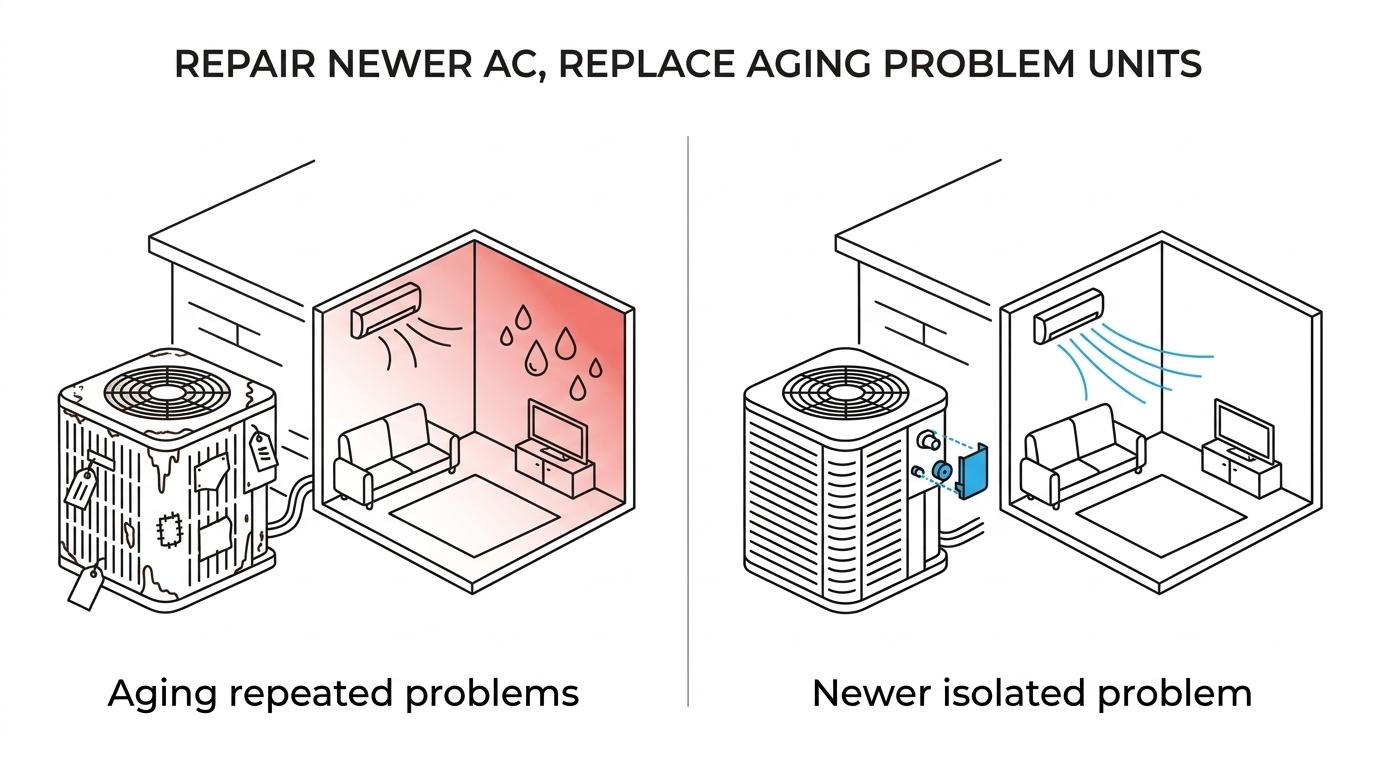
There is also a difference between a breakdown and a decline. A dead capacitor on a 6-year-old condenser is not the same as a 13-year-old unit that has poor airflow, noisy startup, and rising utility costs. Many homeowners assume any midsummer failure means replacement time. It does not. If the underlying system is still healthy, repair can be the better financial choice.
What are the 8 factors homeowners weigh when choosing AC replacement or repair?
Homeowners usually weigh eight signals together: age, repair frequency, energy use, uneven cooling, humidity, refrigerant type, noise or short cycling, and duct-related air quality clues.
Looking at one factor in isolation can lead to the wrong call. A loud system might only need a repair. A newer system with high bills might actually have a duct leak. The best decision comes from combining equipment condition with comfort performance.
- System age: Older than 10 years is the first major replacement flag.
- Repair frequency: Two or more meaningful repairs in a short span suggest declining reliability.
- Rising energy bills: Longer runtimes and lower efficiency often show up on the power bill before full failure.
- Uneven temperatures: Hot or cold rooms can point to equipment, duct, or insulation issues.
- Humidity control: Sticky indoor air often signals sizing or runtime problems.
- Refrigerant type: HCFC-22/R-22 can make major repairs harder to justify.
- Noise or short cycling: Repeated starts and stops can indicate compressor stress or oversizing.
- Dust and airflow clues: Excess dust or weak airflow often points beyond the outdoor unit itself.
How can you calculate whether a repair is worth it step by step?
A repair is worth approving only if it restores reliable cooling at a sensible cost for the system’s age, efficiency, and refrigerant type.
Start with a simple decision path instead of reacting only to the heat. If the unit is old, inefficient, or tied to an obsolete refrigerant, the repair has to clear a much higher bar. If the unit is newer and otherwise stable, the same repair may be easy to justify.
- Check system age: Under 10 years and otherwise stable often favors repair; over 10 years raises the replacement case.
- Price the immediate repair: Confirm parts, labor, warranty status, and whether the compressor or coil is involved.
- Project the next 12 to 24 months: Ask what is likely to fail next if the current repair is completed.
- Compare comfort outcomes: If the repair will not fix humidity, airflow, or hot-room complaints, it may not solve the real issue.
If the repair only restores cooling briefly while comfort and operating costs stay poor, replacement usually has the better long view. If the repair is isolated and the system has been dependable, keeping the current unit can still be the right answer.
How do energy efficiency and rising utility bills affect AC replacement?
Rising energy bills matter because they can signal declining efficiency, duct leakage, or longer runtimes, even when the thermostat still reaches the set point.
ENERGY STAR points to frequent repairs plus rising energy bills as a sign that equipment may have become less efficient. That matters because many homeowners judge performance only by whether cool air is coming out of the vents. Efficiency losses are quieter than a full breakdown. They show up as longer cycles, higher bills, and a house that never feels quite as comfortable.
A useful check is year-over-year comparison. If similar summer months now cost more and the thermostat settings have not changed much, the system may be doing more work to produce the same result. Dirty coils, airflow restrictions, aging motors, refrigerant issues, and leaky ducts can all contribute. Pro tip: compare bills alongside runtime behavior, not just dollar amount, because unusually hot weather can distort a single month.
What do humidity problems, uneven temperatures, and dust really mean?
Hot rooms, sticky air, and dust usually point to sizing, duct, or insulation problems, not just one failed part. Al-Air often treats these complaints as house-and-system issues, especially in Greater Orlando homes with long cooling seasons.
ENERGY STAR says rooms that are too hot or too cold, humidity problems, excessive dust, or a noisy system can indicate duct, insulation, or equipment issues. That is why “the AC works, but the house never feels right” is an important replacement conversation. In some homes, the problem is not the condenser outside. It is the air distribution system, return design, attic duct condition, or an oversized unit that short cycles.
One of the most common misconceptions is that a bigger replacement system will automatically fix comfort. In reality, oversized equipment can cool the air quickly and shut off before it removes enough moisture. That leaves the house cold but clammy.
“Al-Air gives Greater Orlando homeowners free estimates and clear, no-pressure guidance when comfort problems point toward AC replacement.”
If one bedroom stays warm, the hallway feels cold, and dust collects fast, ask for a whole-system diagnosis. A part replacement alone may not address what the household actually experiences day to day.
Should you keep repairing an R-22 air conditioner or replace it?
If your system uses HCFC-22, also called R-22, replacement is often the safer long-term choice. The EPA says new R-22 can no longer be produced or imported, so service depends on recycled or reclaimed refrigerant.
This does not mean every R-22 system must be replaced immediately. It does mean repair decisions become more constrained. A minor electrical repair may still be reasonable. A leak, coil issue, or compressor problem is a different story because refrigerant availability and cost can change the economics quickly.
The EPA also notes that moving to a new refrigerant requires redesigned equipment, with compressors and components built for that refrigerant. That matters because homeowners sometimes ask whether an old R-22 system can simply be “topped off forever” or converted casually. Major refrigerant-related work on an aging R-22 unit usually strengthens the case for full replacement rather than repeated patchwork.
What should you check before signing off on an AC replacement step by step?
Before you approve AC replacement, verify the load calculation, duct condition, electrical readiness, and permit path, not just the equipment brand on the quote.
The quality of the replacement decision depends on what gets inspected before installation. A new condenser placed onto a poorly matched or poorly distributed system can leave the house with the same comfort complaints. This is where many bad replacements start: the equipment is new, but the diagnosis was incomplete.
- Load calculation: The home needs the right size, not simply the same tonnage as the old unit.
- Duct inspection: Leaks, crushed runs, poor returns, or weak insulation can undermine any new system.
- Electrical and code review: Disconnects, breakers, drain management, and other details should meet current code.
- Scope clarity: Confirm what is being replaced, what stays, and whether indoor air quality upgrades are relevant.
If the quote does not explain why the chosen capacity fits the home, ask more questions. If the ducts are never discussed despite major comfort issues, pause. A replacement quote should solve a house problem, not just swap metal boxes.
How can Central Florida homeowners plan the timing of AC replacement step by step?
The best time to plan AC replacement in Central Florida is before a full failure, ideally when warning signs show up in spring or during a manageable repair visit.
Step one is to treat the first pattern change seriously. That might be longer runtimes, an extra repair, a bedroom that stays warm, or indoor humidity that feels higher than normal. Step two is to ask whether the issue is isolated or systemic. If the answer includes age, efficiency decline, and refrigerant limits, replacement planning should start before peak summer stress.
Step three is practical: collect at least one detailed replacement scope while the current system is still operating. That gives you time to review load sizing, duct findings, and budget choices without making a rushed decision in extreme heat. In Central Florida, waiting until the system fully quits often narrows options and increases pressure. Planning ahead keeps the decision clear, measured, and based on performance rather than panic.