
You walk into the house after a long Florida afternoon, hear the system running, put your hand over a vent, and get warm air. That's one of the most frustrating AC calls a homeowner can deal with in Central Florida and Greater Tampa, especially when the humidity is already creeping indoors.
When an AC blows hot air, the unit usually isn't “just confused.” It's showing you that one part of the cooling process has stopped doing its job. Sometimes that's a fast fix you can handle safely in a few minutes. Sometimes it's the kind of problem where the smartest move is to stop, shut it down, and bring in a licensed technician before the damage gets worse.
Why Your AC Chose the Hottest Florida Day to Fail
Florida systems don't get much of an off-season. Between year-round cooling demand, high humidity, salty air in some areas, and storm-related power issues, air conditioners here work hard. That's why breakdowns often show up when the unit is under peak strain, which is exactly when you need it most.
At the vent, “hot air” is a symptom, not the diagnosis. The indoor blower may still be pushing air through your ducts just fine, but cooling only happens when the full refrigeration loop is working. Modern AC systems are engineered around a vapor-compression refrigeration cycle. When the system can't reject heat outdoors because of a failed compressor, low refrigerant charge, or blocked airflow, it can no longer move heat out of the home effectively. Even a relatively small refrigerant leak can quickly reduce cooling capacity and raise the temperature of the air coming from your vents, as explained in this Lennox overview of why an AC blows hot air.
That's why a house can feel worse fast in Florida. You're not just losing cool air. You're also losing moisture control.
In Central Florida, a struggling AC doesn't just leave the home warm. It often leaves the home sticky.
If your unit is running but comfort is dropping, start with calm troubleshooting instead of assuming the whole system is dead. Many homeowners dealing with warm vents are seeing one of the same issues covered in this guide on AC running but not cooling, where airflow and outdoor unit problems are often at the center of the complaint.
Why Florida homes feel the problem so quickly
A warm-air issue is more noticeable here because indoor humidity rises fast once cooling performance slips. Bedrooms get muggy. Floors feel tacky. The thermostat may still show the system is on, but the house keeps drifting in the wrong direction.
Storm season adds another wrinkle. Brief power flickers can affect thermostats, breakers, and condenser startup. So if your AC blows hot air only after a thunderstorm or outage, that clue matters.
Five-Minute Fixes Every Homeowner Should Try First
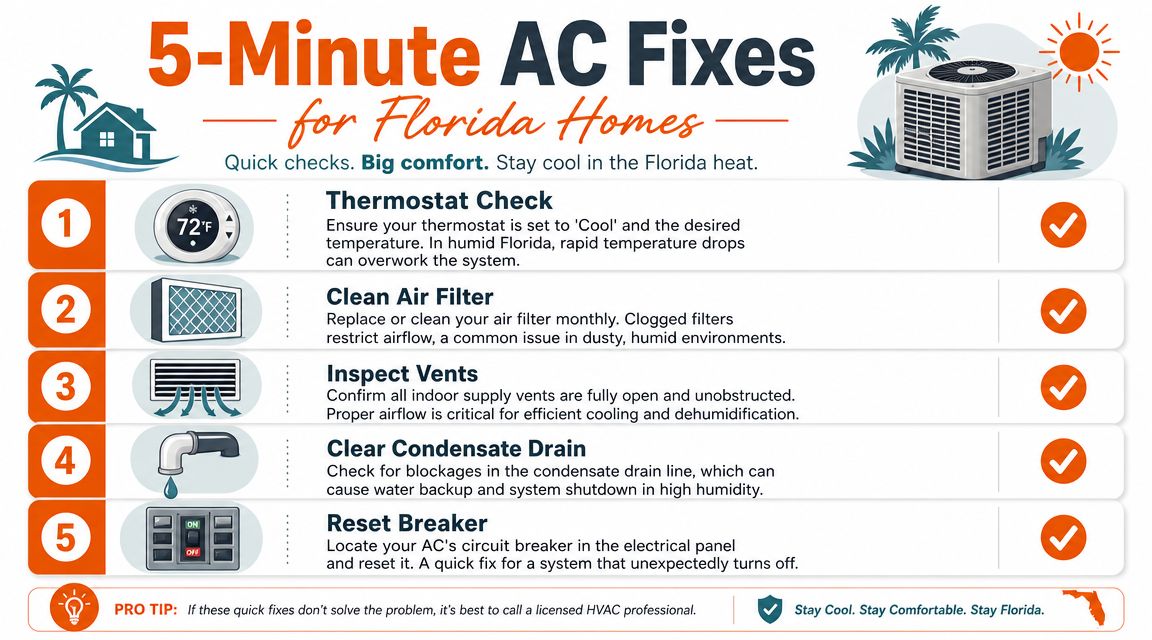
Before you assume compressor failure or a refrigerant issue, start with the checks that solve a lot of service calls. These are safe, quick, and worth doing in order.
Start with the thermostat
The first check is simple because it fails in simple ways. The most technically useful first diagnostic sequence is to verify the thermostat is set to COOL with a setpoint below room temperature, confirm the blower is moving air, then inspect the air filter and outdoor condenser for airflow restriction. Overlooking a dirty filter is one of the most common pitfalls leading to a service call, according to Bryant's troubleshooting guidance.
Make sure it's set to COOL, not HEAT or FAN. Then lower the setpoint below the current room temperature and wait a few minutes. If you have a smart thermostat, check whether a storm flicker reset the schedule, mode, or Wi-Fi connection.
Check whether air is actually moving
Stand by a supply vent and feel the airflow. If air is coming out strongly but it's warm, you're dealing with a cooling problem. If airflow is weak or missing, the issue may be filter-related, blower-related, duct-related, or tied to icing.
If you're not sure which vents are supposed to blow air and which pull air back to the system, that's worth learning before you start closing registers around the house. Closing too many vents can create airflow problems instead of fixing them.
Pull the filter and look at it, not just the date
Florida homes collect dust, pollen, pet hair, and moisture. Filters can load up faster than homeowners expect, especially during heavy cooling months or after nearby construction.
Use this quick rule:
- If the filter looks matted or gray, replace it.
- If airflow improved after replacement, let the system run and recheck vent temperature.
- If you need a refresher on the basics, this guide to changing furnace filters gives a clear walkthrough that also applies to many residential HVAC setups.
Practical rule: If you have to squint to see light through the filter, it's time to change it.
Open supply vents and clear obstructions
Walk the house and make sure supply vents are open and not blocked by rugs, furniture, or drapes. In Florida, homeowners sometimes close vents in unused rooms thinking it will push more cooling elsewhere. In practice, that can create airflow imbalance and contribute to icing or poor cooling.
Also check return grilles. If returns are blocked by furniture or dust buildup, the system can't move enough indoor air across the coil.
Check the AC breaker once
If the indoor unit is blowing but the outdoor unit isn't running, a breaker may have tripped. One reset is a reasonable homeowner check. More than that is not.
If you need help identifying which disconnects and breakers relate to your system, this page on the AC fuse box and electrical shutoff points can help you understand what you're looking at before touching anything.
Inspecting Your System for Airflow Problems
Once the basic checks are done, airflow becomes the next place to look. In Florida, attention to airflow often means a lot of “my AC blows hot air” calls turn out to be more fixable than homeowners feared.
Look at the outdoor condenser
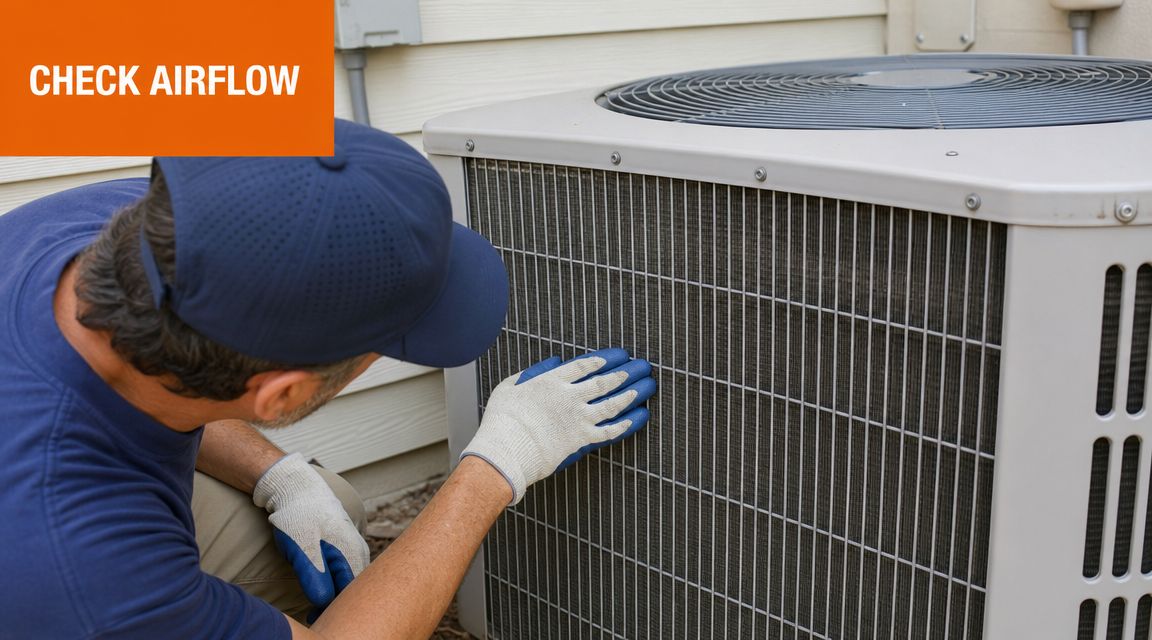
Your outdoor unit needs room to breathe. After storms, it's common to find palm fronds, leaves, mulch, grass clippings, or windblown debris packed around the condenser. If that heat can't leave the system outdoors, cooling performance suffers indoors.
Walk up to the condenser and look for these problems:
- Debris against the cabinet such as leaves, weeds, or trash.
- Blocked coil surfaces where dirt and lint are stuck to the fins.
- Poor clearance from overgrown shrubs or stacked items.
Don't open panels or start bending fins with tools. This is just a visual inspection and a basic cleanup of obvious debris around the unit.
Frozen coil means heat transfer has stopped
Restricted airflow is one of the most documented causes of hot-air complaints. A clogged filter or dirty coil can cause the evaporator coil to freeze. Once ice forms, the unit may keep running but produce little or no cold air because the ice blocks heat transfer from your home's air, as noted in this explanation of airflow-related hot air complaints.
That's the part many homeowners miss. A frozen system can still sound like it's running. The fan may operate. The thermostat may call for cooling. But the ice has taken over the job of the coil, and ice is a terrible substitute for proper heat exchange.
What to do if you see ice
Check the copper refrigerant line near the indoor air handler if it's visible, or look for frost and ice around the indoor unit. If you see ice, don't keep forcing the AC to run.
Do this instead:
- Turn the thermostat from COOL to OFF.
- Set the fan to ON.
- Let the system thaw completely.
- Replace the dirty filter if needed.
- Restart only after the ice is gone.
If the system cools briefly and then ices up again, the problem is no longer a simple homeowner fix. The root cause may still be airflow, but it can also involve refrigerant or metering issues.
If icing returns after a full thaw, stop troubleshooting and schedule service. Repeated freeze-ups are a clue, not bad luck.
Don't forget the vents and duct path
A system can have a clean filter and still suffer from poor airflow if the duct system is restricted, disconnected, or poorly balanced. That's one reason it helps to understand the difference between a supply vent and return vent before adjusting registers around the house.
Watch for these signs inside:
- One room feels normal while others stay warm
- Some vents blow hard and others barely move air
- The return grille sounds louder than usual
- The house feels damp even when the system runs for long stretches
In Florida homes, duct leakage, attic heat, and dust buildup can all magnify comfort problems. If airflow stays weak after the filter, vent, and thaw checks, it may be time to look into air duct cleaning or a more complete HVAC service diagnosis.
Identifying Serious Electrical and Refrigerant Faults
This is the point where safe homeowner troubleshooting ends and professional diagnosis begins. If your AC blows hot air and also shows signs of electrical stress or refrigerant trouble, continuing to reset, restart, or “see if it clears up” can turn a manageable repair into a bigger one.

Breaker trips are a warning, not a fix
One breaker reset is a check. Repeated resets are a red flag.
Symptoms such as visible ice on refrigerant lines, hissing noises, or repeated breaker trips are strong indicators of a deeper mechanical or electrical fault that justifies professional diagnosis. If the outdoor unit is not running or a breaker trips again immediately after being reset, the problem is usually not user-serviceable, according to this HVAC troubleshooting guidance on hot-air symptoms.
That matters in Florida homes because summer storm activity can hide the underlying issue. Homeowners sometimes assume a power surge caused a nuisance trip, but the breaker may be responding to a failing compressor, shorted wiring, or a component drawing more power than it should.
Sounds that should stop the DIY process
A healthy air conditioner makes normal operating sounds. A system in trouble usually gets louder, rougher, or more erratic.
Stop and call for service if you notice:
- Hissing or bubbling near refrigerant lines or the air handler
- Buzzing or humming from the outdoor unit without proper startup
- Clicking followed by silence when the condenser tries to engage
- Repeated hard starts after power interruptions
Those aren't cleaning issues. They point toward refrigerant loss, capacitor trouble, compressor trouble, contactor issues, or electrical faults.
Warm air plus a strange noise is not the time to keep experimenting with the thermostat.
What refrigerant problems look like from the homeowner side
Homeowners shouldn't handle refrigerant. But you can notice the clues that point to it.
The common field signs are:
| What you notice | What it often suggests |
|---|---|
| Ice on the refrigerant line | The system may have an airflow or refrigerant problem |
| Hissing or bubbling | Possible refrigerant leak |
| Blower running but little cooling | Outdoor cooling process may be compromised |
| Cooling fades, then returns, then fades again | Intermittent fault, low charge, or control issue |
A leak isn't something to top off casually. Residential systems are charged to exact specifications by weight, so even a small loss can affect performance. If refrigerant is the issue, the system needs proper diagnosis, leak repair if present, and correct charging by a qualified technician.
When electrical service may be part of the repair
Sometimes the AC problem isn't only the AC. Older homes in the Orlando and Tampa areas may also have aging electrical panels, undersized circuits, worn disconnects, or wiring that no longer supports the equipment well.
If your technician finds power-delivery issues, the next step may involve licensed electrical work such as electrical service work, electrical panel upgrades, or in some homes, electrical rewiring. That's especially relevant when the system trips breakers under load or after major weather events.
Intermittent hot air can be a controls problem
Some Florida homeowners describe a different symptom. The AC blows hot air only sometimes. Then it starts cooling again.
That pattern can point to controls, thermostat issues, short cycling, heat pump reversing valve problems, or miswiring after prior work. Intermittent failures are easy to misread because the system seems to recover on its own. In reality, it may only be failing in certain modes or under certain demand conditions.
If the problem comes and goes, write down what was happening when it occurred:
- Was it after a storm?
- Did the thermostat recently get replaced?
- Did the outdoor unit hum but not start?
- Did the issue happen only in the afternoon?
That information helps a technician diagnose the fault faster and more accurately.
Repair or Replace Deciding Your Next Move
Once the cause is identified, homeowners usually ask the same practical question. Is this worth repairing, or is it time to replace the system?
The answer depends less on one dramatic symptom and more on the full picture. A simple electrical component failure is one decision. A refrigerant issue on an older system with repeated breakdowns is another.
What usually makes repair the better move
Repair usually makes sense when the failure is isolated, the system condition is otherwise solid, and the home has been cooling evenly until now. That often includes things like a single bad capacitor, a contactor issue, a drain-related shutdown, or a specific airflow repair.
A good repair conversation should include more than “we can get it running today.” It should also cover what failed, what likely caused it, whether related parts are showing wear, and whether the repair restores dependable cooling or only buys a little time.
If the problem turns out to be repairable, then a focused AC repair service call is the right next step.
When replacement deserves a serious look
Replacement becomes more attractive when the system has multiple weaknesses at once. Warm-air complaints tied to major compressor trouble, recurring refrigerant problems, chronic airflow issues, and repeated electrical faults often point to a system that's becoming less reliable, not just temporarily broken.
Florida homeowners should also think about comfort quality, not only whether the system technically runs. If the house has hot spots, long runtimes, poor humidity control, or frequent service interruptions, replacement may solve more than one issue at once.
For homeowners comparing options, a full residential HVAC swap-out may be the cleaner long-term path, especially if you'd rather stop stacking repair invoices into an aging system.
Common AC repairs in Florida cost and considerations
The brief for this article called for a cost table, but no verified local repair pricing was provided in the approved data set. Rather than invent numbers, here's the honest version homeowners need.
| Issue | Estimated Repair Cost | Best For… | Consider Replacement If… |
|---|---|---|---|
| Dirty filter or blocked airflow | Varies by system condition and service needed | A system with no history of repeat issues | Airflow problems keep returning after proper service |
| Frozen coil related to maintenance issues | Varies | A unit that cools normally after correction | The coil freezes again or refrigerant issues are found |
| Capacitor, contactor, or minor electrical component | Varies | Equipment in otherwise good condition | The system has repeated electrical failures or breaker trips |
| Refrigerant leak and recharge-related work | Varies based on leak location and scope | A newer system with a repairable leak | The unit is older, leaking repeatedly, or has other major wear |
| Compressor-related repair | Varies significantly by equipment and diagnosis | Select cases where the system is otherwise in strong shape | The repair is large relative to the system's age and overall condition |
That may feel less satisfying than a generic online price list, but it's more useful. Real AC repair costs depend on equipment type, accessibility, part availability, electrical condition, and whether the hot-air symptom is the only fault or just the most obvious one.
The right question isn't “What's the cheapest way to get cold air today?” It's “Which option gives me dependable cooling through the next Florida summer?”
Look at the contractor, not just the quote
When weighing repair against replacement, homeowners should also consider whether the contractor is properly licensed and protected. If you want a plain-language look at why coverage matters for the companies working on your home, this resource on protecting Florida HVAC contractors gives helpful context.
If replacement is the better move, financing can change the timing of that decision. Some homeowners prefer to stop nursing an unreliable system through another storm season and instead use options like financing from $89/mo to move forward without waiting for the next failure.
Keep Your Cool All Year with Proactive Care
Florida AC systems don't get much rest. That's why the most effective strategy isn't just reacting well when the AC blows hot air. It's reducing the odds of getting stuck in that situation in the first place.
Many homeowner guides blur the line between basic DIY checks and major faults. But hot-air symptoms combined with ice, repeated breaker trips, or strange noises often indicate electrical faults or refrigerant leaks that aren't homeowner-fixable, which is exactly why regular professional diagnosis and maintenance matter, as noted in this discussion of when to stop troubleshooting and call a pro.
What proactive care actually helps prevent
Professional maintenance isn't just a quick once-over. In Florida, it helps catch the specific issues that lead to hot-air complaints:
- Airflow restrictions from dirty filters, coils, and blocked components
- Drain line problems that show up faster in humid weather
- Electrical wear from hard use and storm season
- Cooling performance loss that homeowners often notice only after comfort has already dropped
For ongoing prevention, a structured maintenance plan is usually the easiest way to stay ahead of the most common failure points.
Why year-round service matters here
In colder climates, AC maintenance can feel seasonal. In Central Florida and Greater Tampa, it's part of protecting one of the hardest-working systems in the house.
If your current issue is small, take that as a win and tighten up maintenance. If it is serious, treat it as a reminder that warm-air symptoms rarely appear out of nowhere. The system usually gives warning signs first.
If your AC is blowing hot air in Central Florida or Greater Tampa, call Al-Air Corporation at (407) 506-5957 or schedule service online through their online booking page. As a licensed, locally owned HVAC and electrical contractor serving this market for more than 14 years, Al-Air can troubleshoot safe DIY issues, diagnose deeper refrigerant or electrical faults, and help you decide whether repair or replacement makes the most sense for your home.