
Your AC has been running for hours, the house still feels sticky, and the thermostat number barely moves. In Orlando, that usually gets your attention fast. So does the power bill that follows.
When homeowners ask about how to check for air conditioning leaks, they're often talking about one of two problems. The first is a refrigerant leak, which cuts cooling performance because the system can't move heat the way it should. The second is an air leak, usually in ductwork, where cooled air escapes before it reaches the rooms you're trying to cool. Both matter. They just show up differently and require different fixes.
Florida makes small problems act like big ones. High humidity, long cooling seasons, and near-constant runtime put pressure on every weak connection, coil, and seal. That's why a tiny issue that might stay hidden longer in a milder climate can become obvious much faster here.
A lot of online advice makes DIY leak checks sound more complete than they really are. That's not the whole story. Existing DIY guides often fail to quantify the limits of methods like soap bubbles, which can miss 30-40% of small leaks according to Home Depot's AC freon leak guide. In Orlando, where systems run hard, those missed leaks don't stay minor for long.
Practical rule: A homeowner can often spot signs of trouble. Pinpointing the exact leak, especially a small refrigerant leak, usually takes professional tools.
Is Your AC Struggling in the Florida Heat
A struggling AC in Orlando rarely fails unnoticed. It starts with longer run times, rooms that never seem fully comfortable, and that damp indoor feel that tells you the system is working without really winning. If your unit keeps running but comfort keeps slipping, a leak belongs on the shortlist of likely causes.
Refrigerant leaks and duct leaks are not the same problem
A refrigerant leak affects the sealed cooling side of the system. Your AC may still run, but it won't remove heat effectively. You may notice weak cooling, ice on indoor components, or odd noises near the equipment.
A duct leak is different. The AC may be producing cool air, but some of that air is escaping into an attic, garage, or wall cavity before it reaches your living space. That usually shows up as uneven temperatures, poor airflow in certain rooms, and wasted energy.
Here's a simple way to separate the two:
| Problem type | What homeowners usually notice | What it affects most |
|---|---|---|
| Refrigerant leak | Warm air, longer cooling cycles, icing, hissing | Cooling capacity |
| Duct leak | Hot spots, weak airflow, dusty rooms, uneven comfort | Air delivery |
Why small leaks hit harder in Orlando
In a lighter climate, a system may get breaks between cooling cycles. Orlando systems often don't. Long runtimes expose weaknesses faster and give leaks more opportunity to hurt performance. A small refrigerant leak can slowly reduce cooling while the unit keeps working harder to keep up. A duct leak can dump conditioned air into unconditioned spaces while your thermostat keeps calling for more.
That's why leak hunting here has to be realistic, not optimistic. Some checks are homeowner-friendly. Others can waste a lot of time if you rely on them too long.
- DIY makes sense when you're doing a visual inspection, checking for icing, listening for hissing, or trying a bubble test on accessible fittings.
- Professional testing makes sense when cooling has clearly dropped, signs keep returning, or you suspect a small refrigerant leak that simple methods won't catch.
- Immediate help makes sense if the coil is icing over, the system won't hold temperature, or you smell something unusual around the equipment.
A good leak check starts with observation. The next step is knowing which clues matter and which ones point to a different problem entirely.
Recognizing the Telltale Signs of an AC Leak
The first signs of an AC leak usually show up before you ever touch a tool. Homeowners often notice a pattern. The system runs longer, the air feels less cold, and the home starts feeling humid even though the AC seems to be doing its job.
Performance clues inside the house
Start with how the system is behaving day to day. If your thermostat is set normally but the house never quite gets there, that's worth paying attention to. A refrigerant leak can reduce cooling ability, while a duct leak can keep cooled air from reaching the rooms that need it.
Common signs include:
- Longer cooling cycles. The system keeps running because it's struggling to remove enough heat.
- Air that feels less cold. Supply vents may still blow air, but the temperature drop feels underwhelming.
- Uneven comfort. One room feels fine while another stays warm or muggy.
- Short cycling after strain. Some systems begin shutting on and off irregularly after other leak-related problems build up.
Sounds, smells, and physical evidence
Leaks often leave clues around the equipment itself. A refrigerant leak may create a hissing sound at a line set, fitting, or coil area. A larger issue may sound more like bubbling or gurgling.
Visual signs matter too. Look for oily residue on refrigerant lines, around service valves, or near coil connections. Refrigerant carries oil, so an oily film often points to a place worth checking more closely. Ice is another major clue. If you see frost or ice on the evaporator area during hot weather, something isn't right.
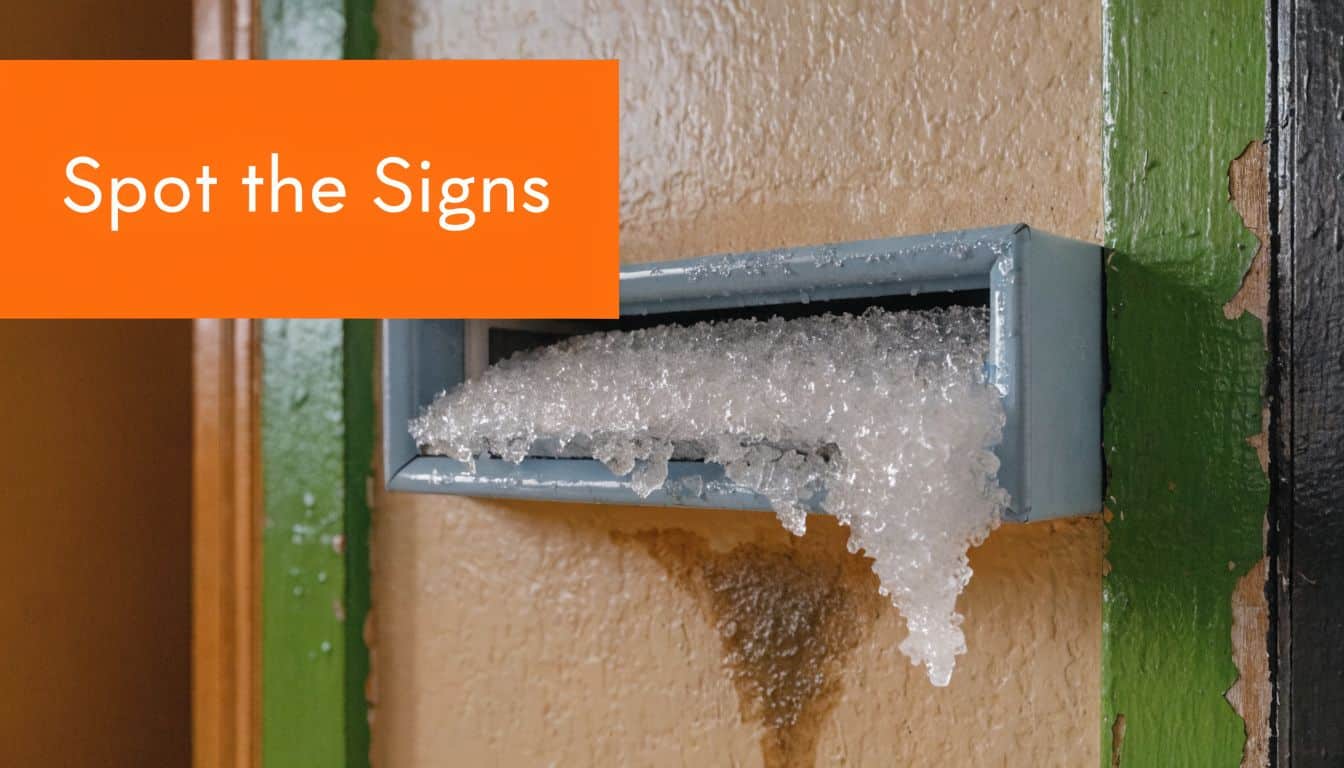
If you see ice on indoor AC components in the middle of an Orlando summer, shut the system off and let it thaw before anyone tries to diagnose it.
What your bill is telling you
Sometimes the clearest warning sign is financial. If your usage habits haven't changed but the bill jumps and comfort gets worse, your AC may be wasting energy trying to overcome a leak or another airflow problem. That doesn't confirm refrigerant loss by itself, but it tells you the system is no longer operating normally.
A good supplemental read is this Miami homeowner's guide to AC leaks from Coral Plumbing and Air. It's helpful because South Florida homeowners deal with similar heat and humidity patterns, and many of the warning signs overlap with what Orlando residents see.
What to check before assuming it's a leak
Not every comfort complaint is a leak. Before you jump to that conclusion, check a few basics:
- Filter condition. A clogged filter can cause weak airflow and icing.
- Thermostat setting. Make sure the system is calling for cooling.
- Return and supply vents. Closed or blocked vents can mimic bigger problems.
- Outdoor unit condition. Heavy debris on the condenser can reduce performance.
Those checks won't diagnose the sealed system, but they help rule out simpler issues. If the signs still point to a leak, you can move on to a safe homeowner inspection.
DIY Leak Detection Methods You Can Try Today
Homeowners can do a useful first pass, but there's an important boundary here. Don't handle refrigerant, don't open the sealed system, and don't try to top off a charge without the proper licensing and equipment. What you can do safely is inspect, listen, and test accessible areas for obvious signs.
A helpful visual summary is below.
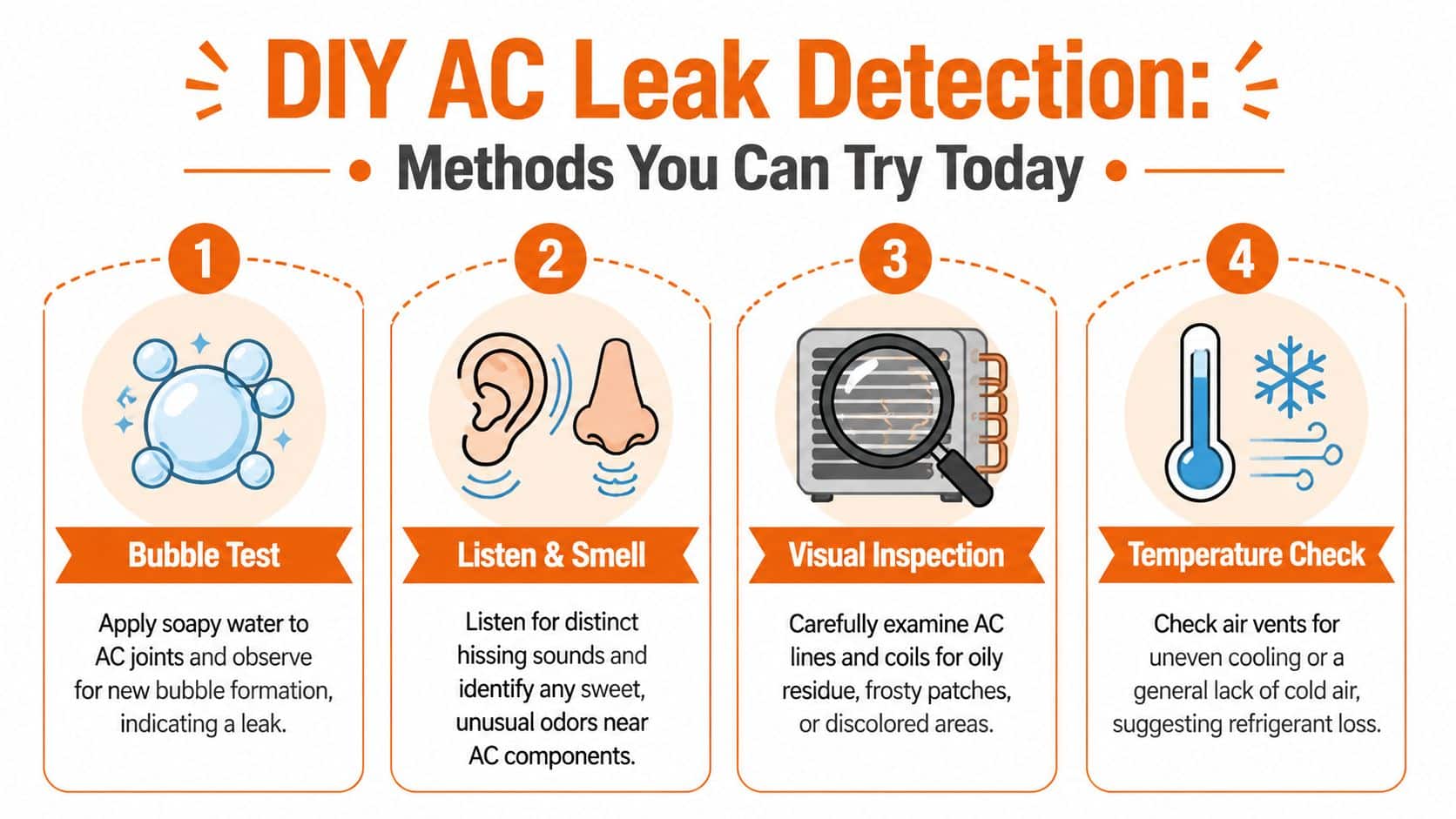
Start with a careful visual inspection
This is the simplest place to begin, and it often tells you whether you're dealing with a likely refrigerant issue, a drainage issue, or an airflow problem.
Check these spots:
- At the outdoor unit. Look around service valves, line connections, and exposed tubing for oily residue, dirt stuck to oil, corrosion, or rubbed spots.
- At the indoor unit. Inspect the area around the evaporator section and visible refrigerant line connections. If you can see the suction line insulation, note whether it's damaged or soaked.
- Around the floor and cabinet. Water can come from condensate problems, not refrigerant. It still matters, but it points to a different repair path.
If you're not sure what you're looking at, it helps to understand the major components first. This guide to the parts of a central AC unit makes it easier to identify the condenser, evaporator area, line set, and connection points before you inspect.
Use the soap bubble test on accessible joints
The soap bubble test is one of the oldest and most practical leak checks. It works best on accessible fittings and larger leaks. According to this AC leak detection video guide, the method can reliably detect leak rates as large as 4.2 ounces (120 grams) of coolant per year, but it won't catch the tiny leaks that still hurt performance over time.
That means it's a good screening tool, not a final answer.
How to do it safely
- Turn off power if you're working near electrical access panels. If you're only inspecting exposed areas, keep your hands clear of wiring and moving parts.
- Mix a basic soap-and-water solution in a spray bottle or bowl.
- Apply it to accessible joints and fittings where refrigerant lines connect.
- Watch for fresh bubble formation, not just foam from spraying.
- Mark the area with painter's tape or a note on your phone if you see active bubbling.
A few realities matter here. The bubble test is much better on larger leaks than small ones. Wind, dirt, cramped access, and insulation can also hide the exact source.
Field note: If the bubble test shows a leak, that's useful. If it shows nothing, you still haven't ruled out a refrigerant problem.
Try listening and smelling before buying more tools
You don't need equipment for this. Stand near the indoor unit and the outdoor condenser while the system is running. Listen for hissing around line connections and coil areas. Pay attention to unusual chemical-like odors near the equipment.
This isn't precise, but it can help you narrow down where to look next.
For homeowners who like comparison-style troubleshooting, this article on detecting water leaks in Las Vegas is a useful reminder that leak detection in any home system starts the same way: observe patterns, isolate symptoms, and don't confuse visible moisture with the actual source.
UV dye kits can help, but they're not always the best first move
Some homeowners ask about UV dye. It can help identify a leak path by leaving a trace that glows under blacklight, but it's not as simple as spraying soapy water on a fitting. It involves adding dye to the system and then inspecting later for evidence.
That's where DIY can get shaky. If you're already at the point of adding material to the system, many homeowners are better off stopping and scheduling a proper diagnosis. It's easy to spend time and money without getting a clean answer.
This video gives a general look at leak-checking approaches homeowners often consider:
When DIY is enough and when it isn't
Here's the practical split:
| Situation | DIY check is reasonable | Call a pro |
|---|---|---|
| Weak cooling but accessible fittings look suspicious | Yes | If nothing obvious turns up |
| Oily residue on a line connection | Yes, document it | Yes, for confirmation and repair |
| Ice on coil or line repeatedly | Limited | Yes |
| System cools poorly but no visible leak signs | Limited | Yes |
| Suspected tiny refrigerant leak | No reliable DIY answer | Yes |
DIY works best when you're trying to answer one question: Is there obvious evidence of a problem? If the answer is yes, you've saved time. If the answer is no but the symptoms continue, that's usually where homeowner testing reaches its limit.
Advanced Leak Detection and Why Pros Use Them
The reason professionals find leaks that homeowners miss isn't mystery. It's tool sensitivity, controlled testing, and process. Small refrigerant leaks don't always leave visible oil, make noise, or produce bubbles where you can reach them. That's where professional methods pull away from DIY.

Electronic sniffers find what your eyes can't
A modern electronic leak detector, often called a sniffer, samples the air near likely leak points and alerts the technician when refrigerant concentration rises. According to PV Heating, Cooling & Plumbing's leak detection guide, these detectors can identify leaks as small as 0.5 ounces per year, and the evaporator coil is the source in approximately 70-80% of residential leak cases.
That changes how a skilled tech approaches the visit. Instead of guessing, they prioritize the coil, line connections, service ports, and other high-probability locations. They also move the probe slowly and keep it close to the surface, because rushing past a pinhole leak can miss it.
If a diagnosis points to a failing coil, this overview of AC coil replacement helps homeowners understand why the repair path often goes beyond a simple patch.
Pressure testing gives a much firmer answer
Pressure testing is one of the most dependable ways to confirm whether a sealed system is tight. According to Hagerty's pressure testing walkthrough, technicians use a multi-stage nitrogen pressure testing protocol starting at 100 PSI, and for micro-leaks they may use a CO₂ and Argon gas mixture with a chemical sniffer, providing 100% detection capability across all leak sizes.
That matters because pressure testing doesn't rely on luck. It creates conditions where the leak has to reveal itself. Large leaks may show up quickly with pressure loss or audible escape. Smaller leaks may need time, soap solution, or tracer gas detection.
Why this works better than a one-tool approach
Professional diagnosis usually combines methods. A tech may:
- Pressurize the system to check whether it holds.
- Use bubbles on accessible areas after pressure is applied.
- Sweep with an electronic detector around coils, fittings, and line sets.
- Confirm the repair by retesting, instead of assuming the leak is gone.
A proper leak repair isn't just finding a hole. It's proving the system is sealed before refrigerant goes back in.
That last part is what homeowners usually don't get from DIY efforts. You may find one obvious problem and still miss another. A licensed technician works toward confirmation, not just suspicion.
Understanding AC Leak Rules and Costs in Florida
Leak detection isn't just a technical issue. In Florida, it also crosses into legal and safety territory once refrigerant handling enters the picture. Homeowners can inspect, listen, and document symptoms. They shouldn't recover, purchase, or recharge refrigerant without the required licensing.
Where the legal line is
The simple version is this. You can observe the system. You can shut it down if it's icing or acting abnormally. You can schedule service and describe exactly what you found. But once the work involves opening the sealed refrigerant circuit, adding charge, or performing recovery, that belongs with a qualified HVAC professional.
That's one reason leak diagnosis should be taken seriously. A bad guess doesn't just waste time. It can lead to the wrong repair, unnecessary refrigerant loss, or repeated breakdowns because the actual source was never confirmed.
Why the evaporator coil gets so much attention
When technicians investigate a residential leak, the evaporator coil gets a close look for good reason. As noted earlier in the linked industry guidance, electronic detectors can find very small leaks, and the coil is often the source in residential systems. In practical terms, that means homeowners should be prepared for the possibility that the issue isn't at an easy-to-reach outdoor fitting. It may be buried in the indoor coil section where DIY inspection is limited.
If you're already at the point of scheduling service, a local Orlando AC repair service page can help you understand what a standard repair visit usually involves and how quickly a technician can move from symptoms to testing.
Don't expect one flat repair answer
Costs vary too much by leak location, accessibility, equipment age, and whether the repair is a simple connection issue or a component replacement. A loose service-related problem isn't the same as a leaking evaporator coil. A duct leak isn't the same as a refrigerant leak either.
Here's the practical breakdown:
- Refrigerant leak path. Diagnose the leak, repair or replace the failed part, verify the system is sealed, then recharge properly.
- Duct leak path. Inspect accessible duct runs, seal or reconnect damaged sections, and restore airflow to the rooms that are underperforming.
- Mixed symptom path. Some homes have both poor airflow and a cooling-side issue, which is why good testing matters more than assumptions.
Homeowner advice: Ask what type of leak the technician suspects before repair starts. Refrigerant leaks and duct leaks solve differently, and the repair plan should reflect that.
If you keep that distinction clear, the rest of the decision-making gets easier.
Preventive Maintenance Your Orlando AC Will Love
The best leak check is the one you never need because the problem was caught early. In Orlando, prevention matters because systems work hard for long stretches, and small weaknesses don't stay hidden very long.

A maintenance routine that actually helps
Homeowners don't need to do everything themselves, but a few habits make a real difference.
- Change the filter regularly. Restricted airflow can stress the system and contribute to icing and performance complaints that look like leak symptoms.
- Keep the outdoor unit clear. Trim back plants and remove debris so the condenser can breathe.
- Watch for repeat patterns. If one room is always warmer, or the AC starts running longer than normal, note it early instead of waiting for a full breakdown.
- Check visible insulation on refrigerant lines. Damaged insulation won't cause a refrigerant leak by itself, but it can hurt performance and point to wear around the line set area.
What a professional tune-up catches earlier
A good maintenance visit often finds problems before they become obvious. That includes corrosion, weak connections, abnormal operating pressures, oily traces near fittings, and coil issues that a homeowner would never see without opening the equipment.
In Orlando's climate, that early catch matters because the system may not get much downtime to recover. A unit that's barely holding on in spring often fails outright once summer demand ramps up.
A simple checklist for homeowners
Use this as a practical baseline:
| Task | Why it helps |
|---|---|
| Replace or clean the air filter | Supports airflow and reduces icing risk |
| Keep supply and return vents open | Prevents airflow imbalance |
| Rinse debris from around the condenser | Helps heat rejection |
| Look for oil, ice, or unusual noise | Flags problems early |
| Schedule routine professional maintenance | Finds hidden wear before it becomes a leak |
Good maintenance doesn't guarantee you'll never have a leak. It does improve the odds that you'll catch one while the repair is still straightforward.
If your AC is running nonstop, cooling unevenly, or showing signs of a refrigerant or duct leak, Al-Air Corporation can help you sort out what's really happening. Their team serves Greater Orlando homeowners with clear diagnostics, honest repair options, and round-the-clock support when comfort can't wait.