
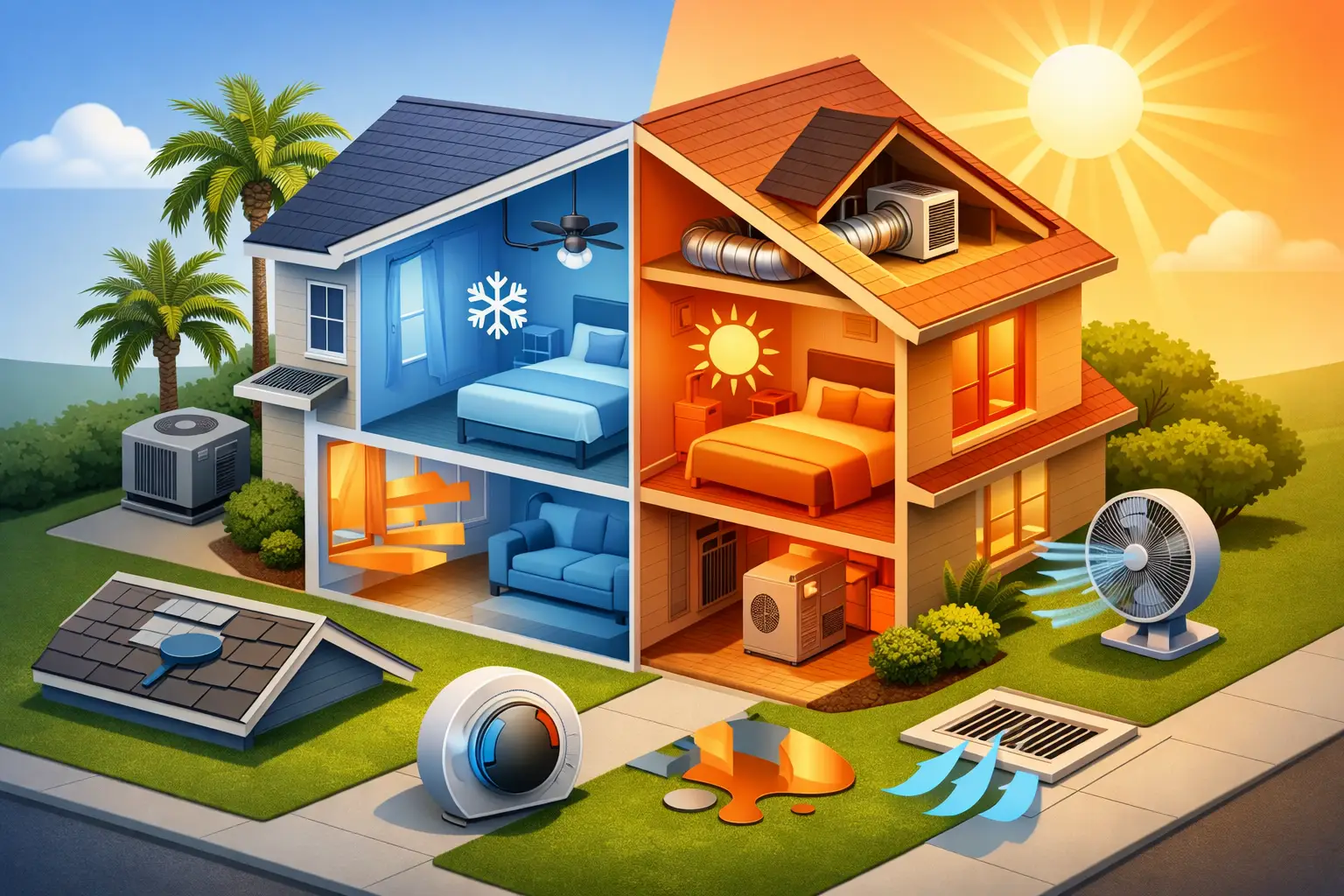
A bedroom that stays sticky while the living room feels like a refrigerator is more than an annoyance in Central Florida. It can make sleep miserable, drive up utility costs, and leave you wondering whether your AC is about to fail. The top causes of uneven home cooling usually come down to airflow, insulation, thermostat placement, ductwork, or an AC system that is no longer operating as it should.
The good news is that a hot room does not automatically mean you need a new air conditioner. A clear diagnosis matters. Some fixes are simple, while others involve hidden duct leaks, electrical controls, or equipment problems that need a licensed technician. Here is what may be causing the temperature difference – and what to do next.
1. Restricted airflow from a dirty filter or blocked vents
Your air conditioner can only cool rooms that receive enough air. A clogged return-air filter restricts the system’s breathing room, reducing airflow across the whole house. Rooms furthest from the air handler often feel the problem first.
Start with the filter. If it looks gray, dusty, or bowed inward, replace it with the correct size and type. In Florida, where AC systems work hard for much of the year, many homes need a filter check every 30 to 60 days. A filter with an extremely high MERV rating can also create airflow issues if the system was not designed for it, so do not assume more filtration is always better.
Then check the supply registers in the warm room. Furniture, rugs, curtains, and closed dampers can block or limit air. Keep registers open and clear. Closing vents in unused rooms may sound like a way to push cooling elsewhere, but it can raise static pressure and create new problems for the system.
2. Leaking, damaged, or poorly designed ductwork
Ductwork runs through places most homeowners never see: attics, garages, wall cavities, and crawl spaces. That makes it a common source of uneven cooling. A loose connection, crushed flex duct, torn insulation, or unsealed joint can send conditioned air into a hot attic instead of the room where you need it.
This is especially common in older Florida homes and houses with ducts exposed to extreme attic heat. Even a small leak can have a noticeable impact when the attic is well over 120 degrees on a summer afternoon. The AC keeps running, but the back bedroom still will not cool down.
Duct design matters, too. Long duct runs, sharp bends, and undersized branches can starve certain rooms of airflow. This is not a problem that can be solved by simply turning down the thermostat. A technician should inspect airflow, duct condition, and balancing before recommending repairs or replacement.
3. An attic, garage conversion, or room addition without enough insulation
Sometimes the AC is delivering air correctly, but the room is gaining heat faster than it can lose it. West-facing rooms, second-story bedrooms, spaces over garages, and additions are frequent trouble spots. They may have more sun exposure, weaker insulation, or air leaks around windows, doors, recessed lights, and attic access points.
A room over the garage is a classic example. The ceiling below may be insulated, but a hot garage and unconditioned attic can still load that room with heat from two directions. A converted garage can be even more difficult if its insulation, ductwork, and return-air path were never planned for year-round comfort.
Before assuming the AC is the problem, look for obvious gaps, damaged weatherstripping, and poorly sealed windows. Window coverings can help with direct afternoon sun, but they will not correct an insulation or air-sealing problem. If only one room is hot and it is exposed to sun or sits above the garage, the building envelope deserves a close look.
4. Thermostat location and thermostat settings
Your thermostat measures the temperature where it is installed, not where you sleep. If it sits in a shaded hallway, near a return grille, or in the coolest part of the home, it may satisfy the system before warmer rooms catch up. That is why a thermostat set to 74 degrees can coexist with a bedroom that feels closer to 80.
Check that the thermostat is not exposed to direct sunlight, warm lamps, kitchen heat, or a nearby supply vent. Also make sure its fan setting is correct. Setting the fan to ON circulates air continuously, which can help reduce temperature swings in some homes. It can also increase humidity between cooling cycles, though, so AUTO is often the better choice during Florida’s humid months.
Smart thermostats and remote sensors can help when the issue is primarily a poor sensing location. They are not a cure for weak airflow, a duct leak, or an undersized system. The right answer depends on what the system is actually doing.
5. An AC system that is undersized, oversized, or aging
When uneven cooling affects several rooms, particularly during the hottest part of the day, the equipment itself may be struggling. An undersized system may run for long stretches without catching up. Low refrigerant, dirty coils, a failing blower motor, or a weak capacitor can reduce cooling performance and airflow even further.
An oversized AC can create a different issue. It may cool the thermostat area quickly and shut off before air has circulated evenly throughout the home. Short cycles also reduce dehumidification, leaving rooms feeling clammy even when the temperature reading looks reasonable.
Age alone does not prove an AC needs replacement. A properly maintained system can often be repaired, while a newer unit installed without a proper load calculation may never cool evenly. A good evaluation considers system condition, refrigerant performance, airflow, ductwork, insulation, and the home’s layout – not just the unit’s age.
6. A dirty coil, clogged drain, or neglected maintenance
Florida AC systems collect dust, moisture, and biological growth faster than systems in drier climates. A dirty indoor evaporator coil restricts airflow and heat transfer. A dirty outdoor coil makes it harder for the unit to release heat outside. Both can leave the system running longer while certain rooms remain warm.
Drain problems can also affect operation. If the condensate drain backs up, many systems shut down through a safety switch to prevent water damage. Other problems, such as a dirty blower wheel or failing electrical component, may reduce performance before the system stops completely.
Routine maintenance is not about finding a reason to replace equipment. It is how you catch small problems before they become a no-cooling emergency during a 95-degree afternoon. A proper visit should include more than a quick look at the thermostat. Airflow, electrical connections, coils, drains, refrigerant operation, and overall system performance all need attention.
7. Return-air problems and closed interior doors
Supply vents push cool air into a room. Return vents pull air back to the system to be cooled again. If a room has a strong supply vent but no effective return-air path, pressure can build when the door is closed. The room may receive less cool air and feel stuffy.
This often shows up in bedrooms overnight. You close the door, the room gets warm, and the rest of the house stays comfortable. A properly sized door undercut, transfer grille, jumper duct, or dedicated return may be needed, depending on the home’s design. This is not a job for guesswork because changes to duct and return-air systems affect overall airflow and system pressure.
What You Can Check Before Calling for Service
There are a few safe checks worth making: replace a visibly dirty filter, confirm all supply registers are open, clear furniture away from vents, inspect the thermostat setting, and make sure the outdoor unit has no leaves or debris crowding it. Do not remove electrical panels, handle refrigerant lines, or try to force dampers inside inaccessible ducts.
If the problem appeared suddenly, the AC is blowing weakly, you see ice on refrigerant lines, notice water near the air handler, or the breaker trips, it is time for professional service. Those signs can point to a mechanical or electrical problem that will not improve on its own.
Get the Right Fix, Not a Guess
Uneven cooling is frustrating because several issues can create the same symptom. The fastest path to a comfortable home is identifying whether the real problem is airflow, ductwork, heat gain, controls, or equipment performance. No runaround and no guessing based on the temperature of one room.
For homeowners across Central Florida and the Tampa area, Al-Air can assess the full system and explain the options clearly, whether the fix is maintenance, duct repair, a thermostat solution, or a larger HVAC and electrical upgrade. A room that never cools properly is worth addressing before the next heat wave makes it a whole-house problem.