
At its core, the difference between a supply vent vs return vent is simple: one pushes conditioned air into a room, and the other pulls stale air out. This constant push-and-pull is the foundation of your home's entire heating and cooling system. Getting this relationship right is what separates a comfortable, efficient home from one with frustrating temperature swings.
Understanding the Airflow Cycle
Think of your HVAC system as a breathing organism. It inhales and exhales to keep your home’s environment stable and comfortable. This continuous loop is what maintains not just the temperature, but also your indoor air quality and energy bills. Supply and return vents are the essential gateways for this process.
Without this balanced cycle, you're left with an inefficient system that struggles to keep up.
The Role of Supply Vents
Supply vents are the delivery end of the system. After your furnace or air conditioner heats or cools the air, these vents are responsible for distributing it throughout your house. You'll recognize them because they actively blow air, and they often have adjustable slats (louvers) so you can direct the airflow.
When your supply vents are working correctly, every room gets the conditioned air it needs, getting rid of those stubborn hot and cold spots for good.
The Importance of Return Vents
Return vents do the equally important job of pulling air out of your living spaces and sending it back to the HVAC unit. As the air is drawn in, it passes through a filter, which traps dust, dander, and other airborne particles. This is your system’s first line of defense for air quality.
These vents are typically larger than supply vents and have a simple, non-adjustable grille. If return airflow is blocked or insufficient, the system essentially "starves," which puts a huge strain on the components and leads to poor performance.
In a well-designed system, other components also play a protective role. For instance, specialized backdraft dampers are often used to ensure unconditioned outside air doesn't leak back into your home and disrupt this cycle.
| Feature | Supply Vent | Return Vent |
|---|---|---|
| Airflow Direction | Pushes conditioned air out | Pulls room air in |
| Primary Function | Delivers fresh, heated/cooled air | Recirculates air for re-conditioning & filtering |
| Typical Size | Smaller | Larger to handle more air volume |
| Cover Type | Adjustable fins (louvers) are common | Usually a simple, fixed grille |
| Feeling Air | You’ll feel air blowing out of it | You’ll feel a gentle suction pulling air in |
How to Identify Vents in Your Home
Ever wondered which vents in your home blow air out and which ones pull it in? Knowing the difference is the first step to understanding your home's comfort system, and thankfully, you don't need any special equipment to figure it out.
The easiest and most definitive method is what we in the industry call the "tissue test." First, go to your thermostat and turn the system's fan to the "On" setting. Then, grab a piece of tissue paper and hold it up to one of your vents.
- If the tissue blows away, you've found a supply vent. It's actively pushing conditioned air into the room.
- If the tissue gets sucked toward the grille, that's a return vent. Its job is to draw room air back into the HVAC system.
It’s a simple trick, but it works every time.
Spotting Clues in Design and Location
Once you’ve tried the tissue test, you’ll start noticing other clues. The vents themselves often tell you their purpose just by how they look and where they are.
Supply vents often have levers and adjustable slats (called louvers) that let you direct the airflow. On the other hand, return vents usually have a simple, non-adjustable grille. They are also typically much larger than supply vents because they need to pull in a large volume of air quietly.
Location is another dead giveaway. You'll commonly find supply vents on ceilings, high on walls, or on the floor, especially under windows to counteract heat gain or loss. Return vents are almost always found in central locations, like a main hallway or on the lower part of a wall in a large room, pulling air from the home's core.
This diagram helps visualize how the two work together to create a continuous airflow loop.

As you can see, the supply vent delivers the comfortable air you want, and the return vent takes the "used" air back to be re-conditioned. It's a constant cycle.
For a quick reference, here’s a simple breakdown of the key differences you can look for.
Quick Identification Guide: Supply vs. Return Vents
| Characteristic | Supply Vent | Return Vent |
|---|---|---|
| Airflow | Blows air out | Sucks air in |
| Louvers/Slats | Usually has adjustable slats | Fixed grille, no slats |
| Size | Typically smaller | Typically larger |
| Location | Ceilings, floors, high on walls | Central hallways, low on walls |
| Air Filter | Never has a filter | Often has a filter behind the grille |
This table makes it easy to spot the right vent at a glance. Knowing which is which is crucial for basic maintenance, like changing your air filter at the return vent.
Key Insight: The most significant difference between supply and return vents is their function within the HVAC cycle—one delivers air, the other retrieves it. This fundamental contrast in airflow direction is the easiest way to tell them apart.
By using these simple identification methods, you can map out your home's airflow and get a much better handle on how your system is working. This knowledge empowers you to spot potential problems, like a blocked return or a weak supply, long before they turn into major comfort or efficiency issues.
Why Both Vents Are Critical for HVAC Performance
It’s a common mistake to think of your HVAC system as just a furnace or an AC unit. The real key to its performance is the entire ductwork system—a closed-loop circuit where your vents play two essential, co-dependent roles. For your system to run efficiently, the partnership between supply and return vents has to be flawless.
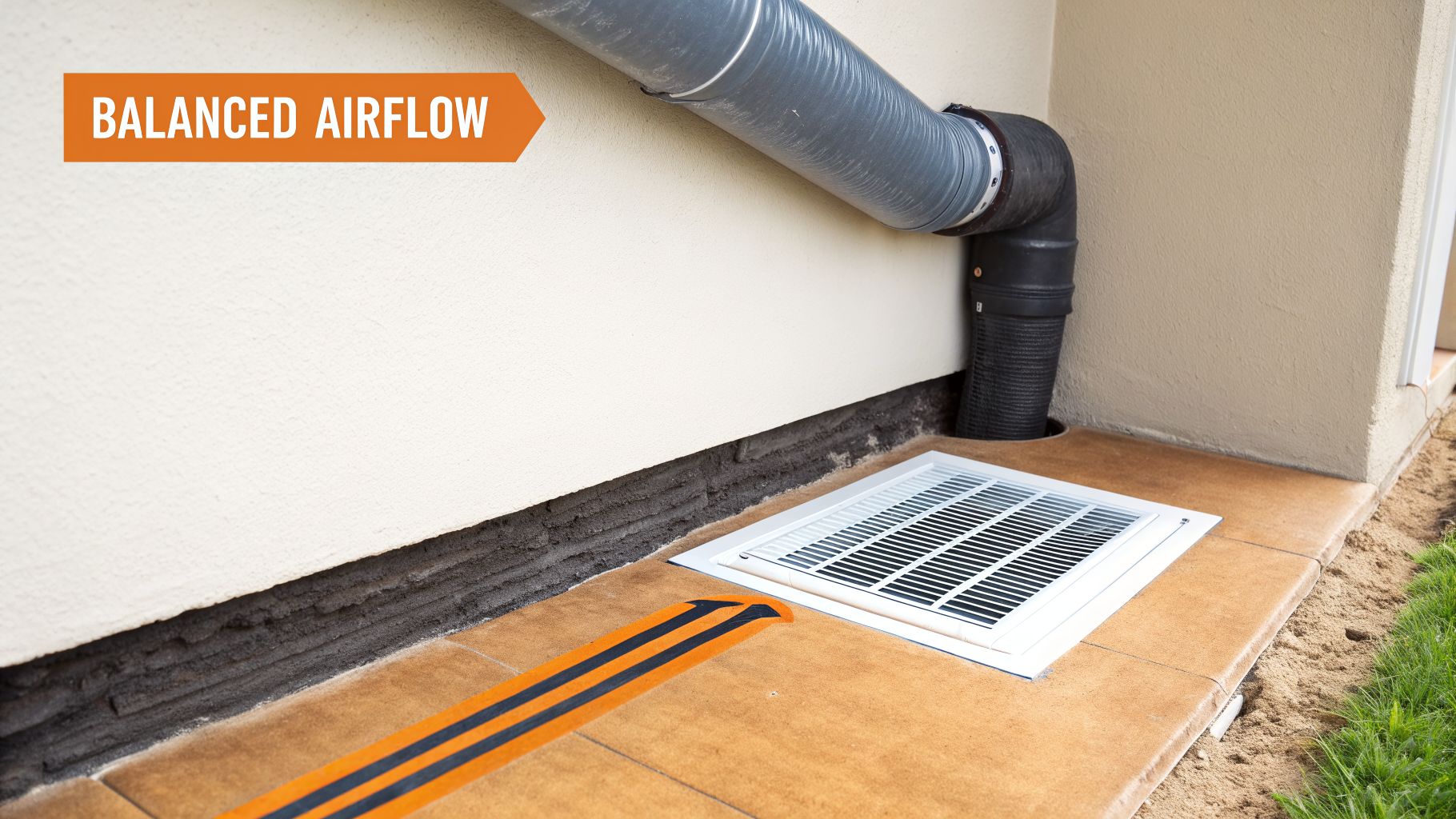
The supply vents are the ones you feel. They're responsible for delivering the conditioned air—cool or warm—into each room. When they're working right, you get an even, comfortable temperature throughout your home, without those annoying hot and cold spots.
But here’s the thing: that air needs a path back to the main unit. That's the job of the return vents. They pull stale, used air out of your living spaces and send it back to be re-conditioned. This return trip is crucial because it pulls the air through the system's filter, cleaning it before it gets sent back out.
The Problem with Pressure Imbalance
So, what happens when the amount of air being pushed out doesn't equal the amount being pulled back in? You get an imbalanced system and pressure problems. It’s like trying to drink from a straw with a crack in it—the system has to work way harder just to function, and it never performs as it should.
An imbalanced system usually makes its presence known. You might hear:
- Whistling noises as air gets squeezed through blocked or undersized vents.
- Doors that slam shut on their own from the pressure difference.
- You'll definitely feel it in your wallet with skyrocketing energy bills.
This is why proper duct design is non-negotiable. NREL guidelines, for example, state that return vents need at least 1.5 times the free area of the duct's cross-section, with air speeds kept under 500 feet per minute. In Greater Orlando, where powerful AC units can move 1,200–2,000 CFM of air, this isn't just a suggestion—it's essential. You can learn more about how professionals tackle this by checking out these insights on dedicated return vents.
The Bottom Line: A balanced airflow system is the foundation of home comfort and energy efficiency. When returns are out of sync, you can see 15-20% efficiency losses, effectively turning your expensive HVAC system into an energy hog.
Achieving HVAC Harmony
Ultimately, the goal is perfect harmony. The volume of air your supply vents push out should be precisely matched by the volume your return vents pull in. This balance prevents the system from being "starved" for air or becoming over-pressurized.
When the supply vent vs return vent functions are in sync, you're not just more comfortable. You’re also getting cleaner air, paying less on your energy bills, and extending the life of your entire HVAC system.
The Impact of Airflow Balance on Your Energy Bills
It’s easy to think of your HVAC system in terms of comfort, but its performance is directly connected to your wallet. When we want to know how efficiently a system is really running, we look at a measurement called Delta T, which simply stands for temperature differential. It's not some complicated industry jargon—it's a straightforward number that tells a big story.
Think of Delta T as a quick health screening for your air conditioner. We measure the temperature of the air going into your return vent and compare it to the temperature of the air blowing out of a supply vent. A healthy, efficient system will always produce a consistent temperature drop. This simple test tells us in minutes if your AC is doing its job or just burning through electricity.
What Is a Healthy Delta T?
When your AC is cooling properly, a good Delta T is proof that it's successfully pulling heat and humidity out of your home. An optimal reading confirms that every part of your system, from the compressor outside to the refrigerant in the lines, is working together as it should.
An unusual reading, however, is a red flag. It’s a clear signal that something is wrong, forcing your system to run longer and work much harder to cool your home. That extra effort shows up directly on your utility bill.
Expert Insight: We treat Delta T like a system's vital sign. It's a direct indicator of performance, telling us if you're getting the efficiency you paid for or if a hidden problem is quietly driving up your energy costs.
So, what’s the magic number? The ideal temperature difference, or Delta T, for a cooling system is between 16 and 22 degrees Fahrenheit.
If we see a reading below 16°F, it often points to a problem like a dirty evaporator coil or a low refrigerant charge. On the flip side, a reading above 22°F almost always signals a restricted airflow, which could be caused by anything from a clogged filter to undersized ductwork. In fact, research shows that a staggering 90-100% of older homes need their ducts sealed to achieve these numbers, a fix that can boost efficiency by 20-30%. You can read more about how ductwork affects system performance in these in-depth HVAC analyses on sumzim.com.
Why Airflow Balance Matters in Florida
Here in Florida, with our high humidity, maintaining the right Delta T is even more important. A balanced system doesn't just cool the air; it has to be able to effectively pull moisture out, too. This is your first line of defense against that clammy feeling and potential mold growth.
An imbalanced system with poor airflow simply can't dehumidify correctly. Your home will feel sticky and uncomfortable, even if the AC runs constantly.
Ultimately, understanding the relationship between a supply vent vs return vent through the lens of Delta T makes the technical side of HVAC personal. It’s not just about airflow—it’s about getting the comfort you deserve, lowering your energy bills, and protecting your investment for years to come. For more tips, check out our other articles on achieving better energy efficiency.
Spotting Vent Problems and What to Do About Them
If you've ever noticed that one room feels like a sauna while another is an icebox, you know how frustrating uneven temperatures can be. Your first instinct might be to blame the thermostat, but the real culprits are often your vents. The health of your HVAC system—and your home's comfort—depends on a delicate balance between the air going out and the air coming back in.

When this balance is off, your house will give you clues. Weak airflow from a vent, a strange whistling sound, or even doors that seem to slam shut on their own when the system kicks on are all red flags. The good news is, you don't always need a professional right away. A few simple checks can often solve the problem.
Simple DIY Vent Checks
Before you pick up the phone, try these basic troubleshooting steps. They only take a few minutes and can often resolve minor issues or, at the very least, give you better information to share with a technician.
- Look for Blockages: This is the number one cause of airflow problems. Take a quick walk around your home and make sure furniture, rugs, or drapes aren't covering any vents. A blocked supply vent means a room won't get the conditioned air it needs, while a blocked return vent can starve the entire system, putting a huge strain on your equipment.
- Check Your Air Filter: A clogged air filter is your HVAC system's worst enemy. It forces the system to work much harder to pull in air, which can lead to damage and higher energy bills. Make it a habit to check your filter monthly and replace it every 1-3 months.
- Inspect Supply Vent Louvers: The little adjustable slats (louvers) on your supply vents can easily get bumped closed during cleaning. Make sure they're open and angled to push air out into the room, not just down at the floor.
Taking care of these small tasks is a big part of keeping your system running smoothly. Consistent upkeep is the best way to prevent small annoyances from turning into expensive repairs. To see how our team approaches preventative care, check out our professional HVAC maintenance plans.
But what if you've cleared all the blockages, put in a fresh filter, and you're still getting weak airflow or hearing odd noises? That usually means the problem runs deeper.
Expert Insight: If you've handled the easy fixes and still have hot spots or weak airflow, the issue isn't with the vent cover itself—it's likely a problem inside the ductwork or with the HVAC unit. These are clear signs it's time to call in a professional.
Knowing how to perform these checks helps you tackle the small stuff. More importantly, it helps you understand the difference between a simple fix and a serious problem, which is crucial for managing your home’s comfort and your system's performance.
When to Call a Professional for Vent and Ductwork Service
While a little DIY investigation can solve simple issues, some problems are just too big for a homeowner to tackle. If you've cleaned the vents, put in a fresh filter, and made sure no furniture is blocking airflow, but you're still having trouble, it’s a clear sign to call in a certified HVAC technician.
Persistent issues like weak airflow, strange noises from behind the walls, or that one room that’s always too hot or too cold—these aren't things you can fix by just adjusting a vent cover. They usually point to a deeper problem hidden within the ductwork itself.
When a Professional Assessment Is Necessary
Certain situations simply need an expert eye. A trained technician has the tools and experience to diagnose complex issues that you’d never spot on your own.
You should definitely schedule a service call when:
- You're planning a home remodel. Moving walls or changing your home's layout can completely throw off your system's airflow. A pro can redesign or modify the ductwork to keep everything balanced.
- You have stubborn hot or cold spots. This is a classic symptom of undersized ducts, major leaks, or a system that needs professional balancing to distribute air correctly.
- Your energy bills are creeping up. Hidden leaks or crushed ducts force your system to work much harder than it should, and you're the one paying for all that wasted energy.
- You hear loud whistling or banging. Don't ignore these sounds. They often signal a severe pressure imbalance that can cause serious, long-term damage to your expensive HVAC equipment.
"A professional assessment can uncover problems hidden behind walls, like collapsed or undersized ducts, that DIY checks will always miss. Getting an expert in gives you a real solution for long-term efficiency and comfort, not just a temporary fix."
The Modern Approach to Airflow
How we think about a supply vent vs return vent system has changed a lot over the years. We've moved away from the old-school approach of having one large, central return vent. Today, modern building science shows that having dedicated return vents in every major room is the key to truly comfortable and efficient homes.
This updated setup can boost airflow by 30-50% and cut your energy bills by up to 25%. Here in the Greater Orlando market, where nearly 40% of homes were built before these modern duct standards, this is a huge deal. In fact, our team at Al-Air finds that a staggering 65% of our service calls are related to poor return airflow.
If you’re noticing inconsistent temperatures or poor air quality, your vents could be the culprit. You can learn more by checking out this expert guide to clean air vents. But when you suspect the problem runs deeper than just dirty vents, don't wait for it to get worse. It’s time to look into professional HVAC service calls.
Common Questions We Hear About Home Air Vents
Even after you know the difference between supply and return vents, you’re bound to have a few more questions. As HVAC professionals, we hear them all the time. Here are our answers to some of the most common ones we get from homeowners.
Is It Okay to Close Vents in Rooms I’m Not Using?
This is probably the number one question we're asked. It seems like common sense—why heat or cool a room you aren't in? But in reality, closing supply vents is almost always a bad idea.
Your HVAC system was designed to circulate a specific volume of air. When you start closing vents, it creates a pressure backup in the ductwork, forcing your system to work much harder to push the air out. Think of it like pinching a garden hose. This strain can lead to less efficiency and even damage expensive components over time. For best results, keep those vents open.
A Pro's Take: You might think you're saving money, but closing vents often does the opposite. The increased pressure can force air to leak out of tiny cracks elsewhere in your duct system, wasting the very energy you were trying to conserve.
Can My Home Have Too Many Return Vents?
Honestly, it’s almost impossible for a house to have too many return air vents. We see the opposite problem all the time. Most homes, especially older ones, were built with far too few returns.
Your HVAC system needs a clear, easy path for air to get back to the unit to be reconditioned. Without enough return airflow, the system essentially "starves," which causes it to run inefficiently, get noisy, and struggle to maintain good air quality. When it comes to return vents, more is almost always better.
Why Are My Return Vents So Loud?
If you're hearing a loud whistling or roaring sound from your return vents, your HVAC system is sending you a clear signal: it’s struggling to breathe. That noise is the sound of air being pulled forcefully through a restriction.
This usually points to one of two culprits:
- A Clogged Air Filter: This is the first thing to check. A dirty filter blocks airflow and makes your system's fan work overtime to pull air through.
- Undersized Ductwork: The return grille or the duct connected to it might just be too small for the amount of air your system needs to pull, creating a permanent bottleneck.
Either way, a loud return vent is a symptom of a problem that needs attention.
Is your HVAC system making strange noises or struggling to keep you comfortable? Don't wait for a small airflow issue to become a major headache. The certified technicians at Al-Air Corporation can pinpoint and fix any problems with your supply and return vents, restoring your home's comfort and efficiency. Contact us today for a free estimate.