
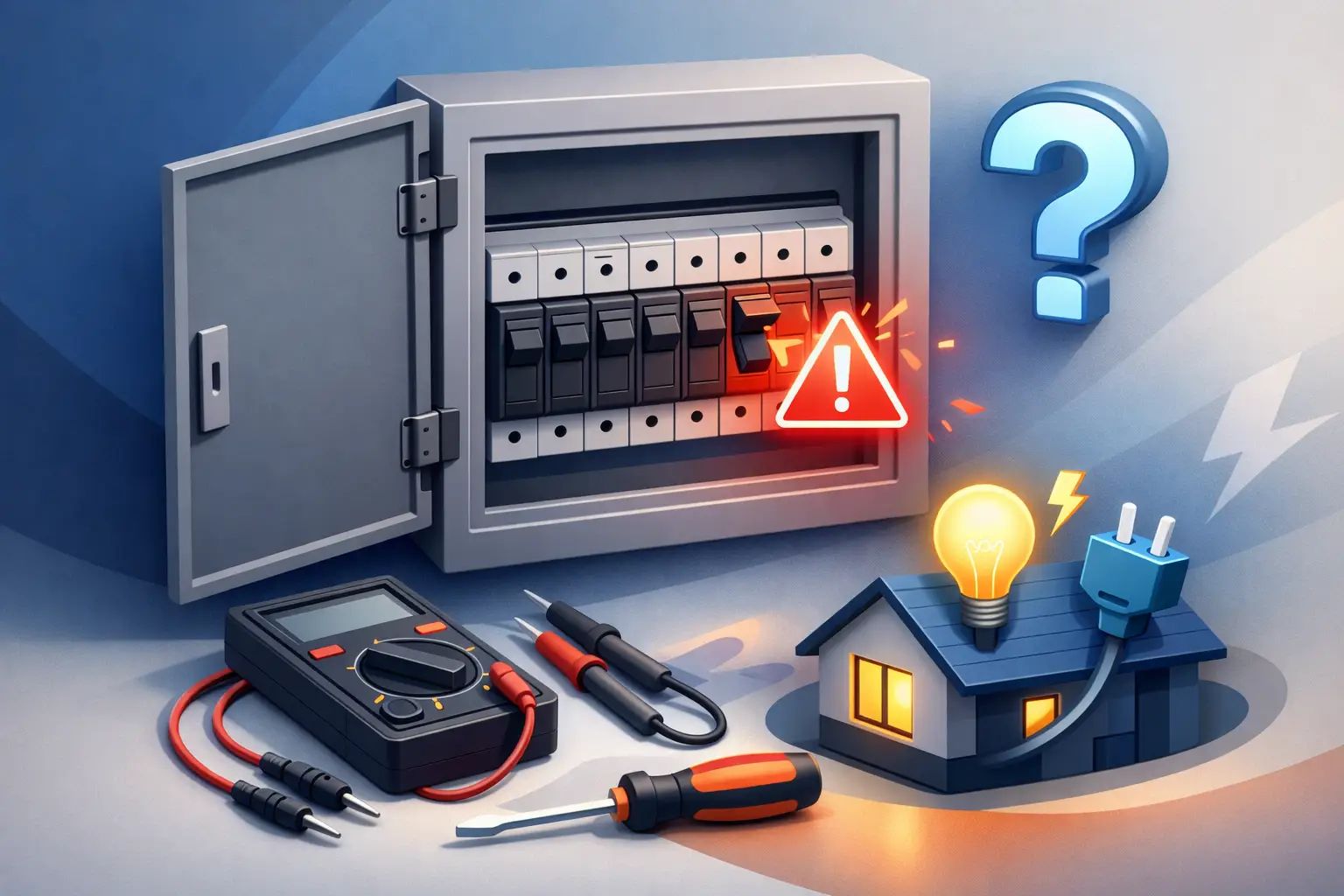
A breaker that trips once during a storm is one thing. A breaker that keeps shutting off your kitchen, bedroom, or AC is your electrical system telling you something is wrong. If you want to know how to troubleshoot tripped breakers without making the problem worse, start with safety, then work backward from what was running when the power cut out.
Your breaker’s job is simple: stop electricity when a circuit is pulling too much current or when there is a fault that could lead to damaged wiring, equipment failure, or fire risk. That means a tripped breaker is not the problem by itself. It is the warning sign. Sometimes the cause is minor, like too many appliances on one circuit. Sometimes it points to a worn-out breaker, a short in the wiring, or a larger panel issue that needs a licensed electrician.
How to troubleshoot tripped breakers safely
Before you touch the panel, make sure your hands are dry and the area around the electrical panel is clear. If you smell burning, see scorch marks, hear buzzing from the panel, or notice the breaker will not stay on at all, stop there. That is not a reset-and-hope situation.
Open the panel door and look for the breaker that is sitting in the middle position or off position. Most tripped breakers do not flip cleanly all the way to OFF. To reset it properly, push it fully to OFF first, then switch it back to ON. If it clicks on and stays on, that tells you the breaker can physically reset. If it trips again right away, you likely have an active fault on that circuit.
Now pay attention to what lost power. Was it a bathroom receptacle, the garage, part of the kitchen, or your air conditioner? Knowing exactly what is on that circuit makes troubleshooting faster and more accurate.
Start with the simplest cause: an overloaded circuit
In a lot of homes, especially older ones, the issue is not damaged wiring. It is too much demand on one circuit at the same time. Space heaters, microwaves, hair dryers, toasters, portable AC units, and even some vacuum cleaners can push a circuit past its limit.
If the breaker tripped while multiple devices were running, unplug or turn off everything on that circuit. Reset the breaker, then plug things back in one at a time. If it trips only when a certain combination of appliances is on, you are likely dealing with an overload.
This matters in Central Florida homes where newer equipment gets added over time. A garage fridge, a workbench setup, holiday lighting, or an EV charger can change the electrical demand in ways the original circuit layout was never built to handle. The breaker may be doing exactly what it is supposed to do.
An overload does not always mean something is broken, but it does mean the circuit usage needs to change. In some cases, spreading devices across other circuits is enough. In others, the real fix is adding a dedicated circuit or upgrading the panel capacity.
If it trips immediately, look for a short or ground fault
A breaker that trips the second you reset it is different from one that trips after 20 minutes of heavy use. Immediate tripping usually points to a short circuit, ground fault, or a failed device connected to that line.
Start by unplugging everything on that circuit. Then reset the breaker again. If it stays on with nothing plugged in, one of the connected devices may be the problem. Plug items back in one by one until the breaker trips again. When you find the item that causes the trip, stop using it.
If the breaker still trips with everything unplugged, the issue may be in the wiring, an outlet, a switch, or a hardwired piece of equipment. This is common with disposals, dishwashers, bathroom exhaust fans, and HVAC components because those systems are not always easy for a homeowner to isolate safely.
There is some nuance here. A bad breaker can also mimic a fault, especially in older panels. But unless you are trained to test the circuit properly, it is hard to tell whether the breaker is weak or whether it is responding correctly to a hidden problem downstream.
Check for GFCI and AFCI clues
Not all breaker trips mean the same thing. In many homes, bathrooms, kitchens, garages, laundry areas, bedrooms, and newer living spaces may have GFCI or AFCI protection. These devices are designed to trip faster under certain conditions.
A GFCI-related trip often points to moisture, a damaged appliance cord, or a problem at a receptacle near water. An AFCI-related trip may be triggered by arcing from loose connections, damaged cords, or deteriorating wiring. These are not random nuisance trips every time. Sometimes they are sensitive, yes, but often they are catching a real safety issue before it becomes a bigger one.
If your panel has specialty breakers with test buttons, note which type is tripping. That detail helps narrow down the cause and helps an electrician diagnose the issue faster if service is needed.
Watch for patterns instead of guessing
One of the best ways to figure out how to troubleshoot tripped breakers is to stop treating each trip like a one-time annoyance. Patterns tell you more than a single reset ever will.
If the same breaker trips during the hottest part of the afternoon, your AC or another heavy-load system may be stressing the circuit. If it trips only when you use a countertop appliance, the issue may be load-related. If it trips during rain, humidity, or after irrigation runs, moisture intrusion could be part of the problem. If lights flicker before the trip, that can point to a loose connection or failing component.
Write down what was running, what time it happened, and whether the breaker reset normally. That kind of information saves time and cuts down on trial and error.
When the breaker itself may be the issue
Breakers do wear out. It is not the most common cause, but it happens, especially in older panels or homes with repeated heavy electrical loads. A weak breaker may trip too easily, feel hot to the touch, or fail to reset consistently.
That said, replacing a breaker without checking why it tripped can be a mistake. If there is a wiring fault or overloaded circuit, a new breaker will not solve the real problem. It may only delay it.
This is also where panel condition matters. Corrosion, loose bus connections, outdated panel brands, or signs of overheating can turn what looks like a single breaker problem into a bigger electrical reliability issue. If your home has an older panel and multiple circuits are acting up, it is worth getting the whole panel evaluated rather than chasing one symptom at a time.
What not to do
Do not keep resetting a breaker that trips repeatedly. Do not swap in a larger breaker to stop the nuisance. Do not ignore a warm panel, a burning smell, or outlets that are discolored. And do not assume the problem is harmless just because the power comes back for a while.
Those shortcuts are how small electrical problems become expensive repairs. The breaker is there to protect the wire behind the wall. If you override that protection, the risk goes up fast.
When to call a licensed electrician
Some breaker issues are straightforward. Others need proper testing at the panel, the circuit, and the connected equipment. If the breaker trips immediately, trips with nothing plugged in, affects hardwired systems, or shows signs of heat or burning, it is time to bring in a pro.
The same goes for repeated trips tied to your air conditioner, electrical panel age, remodel work, or major appliance additions. Florida homes work hard year-round, and electrical demand adds up. If your system is stretched thin, the right answer may be a dedicated circuit, panel upgrade, or wiring repair, not another temporary reset.
At Al-Air, this is exactly the kind of problem we handle every day for homeowners who want a clear answer without the runaround. No guessing, no hidden fees, and no bouncing between separate HVAC and electrical contractors when the issue overlaps.
A tripped breaker is your home asking for attention. If you check the obvious, notice the pattern, and stop before safety gets compromised, you are already making the right call.