
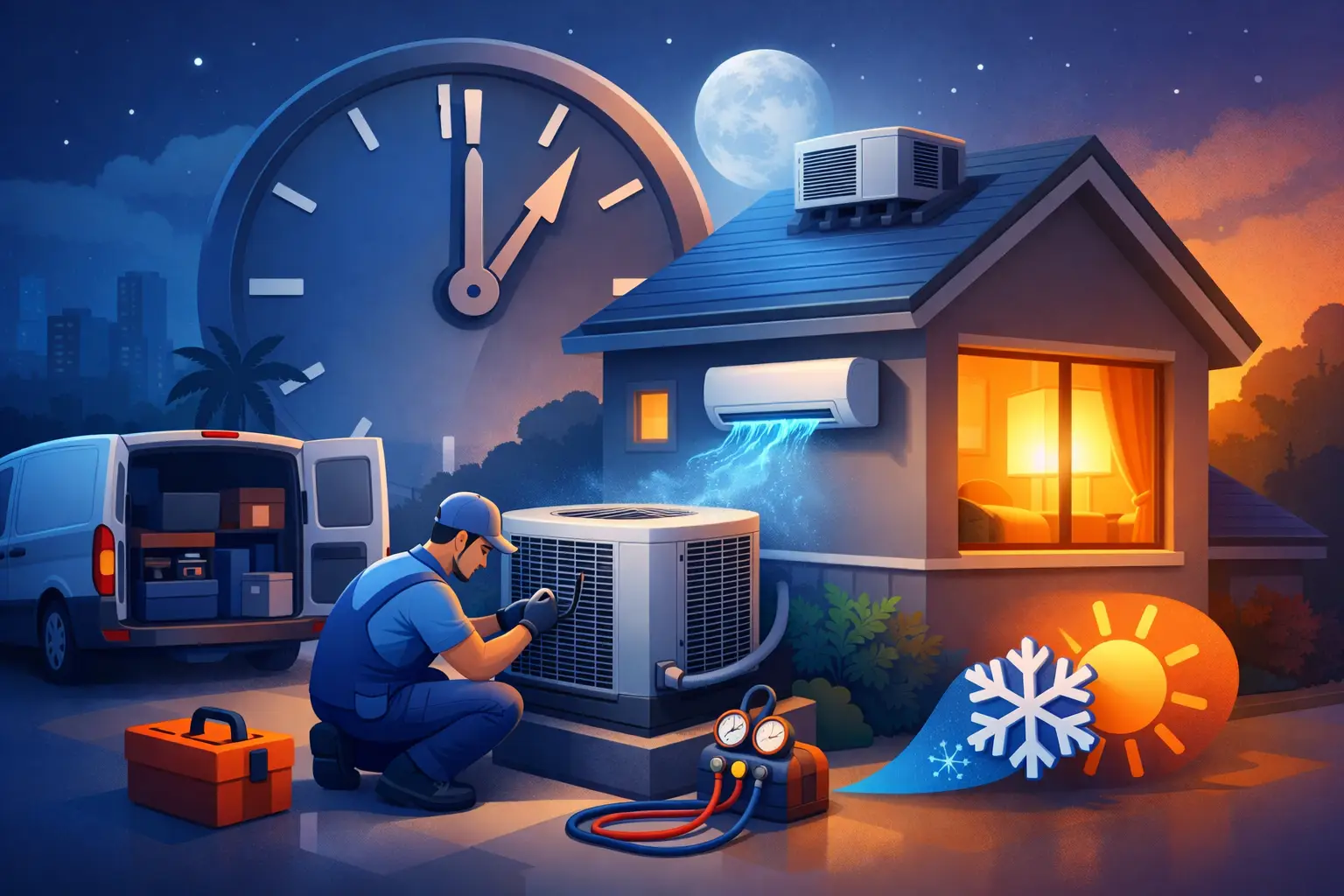
At 10 p.m. in Florida, a broken AC is not a minor inconvenience. It means hot bedrooms, restless kids, rising indoor humidity, and a house that starts feeling miserable fast. That is why 24 hour AC service matters – not as a luxury, but as a practical necessity when your system quits after business hours.
Most homeowners do not think about emergency air conditioning until the moment the thermostat stops dropping, the vents start blowing warm air, or the system shuts down completely. When that happens, what you need is simple: a company that answers, shows up, explains the problem clearly, and gets the system running without adding more stress to an already bad night.
What 24 hour AC service should actually mean
Not every company uses that phrase the same way. Some advertise round-the-clock availability, but what they really offer is an answering service that books you for the next day. Others will come out at night, but tack on emergency fees that make a bad situation more expensive than expected.
Real 24 hour AC service means a technician is available when the failure happens, not when it is convenient for the schedule. It also means clear communication about timing, pricing, and what can realistically be repaired on the spot. In many cases, the issue can be fixed during that first visit. In others, especially when a major part has failed, the right contractor should stabilize the situation, explain the next step, and move quickly.
That difference matters. When your home is heating up after sunset, vague promises and callback chains are the last thing you want.
Why AC emergencies hit harder in Central Florida
Florida systems do not get much of an off-season. Your AC works hard for most of the year, and during the hottest months it may run almost nonstop. That kind of workload exposes weak capacitors, worn contactors, clogged drain lines, low refrigerant conditions, blower issues, and aging electrical components at the worst possible time.
Heat is only part of the problem. Humidity changes the urgency. Once cooling stops, indoor comfort drops quickly, but so does air quality. Rooms feel sticky, sleep gets harder, and families with young children, older adults, or health concerns may need help right away. If you have a home office, servers, sensitive electronics, or tenants, waiting until morning may not be realistic.
This is also where electrical issues can overlap with HVAC problems. A tripped breaker might be the symptom, not the cause. A failing disconnect, a weak panel connection, or an overloaded circuit can shut an AC system down and create a larger safety concern if it is handled poorly. When HVAC and electrical expertise live under one roof, diagnosis tends to move faster and with fewer handoffs.
Signs you need 24 hour AC service now
Sometimes the call is obvious. The system is dead, and the house is getting hotter by the hour. But some emergencies start smaller.
If the AC is blowing warm air and never catches up, that is not something to ignore overnight in Florida heat. If the system keeps tripping the breaker, shut it down and call. If you hear loud buzzing, grinding, or hard-start clicking, or you smell something burning near the air handler, condenser, thermostat, or panel, treat it as urgent.
Water around the indoor unit can also be more than a comfort issue. A clogged condensate line can lead to ceiling, drywall, or flooring damage if it keeps backing up. And if your thermostat is on, but the system is not responding at all, that may point to a control, power, or electrical failure that needs professional attention.
The rule is straightforward: if waiting increases discomfort, risk, or damage, 24 hour AC service is the right move.
What a good emergency visit looks like
A late-night service call should not feel chaotic. It should feel organized.
First, you should get a real response, not a dead-end voicemail. Then you should get a reasonable arrival window and updates if timing changes. Once the technician arrives, the process should be direct: confirm the symptoms, inspect the unit safely, identify the root cause, and explain the repair in plain language.
This is where trust is built. Homeowners do not want a midnight sales pitch. They want answers. If a capacitor failed, say that. If the drain line is blocked, show it. If the compressor has a major issue and repair is not the smart financial move, explain why without dancing around it.
Good emergency service is not about making everything sound simple. It is about making the next step clear.
The trade-off between fast repair and bigger replacement decisions
Not every after-hours visit ends with a full repair, and that is not automatically a red flag. It depends on the age of the system, the failed part, parts availability, and whether there are electrical issues behind the breakdown.
For example, if a ten-year-old unit has a bad capacitor or contactor, a repair may be quick and cost-effective. If the compressor is failing, refrigerant is leaking, and the system has a history of service calls, it may make more sense to discuss replacement once the immediate situation is controlled.
That is where homeowners need straight talk. The cheapest option tonight is not always the least expensive option this season. But the most expensive option is not always necessary either. A good contractor will walk that line honestly, especially when people are tired, uncomfortable, and trying to make a decision under pressure.
Financing can also matter here. If the system is beyond a smart repair, having a clear estimate and payment options can keep an emergency from turning into a financial scramble.
Why licensing and electrical knowledge matter after hours
Emergency calls are where shortcuts show up. A rushed diagnosis, a temporary patch, or a technician working outside their lane can leave you with the same problem two days later – or a bigger one.
That is especially true when AC and electrical issues overlap. Maybe the outdoor unit is not getting proper voltage. Maybe a breaker keeps tripping because the load is wrong. Maybe the system replacement you need also requires a panel upgrade to meet code and support the equipment safely.
This is one reason homeowners in Central Florida and Tampa often prefer a contractor that can handle both sides of the job. No referrals, no runaround, and no waiting for another company to inspect the panel after the AC diagnosis is already done. If the problem is cooling, power, or both, the repair path stays clear.
How to choose the right 24 hour AC service company
When you are sweating through an outage, it is easy to call the first number you see. But a few basics still matter.
Look for a company that serves your area consistently, not one that treats emergency calls as occasional side work. Make sure they are licensed and insured. Pay attention to how they talk on the phone. If they cannot explain their process clearly before the visit, that usually does not improve once they arrive.
Pricing matters too. Honest emergency service should be direct about charges. If a company says 24/7 availability, ask whether that includes after-hours surcharges. Ask if estimates are provided before repairs begin. Clear answers up front save frustration later.
It also helps to choose a company built for more than one kind of home-service problem. If the AC failure turns out to involve wiring, a disconnect, breaker issues, or panel concerns, the job should not stall because your HVAC company has to send you somewhere else. That is one reason many homeowners call Al-Air when speed and accountability both matter.
A few things you can do before the technician arrives
You do not need to troubleshoot the whole system yourself, but a few simple checks can help. Make sure the thermostat is set correctly and has power. Check whether the breaker has tripped, but do not keep resetting it if it trips again. Replace a heavily clogged return filter if you have one on hand. If you see ice on the line or indoor coil area, turn the system off to prevent more strain.
If there is water near the air handler, protect the area if you can do so safely. If you smell burning or see signs of electrical damage, leave the system off and avoid touching affected components.
These steps are not a substitute for service. They simply help limit damage and give the technician a clearer starting point.
A Florida home can get uncomfortable fast when cooling stops, and nobody should have to chase answers in the middle of the night. The right 24 hour AC service gives you something better than a quick fix – it gives you a clear path back to comfort without hidden fees, finger-pointing, or wasted time.