
You notice it before you check the thermostat. The house feels heavy. The air from the vents is weak, or it isn’t cool at all. In Orlando, that change doesn’t stay mild for long. A small AC issue at noon can turn into an uncomfortable house by late afternoon, especially when humidity is hanging in the air.
Most air conditioner troubleshooting starts the same way. Slow down, check the simple things first, and don’t guess at anything that involves electricity or refrigerant. A lot of calls come from problems that look serious but aren’t, like a clogged filter, a tripped breaker, or a thermostat that isn’t calling for cooling. Other calls involve systems that are warning you early with noise, water, or short cycling.
The key is knowing which is which. In Central Florida, that matters even more because heat and humidity can push a struggling system over the edge fast.
That Unmistakable Silence When Your Orlando AC Quits
A common Orlando service call starts with the same sentence: “It was working this morning.”
That’s believable. Air conditioning systems often fail under load, not at startup. The unit may have limped along through the morning, then lost the battle once outdoor heat and indoor humidity built up. Homeowners usually notice one of two things first. Either the house has gone strangely quiet, or the system is still running but the comfort is gone.
The silence can mean several different failures. The thermostat may not be sending a call. A breaker may have tripped. A condensate safety switch may have shut the system down because water isn’t draining. In older homes, power issues can make the equipment act dead even when the actual AC components aren’t the original problem.
If the system is still making noise, the diagnosis shifts. Warm air, weak airflow, hissing, rattling, or constant on-and-off cycling all point in different directions.
Practical rule: Treat the first ten minutes like triage, not repair. Confirm power, thermostat settings, airflow, and filter condition before you assume the compressor or refrigerant is the problem.
What works is a calm sequence. What doesn’t work is resetting everything repeatedly, lowering the thermostat to an extreme setting, or opening the unit panels because the house feels hot. Those moves can hide the actual symptom or make the problem worse.
Good air conditioner troubleshooting isn’t about being fearless. It’s about being methodical.
Your First-Response AC Checklist Simple Fixes for Common Glitches
The first round of troubleshooting should stay simple and safe. No tools, no panel removal, no repeated resets. In Orlando, that matters even more because a shutdown is not just about temperature. Humidity starts climbing fast, and a small airflow or drain problem can turn into water damage or an electrical issue if you keep forcing the system to run.
Check the thermostat before anything else
Set it to Cool and lower the target temperature a few degrees below the room temperature. That gives the system a clear call for cooling.
If the screen is blank, fading, or acting erratic, check the batteries if your thermostat uses them. After a storm, flicker, or brief outage, some smart thermostats also lose programming or stop communicating properly. Give the system a minute after you make the change. Rapidly adjusting the setting does not speed anything up, and it can make the behavior harder to read.
Check the breaker once
Go to the electrical panel and look for the AC or air handler breaker. If one has tripped, reset it one time.
Then watch what happens. If it trips again, leave it off. In my experience, that often points to more than a cooling problem. It can signal a failing motor, a short, a capacitor issue, or a wiring fault. In older Orlando homes, loose connections and moisture around electrical components can complicate what looks like a simple AC failure.
Inspect the air filter
This is still one of the best homeowner checks because restricted airflow causes a long list of problems.
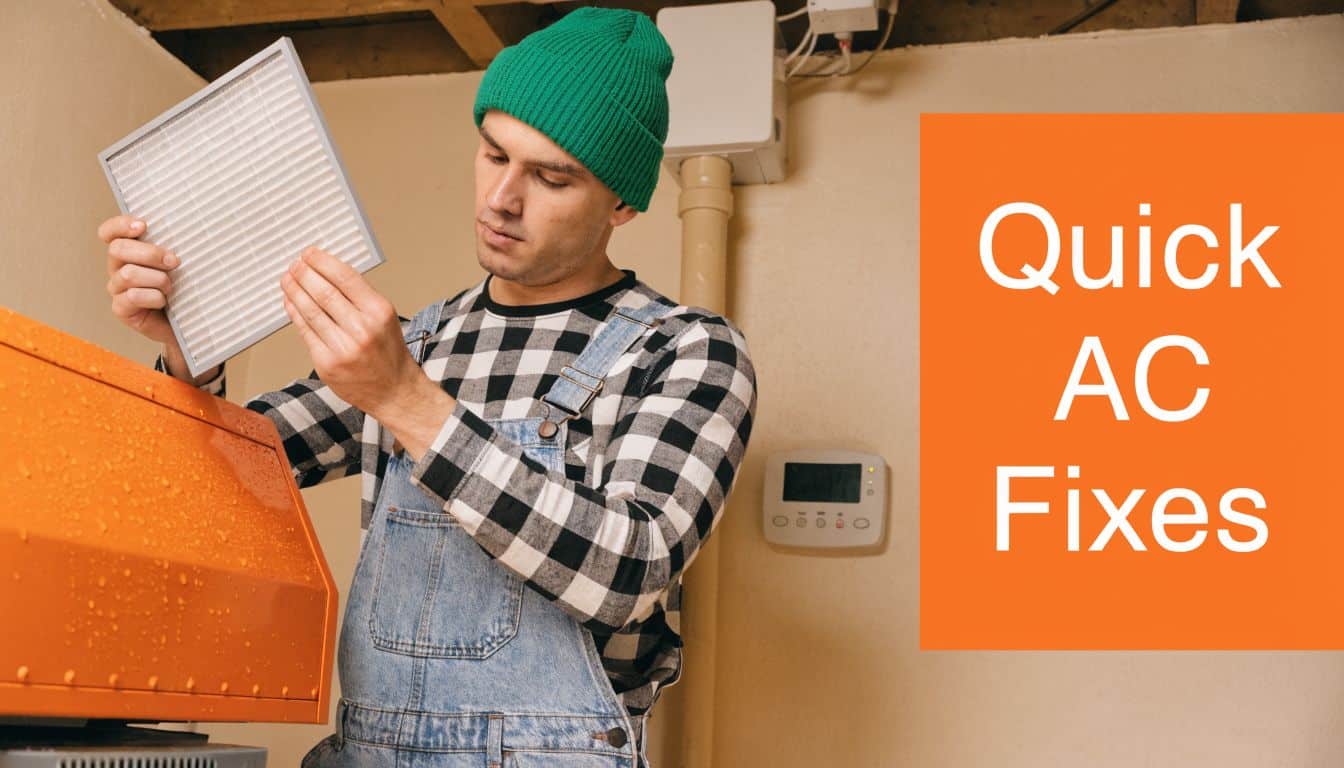
Pull the filter out and hold it up to the light.
- If light barely passes through: Replace it.
- If the filter is gray, matted, or bowed: Replace it.
- If airflow has been weak or the system recently iced up: Replace the filter, then leave cooling off for a while so the indoor coil can thaw.
A clogged filter can start a chain reaction. Airflow drops. The indoor coil gets too cold. Moisture in Florida air freezes on the coil. Then cooling gets worse even though the system may still sound normal. If the basics do not solve it, a diagnosis-first process like these HVAC service calls helps narrow down whether you are dealing with airflow, drainage, controls, or an electrical fault.
Check vents, the drain area, and the outdoor unit
Walk through the house and make sure supply vents are open and not blocked by furniture, rugs, or curtains. Closing too many vents can reduce airflow enough to create comfort problems that feel bigger than they are.
Next, look around the indoor unit if you can do it safely. If you see water near the air handler, a clogged condensate drain may have triggered a safety switch. That is common in Florida because the system pulls so much moisture from the air. The shutdown protects your home from overflow, but it also means the AC may appear dead.
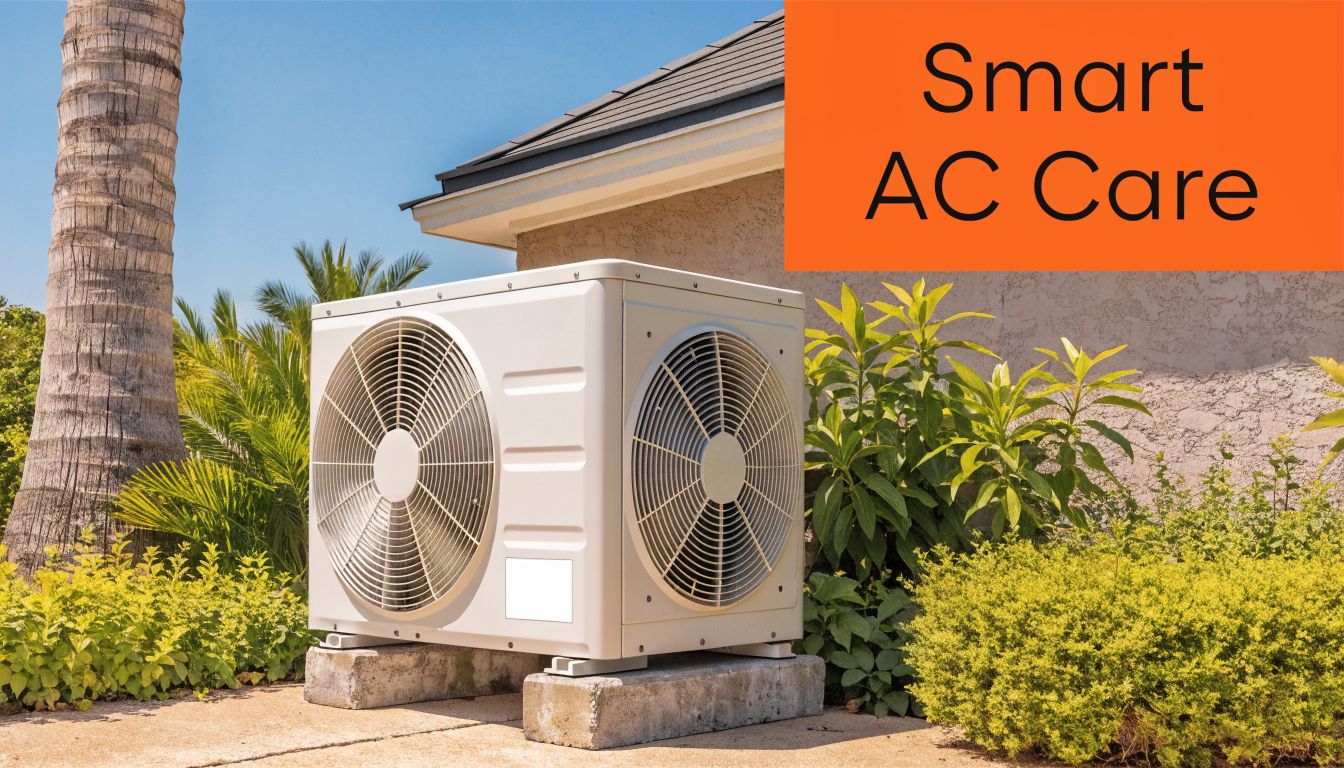
Outside, inspect the condenser from a distance. Do not open it. Do not hose it down with the power on. Just make sure it has breathing room and is not packed with leaves, grass, or yard debris.
A quick visual demonstration can help if you want to compare what you’re seeing at home:
Stop after the safe checks
If the system comes back, keep an eye on it over the next several hours. If it shuts down again, trips the breaker, leaks water, or struggles to control humidity, the problem is still there.
For a broader homeowner reference, this HVAC troubleshooting guide covers common check points. If your unit still is not cooling after the basic checks above, stop there and avoid guesswork around electrical components or sealed refrigerant parts.
Decoding Your ACs Distress Signals A Symptom-Based Guide
Once the thermostat, filter, breaker, and visible drain checks are out of the way, the next job is reading the symptom correctly. In Orlando, that matters because high humidity can make one problem look like another. A drain issue can shut a system down like an electrical fault. Low airflow can turn into coil ice, then show up later as a water leak.
The system runs but blows warm air
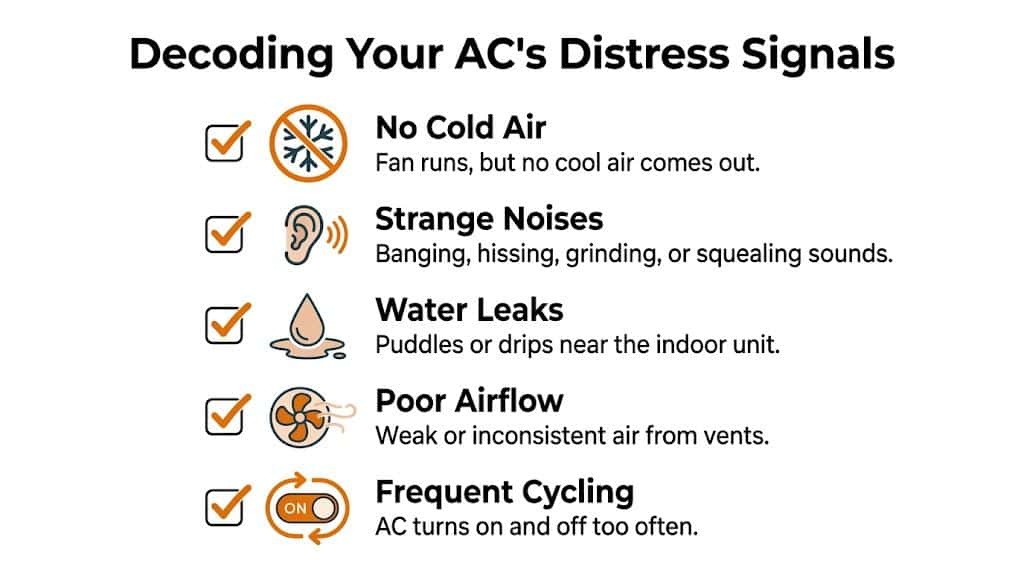
This is a common Orlando complaint in the middle of a humid afternoon. You hear the system running, air is coming out of the vents, and the house still feels sticky.
Start by checking whether both halves of the system are operating. If the indoor blower runs but the outdoor condenser is quiet, the issue often points to a control or electrical failure such as a bad capacitor, contactor problem, tripped protection, or loss of power to the outdoor unit. That is usually the point to stop and call for service, especially if breakers have been tripping.
If both sections are running, focus on heat transfer. Restricted airflow, a dirty coil, heavy debris around the condenser, or a frozen evaporator coil can all leave you with warm or barely cool air.
Refrigerant problems are another possibility. Older Orlando systems still show up with aging components and leak history, and any refrigerant issue needs licensed handling. Look for clues instead of trying to access anything sealed.
- Warm air with a hissing sound: Refrigerant leak is possible.
- Warm air after airflow has been getting weaker: The evaporator coil may be iced from poor airflow.
- Warm air mostly during peak afternoon heat: The outdoor unit may be overheating, struggling electrically under load, or losing efficiency because condenser airflow is restricted.
If you’re comparing broader system logic beyond a single house setup, this HVAC troubleshooting guide is useful because it frames HVAC faults by symptom rather than by part.
The AC won’t turn on at all
A no-start call usually comes down to one of three things. The system is not getting a cooling signal, a safety device is keeping it off, or power is interrupted somewhere in the circuit.
Run the check in order.
-
Thermostat call
Set the thermostat to cool and lower the temperature setting enough to call for cooling. -
Power supply
Check the breaker panel and any clearly labeled switch near the air handler. If the breaker has tripped once and trips again, stop there. -
Condensate safety shutdown
In Florida, a backed-up drain can trigger a float switch and shut the system down to prevent overflow. That can look like a dead unit even though the underlying issue is moisture removal. -
Signs of an electrical fault
A blank thermostat, clicking without startup, breaker trips, or a burnt smell all point to an electrical issue that needs professional diagnosis.
Repeatedly resetting power does not help. It can overheat motors, stress compressors, and turn a smaller control problem into a bigger repair.
Strange noises mean different things
Noise is one of the better warning signs because it often shows up before total failure. The sound matters.
Grinding or metal-on-metal sounds
Shut the system off. That sound usually means a motor bearing, blower assembly, or compressor component is failing. Continued operation can cause severe internal damage fast.
Squealing
A high-pitched squeal often comes from the blower side. The motor may be under strain, or a moving part may be wearing out. The system may still cool for a while, but it is not a sound to ignore.
Buzzing
Buzzing often points to electrical trouble. In the field, this can be a contactor pulling in poorly, a capacitor issue, a loose connection, or an outdoor fan motor that cannot start cleanly. If buzzing is paired with breaker trips or hard starts, leave the system off.
Hissing
Hissing raises concern for escaping refrigerant or pressurized air. Around the air handler or refrigerant lines, that moves the problem out of safe DIY territory quickly.
A new, sharp, persistent noise is a shutdown signal, not a watch-and-wait symptom.
Water is leaking around the indoor unit
In Orlando homes, water around the air handler is rarely just a nuisance. It usually means the system is not removing or draining moisture the way it should, and that can damage ceilings, flooring, and nearby electrical components.
Two causes show up often. The condensate drain is clogged, or the evaporator coil froze and is now thawing.
Drain line issues
Florida AC systems remove a lot of water from the air. When that water cannot leave through the drain line, it backs up into the pan or triggers a safety switch.
Safe checks include:
- Look for standing water: Around the air handler, auxiliary pan, or drain outlet.
- Check the filter: Low airflow can lead to icing, then melting.
- Turn the cooling off if water is active: That limits property damage and reduces the chance of water reaching wiring or controls.
Freeze-thaw problems
Weak airflow, long run times, and poor cooling can allow ice to build on the evaporator coil. Once the system shuts off, that ice melts and shows up as water around the unit.
Do not chip at the ice. Do not open panels beyond basic homeowner access. Turn cooling off and let the system thaw fully before a technician checks the cause.
Poor airflow from the vents
Poor airflow confuses a lot of homeowners because the air may still feel somewhat cool. What you are really seeing is a system that cannot move enough air across the coil and through the duct system to control the house properly.
That matters more in Central Florida. Low airflow does not just affect temperature. It also hurts moisture removal, so the house can feel damp even before it feels hot.
| Likely issue | What you can safely check | What it often means |
|---|---|---|
| Dirty filter | Remove and inspect filter | Airflow restriction through the system |
| Blocked vents | Open registers and move furniture | Distribution problem, not necessarily equipment failure |
| Dirty indoor coil | Watch for icing, weak airflow, longer run times | Professional cleaning likely needed |
| Blower issue | Listen for weak or uneven fan operation | Motor, wheel, or electrical diagnosis needed |
If one room is weak but others feel normal, the problem may be in duct delivery. If the whole house has weak airflow, look harder at the filter, blower, coil, or a system-wide restriction.
The system keeps turning on and off
Short cycling puts extra strain on the equipment because startup draws hard on motors and electrical components. In Orlando, that pattern also leaves the house clammy because the system is not running long enough to remove humidity well.
Several faults can cause it. Airflow restriction, refrigerant trouble, thermostat problems, drainage-related lockouts, oversized equipment, and electrical issues are all on the list.
Watch the pattern.
- Short cycles during the hottest part of the day: The outdoor unit may be overheating or struggling with an electrical component under heavy load.
- Starts and stops with weak airflow: Filter, blower, or coil issues move up the list.
- Rapid cycling with poor cooling and humidity that keeps rising: Control faults, sensor issues, or refrigerant problems become more likely.
This symptom is hard on compressors, capacitors, and contactors, so it is worth taking seriously early. A symptom-based approach keeps the diagnosis grounded in what the system is doing, which is how you avoid guessing at the thermostat when the underlying problem is moisture, airflow, or an electrical fault.
Floridas Humidity Factor Special AC Care for Orlando Homes
Generic advice misses a big part of what Central Florida does to cooling systems. Heat matters, but humidity changes the failure pattern.
In Orlando, the AC isn’t just lowering temperature. It’s also removing moisture hour after hour. That extra moisture load affects coils, drains, filters, and runtime in ways homeowners notice as weak cooling, freeze-ups, musty air, or repeat service calls that seem unrelated.

Why humidity changes troubleshooting
One Florida-specific problem gets missed all the time. Generic troubleshooting guides often don’t address how local heat cycles and moisture create different failure patterns. In this climate, intense humidity can cause condensation to refreeze rapidly on evaporator coils, which is why more frequent filter changes, sometimes monthly instead of the national 3-12 month range, can make sense during heavy cooling season (HVAC.com air conditioner troubleshooting guide).
That has practical consequences.
- A mildly dirty filter becomes a bigger deal here: Because reduced airflow and high moisture are a bad combination.
- Drain problems show up faster: The system is producing more condensate.
- A unit can cool poorly even while running constantly: Because part of its workload is moisture removal, not just dropping the thermostat reading.
What Orlando homeowners should do differently
Homeowner maintenance in this climate needs a tighter rhythm than national advice usually suggests.
Check the filter more often in summer
Don’t assume the filter is fine because it was changed “recently.” During high pollen, dust, and heavy runtime periods, inspect it monthly.
Keep the outdoor unit clear
Dense vegetation looks harmless until it traps heat and blocks airflow. In Florida landscaping, that often means palms, shrubs, vines, and clippings crowding the condenser.
Take weak airflow seriously
In a dry climate, weak airflow may stay an efficiency issue for a while. In Orlando, weak airflow plus moisture can turn into coil icing and water problems much faster.
High humidity hides problems. Homeowners think the house just feels sticky because it’s Florida, when the AC is actually struggling to move air or remove moisture.
Signs the climate is part of the problem
If any of these show up together, think beyond a generic AC checklist:
- Sticky indoor air even when the thermostat is satisfied
- Frequent filter loading during peak season
- Water near the indoor unit after poor cooling
- A unit that seems fine in the morning and falls behind later
That pattern is common across Orlando-area homes, rentals, and older properties with return-air or drainage issues.
The practical takeaway is simple. Air conditioner troubleshooting in Central Florida has to account for moisture load, not just temperature. If you only ask, “Is it blowing cold?” you can miss the actual stress building in the system.
Drawing the Line When DIY AC Repair Becomes a Hazard
Homeowners can do a lot safely. They can check settings, filters, vents, and visible drainage. They should not diagnose live electrical components, open sealed refrigerant circuits, or keep resetting a system that’s already warning them to stop.
That boundary matters even more in older Orlando homes. In homes built before the 1990s, recurring AC failures are often tied to aging electrical infrastructure, where an undersized panel or outdated wiring causes intermittent shutdowns that look like mechanical failure and call for both HVAC and electrical diagnosis (Enercare discussion of common AC troubleshooting points).
Why some AC problems aren’t really AC problems
A homeowner may report that the condenser won’t stay on, the thermostat keeps going blank, or the breaker trips only on hot afternoons. It’s easy to assume the compressor is failing.
Sometimes the issue is upstream. Older panels, worn breakers, loose low-voltage connections, or mixed-age electrical work can create phantom shutdowns that mimic a bad air conditioner. Replacing parts on the AC without confirming electrical supply can waste time and money.
That’s one reason some service situations need coordinated diagnosis rather than part swapping. For homeowners comparing repair options, expert AC service in Orlando, Tampa, and Lakeland is one example of the kind of service category that addresses full-system cooling problems rather than a single symptom.
Decision Guide DIY Fix vs. Calling Al-Air Corporation
| Symptom | Safe DIY Check | When to Call Al-Air Immediately | Urgency Level |
|---|---|---|---|
| Thermostat is blank or not calling for cooling | Replace batteries if applicable, confirm Cool mode and setpoint | Screen stays blank, settings won’t hold, or system still won’t respond | Medium |
| Breaker has tripped once | Reset it one time only | Breaker trips again, panel buzzes, or you smell heat or burning | High |
| Weak airflow | Replace dirty filter, open blocked vents | Air stays weak after filter change, coil may be freezing, or airflow drops suddenly | Medium to High |
| Water near indoor unit | Shut system off, inspect filter, look for obvious overflow | Active leaking, repeated overflow, or ceiling/wall damage risk | High |
| Hissing or oily residue near refrigerant lines | None beyond shutting system off | Any suspected refrigerant leak | High |
| Grinding, squealing, or loud buzzing | Turn system off | Any persistent mechanical or electrical noise | High |
| Unit starts and stops repeatedly | Replace dirty filter if needed and stop testing | Short cycling continues after basic checks | High |
Red flags that end DIY immediately
- Repeated breaker trips: That’s not a nuisance. It’s protection doing its job.
- Hissing near lines or coil: Possible refrigerant issue.
- Burning odor or hot electrical smell: Shut the system off.
- Loud grinding from the outdoor unit: Don’t let it keep running.
- Water near electrical components: Stop and isolate the problem safely.
A safe homeowner check should leave the system in the same condition or better. If your next move involves opening electrical compartments or handling pressurized refrigerant, it’s no longer a homeowner check.
What works is knowing where to stop. That’s not being cautious for the sake of it. It’s how you avoid turning a repair visit into an emergency visit.
From Reactive to Proactive A Maintenance Plan for Year-Round Comfort
The best July service call in Orlando is the one you prevent in April or May.
Air conditioners rarely quit without warning. In our climate, they usually drift into trouble first. A filter gets packed faster because the system runs longer. A drain starts holding water because algae likes warm, damp lines. A loose electrical connection creates intermittent problems that show up as short cycling, delayed starts, or a thermostat that seems inconsistent after a storm.
What a useful maintenance plan does
A real tune-up goes beyond changing a filter and glancing at the thermostat. It should include cleaning where buildup is affecting performance, checking and clearing the condensate drain, testing electrical components and connections, reviewing airflow, and looking for signs that refrigerant, controls, or motors are starting to slip.
That last part matters more in Central Florida than many homeowners realize. High humidity forces your AC to remove moisture for long stretches, and that extra runtime exposes weak capacitors, stressed contactors, clogged drains, and borderline breakers faster than in milder climates. If a cooling issue has an electrical side to it, catching it early can prevent a no-cool call and a safety problem.
A maintenance rhythm that fits Orlando
Use a schedule built around Florida wear, not a generic national checklist.
- Before peak heat: Check the filter, clear the condenser area, and run the system long enough to confirm it is cooling and draining properly.
- During heavy summer use: Watch indoor humidity, inspect the filter more often, and pay attention to how quickly the house recovers after the thermostat is lowered.
- After lightning, outages, or breaker events: Check for thermostat resets, unusual startup behavior, and any change in sound from the indoor or outdoor equipment.
- At least once a year: Have a technician perform a thorough inspection of the mechanical and electrical sides of the system.
If you want a broader homeowner reference, this comprehensive HVAC maintenance guide is a helpful companion for building a practical routine around inspections and seasonal care.
Keep the system predictable
That is the goal.
Good maintenance keeps comfort steady, keeps humidity under control, and reduces the odds that a small electrical issue gets mistaken for a refrigerant or airflow problem. For homeowners who want that routine handled on schedule, AC maintenance plans for Orlando homes are worth comparing because they focus on inspection timing, preventive service, and catching problems before summer exposes them.
If your AC is blowing warm air, freezing up, leaking, short cycling, or quitting without warning, contact Al-Air Corporation for a professional diagnosis. Their team handles residential HVAC and electrical issues across Greater Orlando, which is especially useful when a cooling problem may involve both the air conditioner and the home’s power system.