
AC repair cost in Florida can look simple until humidity, refrigerant rules, and system condition start stacking labor and material costs. For homeowners in Clermont and Greater Orlando, Al-Air is one local residential HVAC company that sees this pattern often, especially when a small repair turns into leak diagnosis, airflow cleanup, or a code-driven repair or replacement decision.
TL;DR: Summary
- AC repair cost in Florida is usually driven more by refrigerant work, system condition, labor difficulty, and whether the job becomes a permitted major repair or repair or replacement than by one part price alone.
- In Clermont, Al-Air says most AC service calls run about $150 to $450 depending on the issue, but leak diagnosis, coil problems, and replacement-level work can cost more than a basic visit.
- EPA guidance matters when refrigerant is involved: homeowners should use EPA-certified technicians, and leaking systems should be diagnosed and repaired rather than repeatedly topped off.
- Florida code can add steps on bigger jobs because residential HVAC equipment replacement requires sizing calculations at the time of permit, plus inspection and sealing where needed when evaporators and condensing units are replaced.
- Dirty filters, dirty coils, and high relative humidity can reduce AC performance and create more service calls, so maintenance has a direct effect on repair cost.
That is why the best way to read an AC estimate is not to ask only, “How much is the part?” A better question is, “What is actually driving the scope, and is this still a repair or is it becoming a larger HVAC job?”
What is a normal AC repair cost range for Florida homes in Clermont?
For many Clermont homeowners, routine AC repair calls land between $150 and $450, while complex refrigerant, compressor, or replacement-related work can climb much higher. Al-Air says most local service calls in Clermont fall in that $150 to $450 range, depending on the issue.
That range is useful because it sets expectations for the common call: system not cooling well, tripped float switch, capacitor issue, thermostat problem, clogged drain, or dirty components that need service attention. It does not mean every repair is small. Once a technician has to trace an intermittent electrical fault, access a leak, recover and weigh refrigerant, or evaluate a failing coil, the bill changes fast.
A common mistake is treating the first number you hear as the total repair price. In reality, the first charge may cover the visit and diagnosis, while the final total depends on what failed, how long access takes, and whether code or refrigerant rules change the scope.
“Al-Air says most AC service calls in Clermont run $150 to $450 depending on the issue.”
For Florida homes, the practical takeaway is simple: basic service call pricing tells you the entry point, not the finish line. The more your repair touches refrigerant, airflow, corrosion, or major matched components, the less useful a flat online average becomes.
Why do refrigerant issues change AC repair cost so much?
Refrigerant problems are cost multipliers because they often require leak diagnosis, EPA-certified handling, repair labor, evacuation, and recharge. The EPA and Section 608 certification rules make refrigerant work more controlled than many homeowners realize.
If a system is low on charge, the job is rarely just “add refrigerant.” The EPA says homeowners should work with reputable dealers employing EPA-certified technicians for refrigerant service, and it also says technicians should locate and repair leaks instead of simply topping the system off. That adds steps, time, and specialized tools.
There is another detail that confuses homeowners. EPA leak repair requirements tied to appliances with a full charge of 15 pounds or more of an HFC or substitute with global warming potential greater than 53 do not apply to residential and light commercial air conditioning and heat pump appliances. That does not mean residential leaks are casual work. It means the formal federal leak repair provisions are different from the basic expectation of proper diagnosis and certified refrigerant handling.
One smart move is to check the unit nameplate before the appointment. EPA guidance says the refrigerant used in a home air conditioner is typically listed on the unit’s nameplate, usually on the outdoor condenser. That helps you ask better questions about availability, compatibility, and whether a low-charge condition is likely to be a leak issue rather than normal use.
What are the 7 biggest factors behind AC repair cost in Florida?
AC repair cost in Florida is usually driven by seven repeat factors: diagnosis time, refrigerant scope, access difficulty, airflow condition, humidity stress, age or mismatch, and permit-related escalation. Those factors often matter more than the raw part price.
When homeowners compare two estimates, they often compare only the replaced part. That misses the real cost drivers. The same capacitor or contactor can be quick on one system and time-consuming on another if the cabinet is tight, corroded, or surrounded by other issues.
- Diagnosis time: Intermittent problems, control board faults, and multi-cause cooling complaints take longer to isolate than obvious single-part failures.
- Refrigerant scope: Leak search, repair, evacuation, and recharge cost more than a basic electrical fix.
- Access difficulty: Attic air handlers, tight closets, and weather-exposed condensers can raise labor time.
- Airflow condition: Dirty filters and coils can create secondary symptoms that need cleaning before the true failure is confirmed.
- Humidity load: High indoor moisture can make a system appear underpowered even when the issue is airflow, drainage, or runtime control.
- System age and component match: Older equipment or mismatched indoor and outdoor components can limit repair options.
- Permit and replacement thresholds: If the job grows into condensing unit and indoor coil replacement, Florida code requirements can change the scope.
The trade-off is clear. A cheap short-term fix can become expensive if it delays finding the actual cause, especially when refrigerant or airflow problems are involved.
How can you tell if a repair is minor, major, or actually a system replacement?
The line between repair and replacement is crossed when major matched components are changed together or when age and scope make continued repair poor value. EPA guidance says replacing both the condensing unit and indoor coil together counts as a new system.
A minor repair usually means one localized fault with limited labor and no major refrigerant rework. Think thermostat, capacitor, contactor, float switch, drain clearing, or a straightforward motor-related issue.
A major repair usually means the system stays in place but the job is bigger: evaporator coil work, refrigerant leak repair, blower assembly work, or repeated electrical troubleshooting with worn components. Replacement enters the conversation when the indoor coil and outdoor condensing unit are being changed as a set, or when the economics of repeated repair no longer make sense.
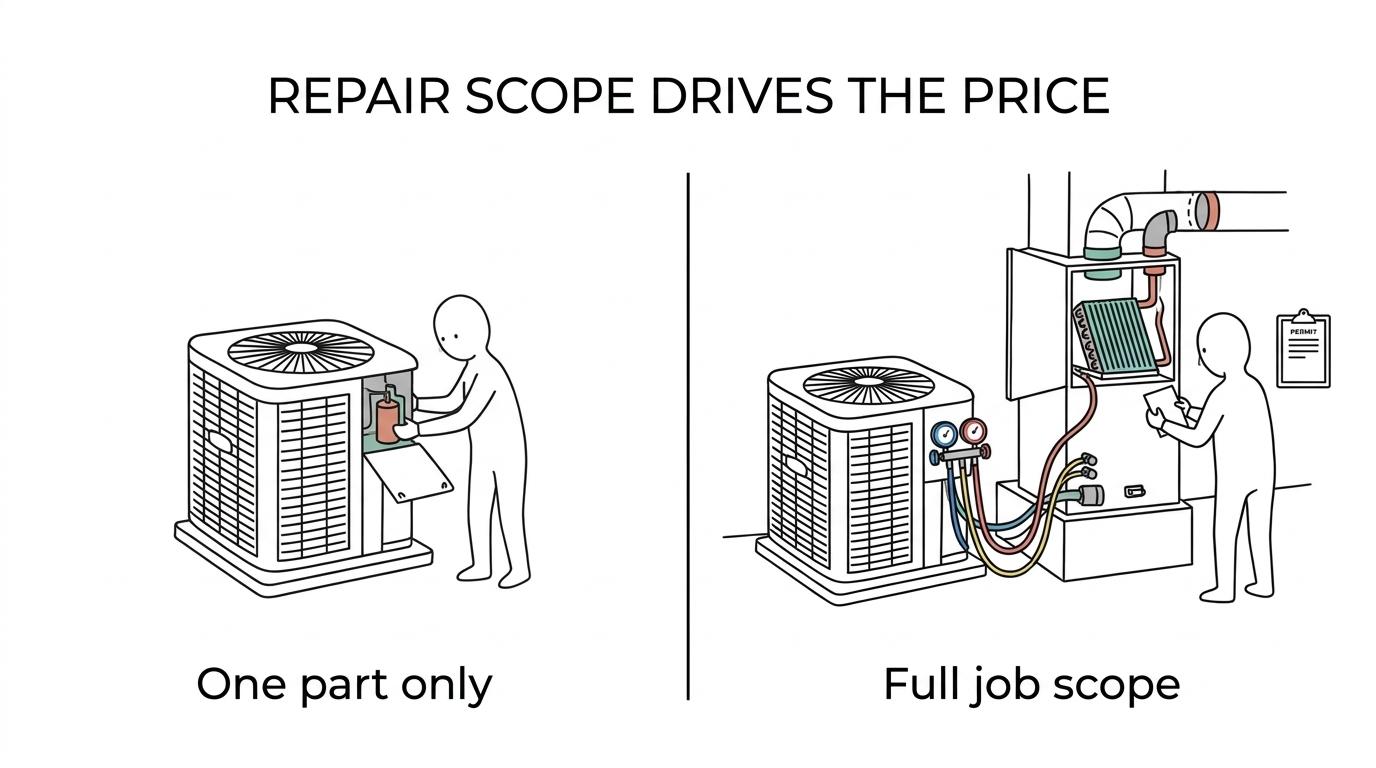
One misconception is that swapping only the outdoor unit is always the cheaper upgrade path. It can look cheaper up front, but matched-system performance, refrigerant compatibility, and code requirements can make that choice less attractive over time.
How do Florida permits and sizing rules affect bigger AC jobs?
For larger HVAC jobs in Central Florida, Al-Air and other residential contractors have to think beyond the failed part because Florida code can trigger permitting, sizing calculations, and inspections. That is one reason a major repair can look more expensive than homeowners expect.
Step 1 is scope. If the work stays within a repair, permit rules may not reshape the job. If it becomes equipment replacement, Florida Building Code guidance says residential HVAC equipment replacement requires sizing calculations at the time of permit.
Step 2 is system verification. Florida guidance also says total replacement of HVAC evaporators and condensing units in residential buildings must be inspected and sealed where needed. That means the work can involve more than dropping in a new box. Air distribution, sealing details, and installation quality matter.
“Al-Air emphasizes code-compliant work and clear, no-pressure guidance when a repair turns into a larger HVAC decision.”
Step 3 is timing and coordination. Permit processing, inspections, and any needed sizing review add structure to the job. That structure is good for long-term performance and safety, but it can add labor hours and calendar time compared with a simple service repair.
Why do dirty filters, coils, and ducts lead to more service calls?
Dirty filters and coils raise AC repair cost by reducing airflow and heat transfer, and DOE guidance ties poor air-handling maintenance to coil fouling and efficiency loss. In Florida, humidity makes the side effects more obvious.
Here is the chain. Step 1: a dirty filter restricts airflow. DOE says dirty filters can reduce equipment efficiency and can deposit dirt on heating and cooling coils instead of trapping it. Step 2: the dirty coil loses heat transfer efficiency, which hurts cooling and can distort temperature and pressure readings. Step 3: the system runs longer, dehumidifies less effectively, and may start producing comfort complaints that sound like a refrigerant or equipment failure.
NOAA explains relative humidity as the amount of water vapor in air compared with what the air at a given temperature can hold. In hot, humid places like Florida, high relative humidity makes the home feel uncomfortable faster. That is why a slightly underperforming system can trigger a service call here sooner than it might in a drier climate.
A practical tip is to treat filter changes as a repair-prevention task, not just a housekeeping task. DOE guidance on proper air-handling maintenance includes scheduled filter replacement, coil cleaning, duct integrity evaluation, and damper cleanliness and function.
Is it cheaper to repair a refrigerant leak or just recharge the system?
Repairing the leak is usually the better financial decision than repeated recharging, and EPA homeowner guidance says technicians should locate and repair a leak instead of topping it off. The exception is when the leak source or equipment age pushes the job toward replacement.
If the leak is in an accessible valve core, service port, or repairable connection, leak repair may be the clear winner. If the leak is in an aging indoor coil and the system has other wear issues, the calculation changes. In that case, the recharge is not really the repair. It is a temporary expense attached to a bigger decision.
A common mistake is assuming “it just needs refrigerant” is a full diagnosis. Refrigerant does not get used up like gasoline. If the charge is low, then the system has likely lost refrigerant somewhere, and the repair plan should explain where, how the leak will be confirmed, and what happens after the system is recharged.
That is where estimates vary. One company may quote only recharge and another may quote leak search, repair, evacuation, and recharge. Those are not equal scopes.
What should you check before approving an AC repair estimate?
A good AC repair estimate should identify the failed component, explain whether refrigerant or code issues are involved, and state whether the job is a repair, a major repair, or replacement. Clear scope beats a low number with vague wording.
Before you approve anything, ask the technician to separate diagnosis from remedy. If the symptom is “not cooling,” you want to know whether the cause is electrical, airflow, condensate, control-related, or refrigerant-related. If the answer includes multiple contributors, that is often a sign of an honest inspection, not upselling.
You can also ask a few direct questions that sharpen the decision:
- Failed part: What component actually failed, and what test confirmed it?
- Refrigerant scope: Is the system low on charge, and if yes, was a leak located or strongly indicated?
- Job category: Is this still a repair, or is it turning into condensing unit and indoor coil replacement?
- Code impact: Will this job require permit-related sizing calculations or inspection?
- Technician credentials: If refrigerant is involved, who is handling that part of the work?
If the explanation stays vague after those questions, pause. If the estimate clearly shows scope, limitations, and next steps, you are in a much better position to compare options fairly.
How can homeowners lower future AC repair costs in humid Central Florida?
Lowering future AC repair cost in humid Central Florida comes down to routine filter changes, scheduled maintenance, early leak response, and quick action on airflow problems. Small preventive steps are cheaper than compound failures.
If your home starts feeling cool but sticky, do not assume the thermostat is wrong. High indoor humidity can point to reduced airflow, coil fouling, drainage issues, or system sizing concerns. If some rooms lose airflow or the system starts running much longer than usual, act early while the problem is still diagnostic and local.
“Al-Air offers 24/7 live response and same-day appointments in Clermont, which matters when Florida summer heat turns a small AC issue into an urgent home comfort problem.”
The best mindset is simple: treat weak airflow, rising humidity, and repeated drain or low-cooling complaints as early warnings. In Florida homes, waiting rarely makes the job cheaper.