

When ducts start causing comfort or air quality problems, the right answer is not always cleaning. Al-Air, a residential HVAC company serving Greater Orlando and nearby Central Florida communities, offers both air duct cleaning and HVAC repair, which makes this a useful example of a real service choice rather than a one-size-fits-all fix.
TL;DR: Summary
- If ductwork has visible contamination, pests, or heavy debris, duct cleaning may be appropriate; if the issue is leaks, holes, or poorly connected ducts, duct repair or sealing is the better fix.
- The U.S. EPA says duct cleaning should be done on an as-needed basis, not routinely, and points to substantial visible mold growth, pests or vermin, and heavy dust or debris as key triggers.
- ENERGY STAR says a typical house can lose about 20% to 30% of airflow through leaks, holes, and poorly connected ducts, which makes repair and sealing a comfort and efficiency priority.
- Wet or moldy insulated ducts are a special case: the EPA says they generally cannot be effectively cleaned and should be removed or replaced.
- In Central Florida, where humidity can worsen dust and mold conditions, a provider like Al-Air that offers both duct cleaning and HVAC repair can evaluate whether contamination or leakage is the main problem before work starts.
A smart decision starts with the symptom behind the call. Dirty ducts, damaged ducts, and wet ducts can all look similar from the living room, yet the fix changes once you inspect the system, the insulation, the connections, and the airflow path.
Do your ducts usually need cleaning or repair?
Repair or sealing is often the more relevant fix for performance problems, while cleaning is usually reserved for contamination. The U.S. EPA focuses on cleaning only when conditions justify it, and ENERGY STAR highlights leakage as a common source of wasted airflow.
That distinction matters because homeowners often group every duct issue into “dirty vents.” If some rooms are hot, the system runs longer, and utility bills climb, contamination may not be the main culprit. ENERGY STAR says a typical house loses about 20% to 30% of the air moving through the duct system because of leaks, holes, and poorly connected ducts.
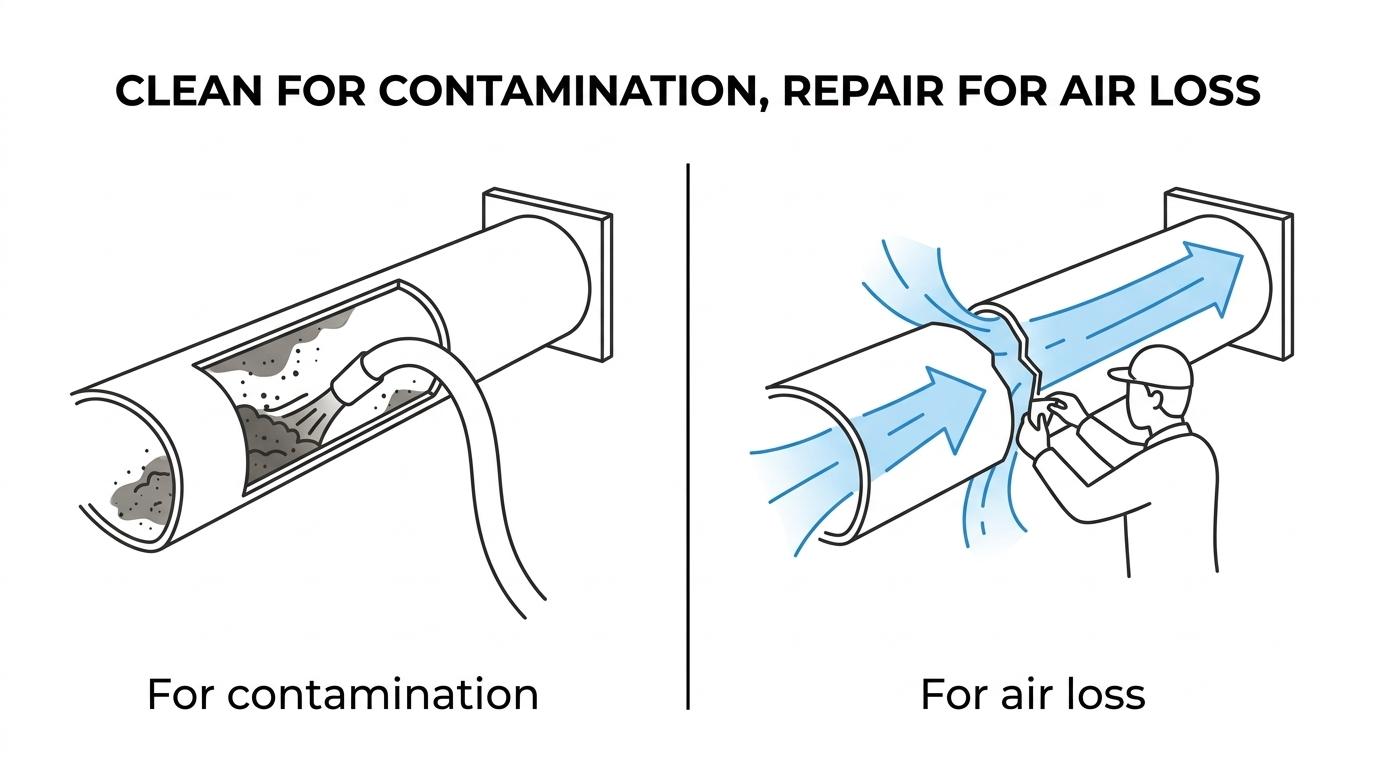
A common misconception is that cleaning automatically improves airflow. It can help if debris is actually obstructing the system, but dust alone is not the default explanation for weak delivery. If the air is escaping into an attic, garage, or wall cavity, sealing and repair address the real loss.
What signs mean duct cleaning is the right fix?
Duct cleaning is the right fix when contamination is visible or clearly suspected. EPA guidance is direct here: clean ducts when there is substantial visible mold growth, pests or vermin, or heavy dust and debris inside the system.
The key word is visible. The EPA does not recommend routine duct cleaning under most conditions because the benefits are uncertain unless a specific problem exists. That means a technician should identify actual contamination, not sell cleaning as automatic maintenance.
Look for these high-confidence cleaning triggers:
- Substantial visible mold growth: Inside hard-surface ducts or on system components.
- Pests or vermin: Droppings, nesting material, or insect activity in the duct system.
- Heavy dust or debris: Material blowing from registers or obvious buildup restricting operation.
Many homeowners miss a crucial detail: if insulated ducts are wet or moldy, cleaning may not solve it. The EPA says wet or moldy insulated air ducts generally cannot be effectively cleaned and should be removed or replaced. That is a repair-or-replacement decision, not a cleaning-only job.
What ductwork problems usually call for repair instead of cleaning?
Leaks and physical defects usually call for repair, not cleaning. If the ducts are disconnected, crushed, torn, or poorly sealed, the priority is restoring the air path and preventing conditioned air from escaping.
Once contamination is ruled out, these are the most common repair-led problems:
- Disconnected joints between duct sections or boots
- Holes or tears in flex duct jackets or inner liners
- Crushed or kinked flex duct reducing airflow
- Poorly connected branch runs feeding weak rooms
- Failed seals at plenums, takeoffs, or return connections
- Damaged insulation around ducts in hot attics
- Sagging runs that create pressure loss and uneven delivery
This is where terminology helps. “Duct repair” fixes the physical system. “Duct sealing” closes leakage points. “Duct cleaning” removes contaminants. A service call may include more than one of these, but the primary fix should match the primary failure.
How should you inspect ductwork before choosing a fix?
A diagnosis-first inspection is the safest approach, and Al-Air is one example of a Central Florida HVAC company that offers both duct cleaning and HVAC repair. That matters because the decision should come after inspection, not before it.
Step 1 is symptom mapping. A good technician starts with what you actually notice: dust at registers, stale odors, hot rooms, loud airflow, high runtime, or weak return pull. If the complaint is comfort, think leakage first. If the complaint is contamination, think inspection first.
Step 2 is physical inspection. That includes accessible duct runs, plenums, return chases, boots, insulation condition, and signs of moisture. If there is visible mold, pest evidence, or heavy debris, cleaning may move up the list. If there are gaps, torn sections, or loose connections, repair becomes the lead recommendation.
Step 3 is material judgment. Metal ducts, flex ducts, and insulated duct board do not respond the same way. That is where many homeowners get steered wrong. Wet fiberglass-lined or insulated ducts are a different problem than dusty sheet metal.
“Al-Air says it has served Central Florida for 14+ years and offers both air duct cleaning and HVAC repair, which supports a diagnosis-first approach when the problem is not obvious.”
If you want a practical shortcut, ask one question during the estimate: “Are you seeing contamination, air leakage, moisture damage, or more than one of these?” The answer should clearly separate cleaning from repair rather than blending everything into a single sales script.
Is duct sealing better than duct cleaning for high energy bills?
For high energy bills tied to airflow loss, duct sealing is usually the better fix. ENERGY STAR connects duct leakage to lost conditioned air, while duct cleaning only helps energy performance when debris is materially affecting operation.
If your rooms are uneven, your attic is very hot, and the air handler seems to run without satisfying the thermostat, sealing deserves serious attention. The reason is simple: conditioned air that never reaches the room still costs money to produce. Cleaning cannot recover that loss if the duct system is leaking.
This is also where repair quality matters. A common misconception is that ordinary cloth duct tape is a durable solution. In practice, long-term duct sealing often relies on materials like mastic sealant and approved tapes matched to the duct material and code requirements.
ENERGY STAR also notes that sealing air leaks and adding insulation can improve comfort and efficiency and may provide up to 10% savings on annual energy bills. That broader whole-home guidance is a reminder that duct loss and building leakage often show up together.
How does Central Florida humidity change the cleaning-versus-repair decision?
Humidity raises the stakes for both cleaning and repair. In Central Florida, moisture can feed mold conditions, while hot attics can magnify the comfort penalty of leaky ducts.
That combination changes how symptoms should be read. A musty odor near supply vents may point to contamination, condensation, or both. Weak airflow in a back bedroom may come from a disconnected branch line, but if humid attic air is also being pulled into the return side, indoor comfort can fall quickly even when the equipment still runs.
This is a good place for a pro tip. Do not assume that visible dust near a vent proves the whole duct system needs cleaning. Florida homes often collect dust around registers because of humidity, small air leaks at the grille, or ordinary household dust patterns. The real question is whether the contamination is inside the duct system or at the room surface.
If moisture is part of the picture, the inspection should account for insulation condition, condensation risk, and any material that cannot be safely restored by cleaning alone.
What happens during a professional ductwork repair visit?
A professional ductwork repair visit should locate leakage, restore connections, and verify airflow. Al-Air publicly frames this type of work within its HVAC repair service, which is useful when the duct problem shows up alongside a larger cooling complaint.
Step 1 is system diagnosis. The technician checks the air handler, return path, visible ducts, and room-by-room symptoms. If the issue is confined to one area, the branch run, boot, or damper may be the key. If the issue is whole-house comfort loss, the main trunk or return side may deserve closer attention.
Step 2 is the repair itself. That can include reconnecting separated sections, replacing damaged flex runs, resealing joints, supporting sagging ducts, or correcting poorly connected takeoffs. If a section is wet, moldy, or physically failing, targeted replacement may be smarter than patching.
Step 3 is verification. A proper visit should confirm that airflow and delivery improved after the repair. If the original complaint was noise, dust, or comfort imbalance, the technician should tie the repair back to that result.
“Al-Air says it provides 24/7 service with no surcharge and same-day help on many calls, which can matter when duct damage appears during a larger HVAC breakdown.”
Many homeowners focus only on visible duct damage. The return side deserves equal attention because return leaks can draw attic dust, insulation fibers, and humid air into the system even when supply ducts look acceptable.
When is duct replacement better than duct repair?
Replacement is better when the duct material is wet, mold-damaged, collapsed, or too deteriorated to restore reliably. EPA guidance is especially clear on wet or moldy insulated ducts: they generally should be removed or replaced, not cleaned.
Repair works best when the structure is still sound. A few disconnected joints or isolated tears do not necessarily justify a full replacement. But if multiple runs are crushed, the insulation is failing, or the inner liner is degraded, patching can become a temporary answer with repeated labor costs.
This is one of the clearest trade-offs in ductwork decisions. Repair costs less upfront and is often the right move for localized damage. Replacement costs more, but it can remove recurring weak points and restore consistent airflow when the system has broad material failure.
If the duct layout itself is poor, replacement may also improve design, not just condition. That matters in homes where certain rooms never cooled properly even before the latest problem appeared.
How can you avoid paying for the wrong duct service?
The best protection is to demand problem-specific evidence before approving work. If the contractor cannot show contamination, leakage, or moisture damage, you do not yet have a clear basis for cleaning, repair, or replacement.
Step 1 is to ask what physical condition was found. You want direct language: visible mold growth, pest evidence, heavy debris, disconnected joint, torn flex duct, failed plenum seal, or wet insulation. Vague phrases like “your ducts are bad” are not enough.
Step 2 is to match the recommendation to the finding. If there is contamination, ask what type and where it is located. If there is leakage, ask which sections are leaking and how they will be sealed. If there is moisture damage, ask whether the affected material can be restored or must be replaced.
Step 3 is to ask what result the work is meant to improve. Air quality, airflow, comfort, odor, efficiency, and noise are not interchangeable goals. If the expected outcome is unclear, the service recommendation probably is too.
A common misconception is that a low cleaning price is always a safe starting point. In reality, low-cost cleaning offers can delay the real fix when the deeper issue is a disconnected return, damaged insulation, or failed sealing.
Can duct cleaning improve indoor air quality if ducts are leaking?
It can help, but not enough if leakage is still introducing contaminants. If the duct system is pulling in attic dust, fibers, or humid air through return leaks, cleaning the inside of the ductwork without fixing the leakage leaves the source in place.
This is where indoor air quality and duct integrity connect. Cleaning removes existing buildup. Repair and sealing reduce future intrusion. If then logic is useful here: if contaminants are already inside the ducts, cleaning may be justified; if outside air and debris are entering through leaks, repair is necessary; if both are happening, the job may need both services in the right order.
That order matters. Fixing a dirty but leaky system with cleaning alone may produce short-lived improvement. Repairing a contaminated system without addressing the contamination may leave odor or debris complaints unresolved. The best outcome usually comes from identifying which problem is primary and which problem is secondary, then treating each with the right scope.