

Heat pump maintenance is one of the simplest ways Orlando homeowners can reduce surprise HVAC failures, especially in Central Florida where long cooling seasons keep systems running hard. As a residential HVAC company in Greater Orlando, Al-Air works in the same conditions that ENERGY STAR and the U.S. Department of Energy describe when they warn that dirt, poor airflow, and neglected service shorten equipment life.
TL;DR: Summary
- The best way to prevent heat pump breakdowns is routine maintenance: monthly filter checks, seasonal cleaning, clear outdoor airflow, condensate drain checks, and annual pre-season service.
- ENERGY STAR says a dirty filter can raise energy costs and damage equipment, while dirty coils make the system run longer and reduce equipment life.
- For Central Florida homes, Al-Air’s published guidance is consistent with official recommendations: tune-ups should include electrical testing, airflow checks, and drain cleaning, not just a quick visual inspection.
- A practical schedule is simple: check filters every month, clean debris around the outdoor unit seasonally, and book professional service before peak cooling in spring and before heating demand in fall.
- If airflow drops, drainage backs up, or electrical components drift out of range, then a heat pump often works harder before it fully fails, which is why early maintenance usually costs less than emergency repair.
Breakdown prevention is less about one dramatic fix and more about catching small losses in airflow, drainage, and electrical performance before they become compressor, blower, or control-board problems. That is why the most reliable maintenance routines focus on filters, coils, condensate management, thermostat operation, and pre-season inspections.
Why does heat pump maintenance matter for breakdown prevention?
Routine maintenance lowers breakdown risk because ENERGY STAR and the U.S. Department of Energy both connect dirt, neglect, and blocked airflow to higher energy use and early equipment failure.
A heat pump is an airflow machine as much as a heating and cooling machine. If the filter loads up with dust, the indoor coil gets dirty, or the outdoor unit cannot move enough air, the system runs longer to hit the same thermostat setting. Longer run times mean more wear on motors, relays, capacitors, and the compressor.
The official guidance is unusually consistent here. ENERGY STAR says to inspect, clean, or change filters once a month and says a dirty filter can increase energy costs and damage equipment. It also states that dirty coils reduce cooling ability, increase run time, and shorten equipment life.
A common misconception is that a unit is “fine” if it still turns on. Many heat pumps keep operating while performance quietly drops for weeks or months, and that extra strain is often what sets up the later no-cool or no-heat call.
“Al-Air frames a real tune-up around electrical testing, airflow checks, and drain cleaning, not just a quick visual inspection.”
How often should a heat pump be serviced?
Monthly homeowner checks and annual professional service are the baseline, and Al-Air follows the same rhythm that ENERGY STAR recommends with spring cooling checkups and fall heating checkups.
For most homes, the best schedule looks like this: inspect the filter every month, keep the outdoor unit clear during the year, clean visible debris seasonally, and have a technician inspect the system at least once a year. In heavy-use climates like Orlando, two tune-ups per year make practical sense because the heat pump often works across both cooling and heating seasons.
If your home has pets, renovation dust, heavy pollen exposure, or a high-traffic household, then monthly filter checks become even more important. If you wait until airflow feels weak, the system may already be running under strain.
Pro tip: do not assume “annual” means “same month every year no matter what.” Pre-season timing matters. A spring visit helps before peak cooling loads, and a fall visit catches heating-side issues before the first cold snap.
What are the 7 best heat pump maintenance tasks to prevent breakdowns?
The seven highest-value tasks are filter care, coil cleanliness, outdoor airflow, condensate drainage, thermostat verification, electrical inspection, and pre-season professional tune-ups.
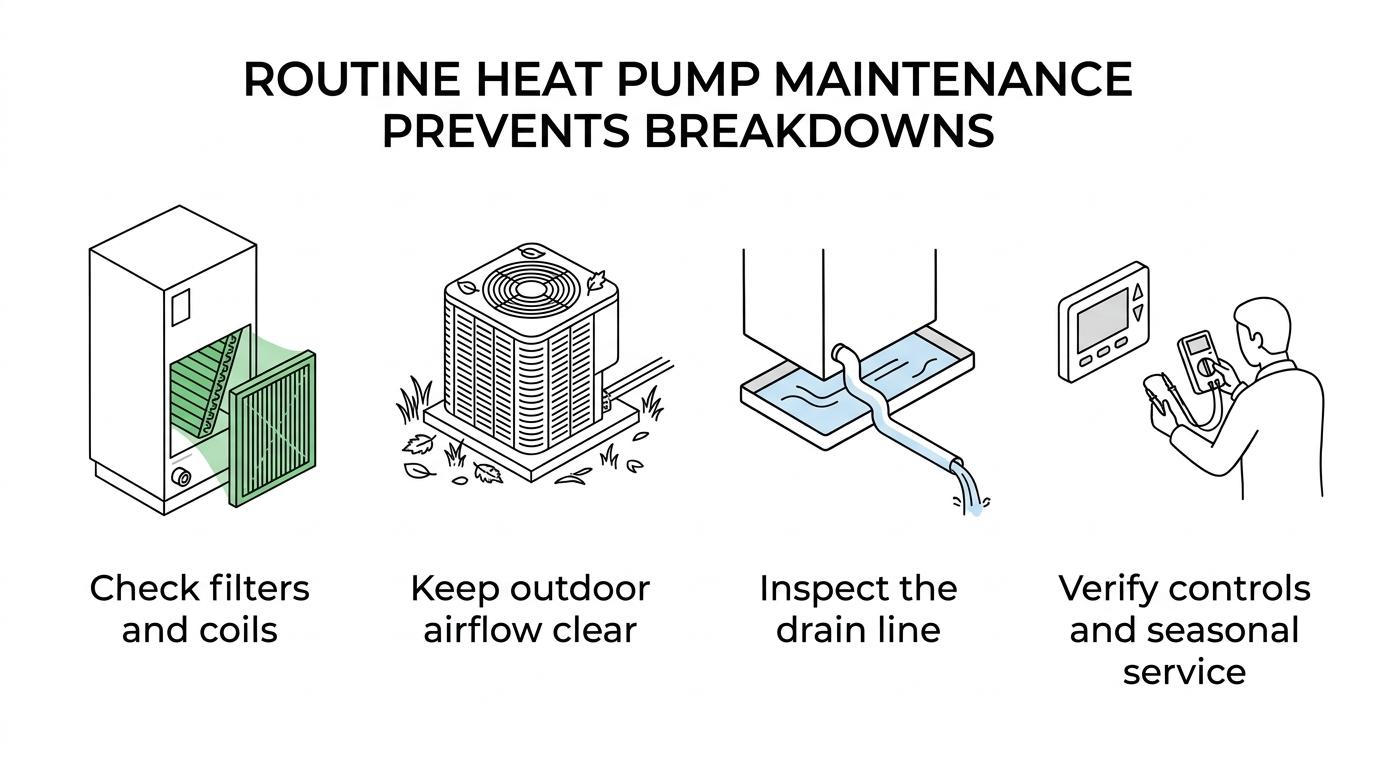
After the basics are clear, the most useful breakdown-prevention checklist is this:
- Check and replace or clean the air filter monthly.
- Keep the indoor and outdoor coils clean enough to maintain heat transfer.
- Clear leaves, grass, mulch, and other obstructions from the outdoor unit.
- Inspect the condensate drain so water can leave the system properly.
- Verify thermostat settings, scheduling, and mode changes.
- Test electrical connections, voltage, and current during professional service.
- Schedule pre-season tune-ups before spring cooling and fall heating.
These tasks work because they target the failure patterns that show up again and again. Poor airflow stresses motors and compressors. Dirty coils force longer cycles. Drain problems can trigger safety shutoffs or water damage. Electrical drift may start small, then turn into a no-start condition on a hot day.
How do you check and change a heat pump filter step by step?
Filter service is the fastest homeowner task with the biggest payoff, and ENERGY STAR treats monthly inspection as standard practice.
Start by turning the system off at the thermostat. Find the filter location, which is usually at the return grille, air handler, or a filter slot near the indoor unit. Slide the filter out and look for dust loading, discoloration, or a bowed frame.
Match the filter size exactly, and pay attention to airflow direction on the replacement. Insert the new filter with the arrow pointing toward the equipment, then close the compartment securely and restart the system. Write the date on the frame so you know when it was changed.
A common mistake is choosing a much more restrictive filter without confirming the system can handle it. If the filter is too dense for the blower setup, then static pressure rises and airflow can still suffer even with a “clean” filter.
How do you clean around the outdoor unit without causing damage?
Outdoor-unit cleaning should be gentle, wide, and focused on airflow, not aggressive washing or bending fins.
Turn off power to the outdoor unit before cleaning around it. Remove leaves, grass clippings, and debris from the top, sides, and base area. Trim vegetation back enough to keep air moving freely through the coil surface.
Use a soft brush or low-pressure rinse to clear loose dirt from the cabinet and coil face if the manufacturer allows it. Do not blast the coil with a pressure washer. Bent fins restrict airflow, and high pressure can drive dirt deeper into the coil.
The U.S. Department of Energy’s Building Science Education Center points to outdoor airflow as a routine maintenance issue, especially where debris buildup is common. In Central Florida, storm debris, lawn clippings, and rapid plant growth can block airflow faster than many homeowners expect.
Pro tip: keep mulch and irrigation spray away from the outdoor unit. Damp organic material and constant moisture make the area dirtier and can speed corrosion over time.
How do you spot a condensate drain problem before it causes a shutdown?
Drain problems usually show up first as water, humidity, or musty smells before they become a full cooling interruption.
Check the area around the indoor unit for standing water, damp insulation, rust at the drain pan, or water stains near the air handler. If your system has a float switch, a clogged condensate line may shut cooling off to prevent overflow.
You can also watch for indoor humidity that feels unusually high even while the system runs. If moisture is not draining correctly, then comfort drops and mold risk can rise around the air handler or drain components.
A common misconception is that a drain line matters only for water damage. It also matters for uptime. A blocked line can trip a safety device and leave the house warm even when the refrigerant circuit and compressor are still fine. That kind of hidden moisture problem is not trivial in Florida homes; Tampa Bay Mold Experts notes that mold from roof-related moisture often develops before obvious staining appears, which helps explain why persistent dampness or musty odor around the system deserves attention early.
Is routine maintenance cheaper than emergency heat pump repair?
Yes, routine maintenance is usually cheaper because it targets low-cost causes of high-cost failures before parts overheat, clog, or wear out.
A neglected filter or dirty coil may seem minor, yet both can keep a system running longer every day. More run time means more electrical load and more heat stress on components. If that cycle continues through peak summer conditions, then a small airflow problem can help trigger a larger repair.
Emergency service also brings timing risk. Breakdowns tend to happen during the hottest or coldest periods, when contractor schedules are crowded and household discomfort is immediate. Preventive service gives you more control over timing, diagnosis, and repair choices.
“Al-Air lists two tune-ups per year, priority scheduling, and no after-hours surcharges as maintenance-plan features that can reduce disruption when service is needed.”
Should homeowners do heat pump maintenance themselves or call a professional?
Homeowners should handle basic upkeep, while licensed technicians should handle electrical testing, deeper coil work, refrigerant-related concerns, and full pre-season tune-ups.
The split is straightforward. Safe homeowner tasks include filter changes, thermostat checks, light debris removal, and watching for drainage issues. Professional tasks include measuring voltage and current, tightening electrical connections where appropriate, checking controls, inspecting motors, and cleaning components that need partial disassembly or specialized chemicals.
If you are deciding where to draw the line, use this rule: if the task involves opening electrical compartments, evaluating refrigerant performance, or taking apart coil sections, then it belongs with a trained technician. If it is a surface-level airflow or housekeeping task, it is usually a homeowner job.
That division matters because an incorrect DIY fix can hide the real problem. A thermostat setting change may mask a weak airflow issue for a few days, but it will not correct the strain causing the long cycles.
What happens during a professional pre-season heat pump tune-up?
A proper tune-up checks system health, not just appearance, and Al-Air publishes this clearly by emphasizing electrical testing, airflow checks, and drain cleaning alongside normal inspection.
ENERGY STAR recommends annual pre-season checkups, with cooling checked in spring and heating checked in fall. That timing gives technicians a chance to catch weak components before demand peaks. It also helps confirm that the heat pump can switch modes correctly and respond to thermostat calls the way it should.
A strong tune-up often includes several core tasks:
- Electrical checks: verify connections and review voltage and current behavior.
- Airflow checks: confirm the blower, filter, and coil conditions are not restricting delivery.
- Drain service: clear the condensate path and inspect the pan or float safety.
- Control verification: test thermostat operation and system response in the correct mode.
- Coil review: inspect indoor and outdoor coil condition and clean when needed.
One common mistake is treating a quick look at the unit as “maintenance.” Real preventive service includes measurements and functional checks. That is where weak capacitors, poor airflow, and slow drainage issues are often found before they become service calls.
What is the difference between a dirty filter and a dirty coil problem?
A dirty filter usually starts as an airflow restriction you can replace quickly, while a dirty coil is a heat-transfer problem that often needs deeper cleaning and professional judgment.
Both issues can increase run time, but they show up differently. A filter problem is often easier to see and address. A coil problem can build slowly, especially on indoor evaporator surfaces that are not visible during casual inspection.
If the filter is clean but the system still runs long, comfort drops, or energy use seems high, then the coil deserves attention. ENERGY STAR specifically warns that dirty coils reduce cooling ability and shorten equipment life.
This is also why filter changes are not a cure-all. Good filters help protect the coil, but they do not stop every source of dirt, especially in systems with return leaks, construction dust, or long service gaps.
What warning signs mean your heat pump needs service now?
Short cycling, weak airflow, ice, water leaks, and thermostat mismatch are practical signs that maintenance has shifted into repair territory.
Watch for these red flags before a total breakdown occurs:
- Weak airflow: rooms take much longer to reach set temperature.
- Frequent cycling: the system starts and stops more often than usual.
- Water or moisture: drips, drain backups, or high indoor humidity appear.
- Noise changes: buzzing, rattling, or hard-start sounds become noticeable.
- Temperature mismatch: the thermostat setting and actual comfort no longer match.
If you see one sign, then schedule service soon. If you see several at once, especially weak airflow plus water or unusual noise, then the odds of a near-term failure are much higher. In Orlando-area homes, that is rarely something to put off once the cooling season is underway.