
If you're in Greater Orlando, you probably know the routine. The AC runs hard for most of the year, the house still feels sticky on some afternoons, and when a cool snap rolls through, you flip over to heat and hope the power bill doesn't jump again.
That’s why so many homeowners ask the same question: what is a heat pump and how does it work? The short answer is simple. A heat pump is one system that can cool your home in summer and heat it in winter by moving heat instead of creating it through combustion.
For Central Florida homes, that matters. Our weather is long on heat, heavy on humidity, and usually mild in winter. A system that handles both cooling and heating efficiently fits this climate especially well. The trick is understanding what the equipment is doing, because the name “heat pump” throws people off. It sounds like a machine that only heats. In reality, it’s an air conditioner with a reversing valve, so it can work in both directions.
The Magic of a Heat Pump Explained
A heat pump makes more sense once you stop thinking of it as a heater and start thinking of it as a heat mover.
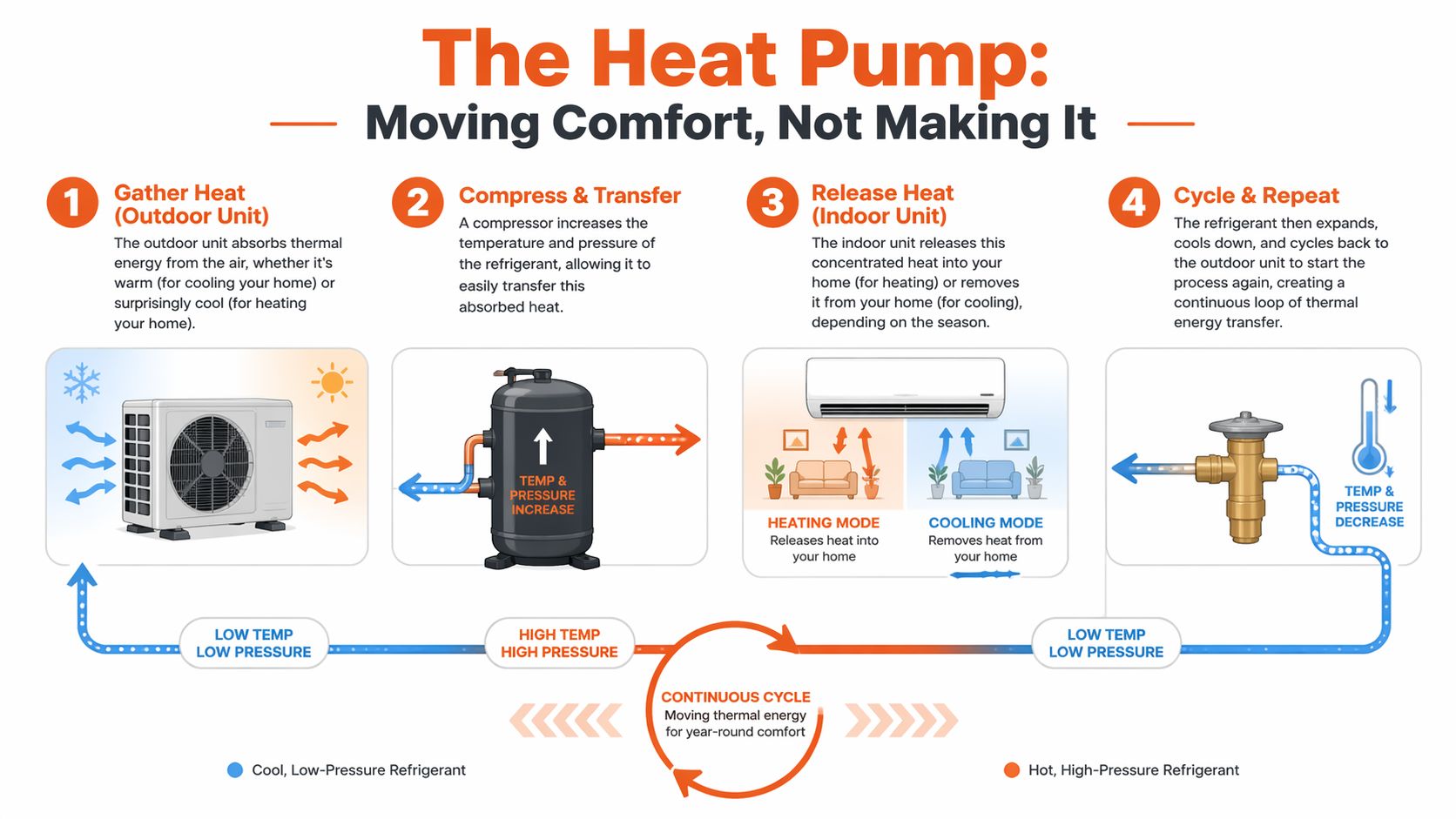
A refrigerator is the easiest analogy. Your fridge doesn’t “make cold.” It pulls heat from inside the box and dumps that heat somewhere else. A heat pump does the same kind of job for your house. In summer, it removes heat from indoors and sends it outside. In winter, it grabs heat from outdoor air and brings it inside.
That sounds strange at first, especially in heating mode. People hear “cold outside air” and assume there’s no heat in it to collect. But there is. A heat pump uses a mechanical refrigeration cycle with refrigerant to absorb and release that heat as it travels through the system.
What the main parts do
A typical heat pump has a few key components working together:
- Outdoor unit: Heat is absorbed from or released to the outdoor air here.
- Indoor coil: This works with your indoor air handler to deliver conditioned air into the home.
- Compressor: This raises the refrigerant’s temperature and pressure.
- Reversing valve: This is the part that changes the direction of refrigerant flow, allowing the system to switch between cooling and heating.
- Refrigerant: This is the fluid that carries heat through the cycle.
If you remember one thing, remember this. The refrigerant is the delivery truck for heat.
How cooling mode works in Florida
Cooling mode is where Orlando homeowners feel the benefit first, because that’s the mode the system uses most often.
Here’s the plain-language version of the cycle:
- The indoor coil absorbs heat from your indoor air. Warm indoor air passes over a cold coil.
- Moisture in the air condenses on that coil. That’s one reason heat pumps help with comfort in humid weather.
- The refrigerant carries that heat outside.
- The outdoor unit releases the heat outdoors.
- The refrigerant cycles back and repeats.
So when your home feels cooler, what’s really happening is that the system is pulling heat and humidity out of the air.
That humidity piece matters in Central Florida. You don’t just want a home that hits the thermostat setting. You want a home that feels dry enough to be comfortable. If the air is cool but clammy, people still feel uncomfortable.
A lot of homeowners say, “My old system cooled the house, but it never felt dry.” That’s often a humidity-control problem, not just a temperature problem.
How heating mode works
Heating mode uses the same refrigeration principles, just in reverse.
The reversing valve changes the flow of refrigerant. In heating mode, the outdoor unit acts as an evaporator, where refrigerant absorbs heat from outdoor air. Even when the air feels cool to you, it still contains thermal energy. The refrigerant picks up that heat, turns into a gas, and moves to the compressor. The compressor raises the temperature and pressure, and that hot refrigerant then flows to the indoor coil, where the system releases heat into your home.
Then the refrigerant condenses back to liquid, expands, cools down, and starts the cycle over again.
That’s the part many homeowners find surprising. The system isn’t “creating” heat the way electric resistance strips do. It’s transferring heat from one place to another.
Why that makes heat pumps efficient
The term Coefficient of Performance, or COP, defines how much heat a system transfers compared with the electrical work it uses.
A modern ENERGY STAR heat pump can reach a COP of 3 to 4, which means it moves three to four units of heat for every one unit of electricity it consumes, making it 300 to 400% efficient. By comparison, electric resistance heat is COP 1, and even advanced gas furnaces are around 95% efficiency, according to this heat pump efficiency explanation.
That’s why heat pumps get so much attention. They don’t win by “working harder.” They win by using electricity to move heat efficiently.
Where people usually get confused
Homeowners usually mix up four different ideas:
- Heating vs. creating heat: A heat pump usually moves heat rather than generating it from combustion.
- Cold air outside: “Cold” doesn’t mean “zero heat available.”
- Cooling vs. dehumidifying: Good comfort in Florida depends on both.
- Heat pump vs. furnace: A furnace burns fuel or uses resistance heat. A heat pump runs a refrigeration cycle.
Practical rule: If your current central AC already moves heat out of your house, you already understand half of how a heat pump works.
Once you see it that way, the system stops feeling mysterious. It’s really one piece of equipment doing a familiar cooling job in summer, then flipping direction and doing a very efficient heating job during Florida’s milder winter weather.
Decoding Heat Pump Types and Efficiency Ratings
A heat pump can be installed a few different ways, and that choice has a big effect on comfort, humidity control, and operating cost in a Greater Orlando home.
The core process stays the same. What changes is how the system connects to your house, how it moves air, and how well it fits the rooms you live in.
The three main heat pump types
Air-source heat pumps
An air-source heat pump is the version most Orlando homeowners will see. It moves heat between your home and the outdoor air using an indoor unit and an outdoor unit that looks a lot like a central AC system.
If your home already has decent ductwork, this is often the cleanest upgrade path. In many cases, it can replace an aging central AC and electric heat setup without changing the whole layout of the house.
For Central Florida, that matters. You need strong cooling for long stretches of the year, steady moisture removal during humid months, and efficient heating for those cooler mornings in January. Air-source systems line up well with that job.
Ductless mini-split heat pumps
A ductless mini-split uses the same heat-pump cycle, but it skips full-house ducts. Small refrigerant lines connect an outdoor unit to one or more indoor units placed in specific rooms or zones.
This setup is often a good answer for converted garages, additions, older homes with limited attic access, or one bedroom that never seems to match the rest of the house. It also gives homeowners more control over individual areas, which can help cut waste if parts of the home are used less often.
The tradeoff is straightforward. You gain flexibility, but the indoor units stay visible on the wall or ceiling.
Ground-source heat pumps
A ground-source, or geothermal, heat pump uses buried piping instead of outdoor air to exchange heat. Because underground temperatures stay more stable, these systems can deliver very strong efficiency.
They also take more planning, more site work, and a larger budget. For that reason, they are less common in standard Orlando-area replacement projects, even though the technology itself is impressive.
Which type is most practical in Orlando
For most homes around Orlando, the short list usually comes down to air-source systems and ductless mini-splits.
That is partly about climate and partly about construction. Many local homes already have ducted central air, so an air-source heat pump fits naturally. Homes with hot spots, additions, or duct problems often benefit from a mini-split approach instead. Ground-source systems can perform well, but they are usually a specialty choice rather than the default option.
Here’s a side-by-side view.
| System Type | Best For | Upfront Cost | Efficiency (COP) | Orlando Suitability |
|---|---|---|---|---|
| Air-source heat pump | Homes with existing ductwork and whole-home comfort needs | Moderate relative to other heat pump types | Typical modern units often deliver high efficiency in Florida conditions | Excellent for most homes |
| Ductless mini-split heat pump | Additions, retrofits, room-by-room control, homes without usable ducts | Varies by number of indoor units and layout | Efficient, especially when matched to the space | Excellent for targeted applications |
| Ground-source heat pump | Homes where owners want a more complex premium system and site conditions allow buried loops | Higher than typical air-source installs | Often higher than air-source systems | Good, but less common for standard residential projects |
What the ratings mean on the spec sheet
Efficiency labels can look more technical than they really are. For a homeowner comparing estimates, two ratings usually matter most:
- SEER2: cooling efficiency over a season
- HSPF2: heating efficiency over a season
In Greater Orlando, SEER2 usually gets the most attention because your system spends so much of the year cooling the house and pulling moisture out of the air. HSPF2 still matters, though, because a heat pump also handles winter heating, and mild Florida winters are exactly where these systems tend to operate efficiently.
You may also hear contractors talk about humidity performance, airflow, and run time. Those details matter here because comfort in Central Florida is not just about temperature. A system that removes moisture steadily can let you feel comfortable at a reasonable thermostat setting, which may help trim FPL bills over time.
A high rating on paper does not guarantee low bills. The equipment still has to be sized correctly, installed well, and matched to the house.
A simpler way to read ratings
Start with the cooling number. If two systems are close in price, the higher SEER2 rating may lower electricity use during Orlando’s long cooling season.
Then look at HSPF2. You do not need extreme cold-weather performance here, but you do want efficient heating during winter mornings and short cold snaps.
After that, ask how the system will handle humidity. That question gets overlooked all the time in Florida homes. A unit that short-cycles or moves air too aggressively can leave the house cool but clammy.
Finally, look beyond the equipment. Leaky ducts, poor airflow, and weak attic insulation can limit what even a good heat pump can do. If you want the system to deliver the savings promised on the label, the home itself has to support it. That is one reason many homeowners also look at insulation for energy efficient homes while planning an HVAC upgrade.
A spec sheet helps narrow your options. A proper home evaluation tells you which option will feel better in your house.
Is a Heat Pump Right for Your Greater Orlando Home
For a lot of Central Florida homeowners, the best argument for a heat pump isn’t theory. It’s daily comfort.
You want a house that cools evenly, pulls moisture out of the air, and doesn’t punish you every time the weather shifts. In this climate, a heat pump lines up well with those goals because the system spends most of its life doing what Florida homes need most. Cooling and dehumidifying.

Why Florida is a strong fit
Heat pumps tend to shine in climates that need a lot of cooling and only moderate heating. That description fits Greater Orlando well.
According to the U.S. Department of Energy’s heat pump system guidance, Florida’s subtropical climate has average winter lows around 50°F, and air-source heat pumps in those conditions can achieve COPs of 3-5, or 300-500% efficiency. The same source notes that a Florida Solar Energy Center study found modern heat pumps can cut cooling bills by 30-50% in Orlando homes compared with older, standard AC systems.
That doesn’t mean every house gets the same result. But it does mean the local climate gives this technology a strong advantage.
The biggest wins for local homeowners
A heat pump tends to make the most sense when a homeowner cares about comfort as much as equipment type.
Some of the strongest local benefits are practical:
- Better humidity control: In a humid region, removing moisture well can make the home feel more comfortable even before temperature becomes the issue.
- Efficient mild-weather heating: Florida winters usually don’t stay bitter for long, so a heat pump can operate in a range that suits it well.
- One system for both jobs: That simplifies the setup for many households.
- Potential bill relief: Homes with older cooling equipment often see the biggest difference after upgrading.
Humidity deserves extra attention here. If you’re already trying to improve the building envelope, resources on insulation for energy efficient homes can help you think through how insulation and air sealing affect HVAC performance. A heat pump can do its job better when the house isn’t constantly letting conditioned air escape.
In Florida, comfort is often a moisture problem wearing a temperature problem’s name tag.
The honest drawbacks
No HVAC option is perfect, and heat pumps aren’t exempt.
The first concern homeowners raise is usually upfront cost. A heat pump can cost more than the most basic AC-only replacement, especially if the project also includes air-handler work, duct improvements, controls, or electrical changes.
The second issue is cold-weather backup. On the occasional colder night, some systems rely on supplemental heat strips to help maintain indoor temperature. That doesn’t make the heat pump a bad choice. It just means homeowners should understand how the system is designed to operate during rare extremes.
Here’s a quick way to judge whether the tradeoff feels reasonable:
- If your current system struggles with humidity, a heat pump may solve more than one comfort complaint.
- If your winters are light and short, the heating side of a heat pump lines up well with local conditions.
- If your current AC is aging, replacing with a heat pump may be a more sensible long-term move than installing another cooling-only system.
- If your home has major insulation or duct issues, those should be addressed alongside equipment decisions.
This short video gives a helpful visual overview of how the technology works in everyday terms.
A simple decision test
A heat pump is often the right fit if you answer yes to most of these questions:
- Do you run cooling for much of the year?
- Does indoor humidity bother you?
- Is your current system older or less consistent than it used to be?
- Would you rather have one system handle both heating and cooling?
- Are you planning to stay in the home long enough to care about efficiency over time?
If that sounds like your household, a heat pump deserves a serious look.
Budgeting for Your Heat Pump Investment
A heat pump quote can look simple at first glance. In real homes around Orlando, the final price depends on what the house needs to stay cool, dry, and efficient through a long Florida cooling season.
That is why homeowners usually get the clearest answer by looking at the full job, not just the outdoor unit. A good proposal should explain what equipment is being installed, what parts of the system need to be updated, and how that work is expected to affect comfort and monthly operating costs.
What changes the price
Two homes can need very different heat pump installations, even if they are close in size. One may be ready for a straightforward equipment swap. Another may need duct repairs, electrical work, or airflow corrections before the new system can do its job properly.
A few items usually shape the budget the most:
- Home size and layout: Larger homes, two-story homes, and homes with isolated hot spots may need a different system design.
- Existing ductwork condition: Leaky, undersized, or poorly sealed ducts can waste cooled air and make humidity control harder.
- Equipment efficiency tier: Higher-efficiency systems often cost more upfront, but they may lower energy use over time.
- Electrical readiness: Some homes need circuit, breaker, or disconnect upgrades to support new equipment safely.
- Installation complexity: Attic access, refrigerant line routing, drain setup, and replacement of matching indoor components all affect labor.
If you want a broader picture of what drives replacement pricing, this Orlando AC installation buying guide explains many of the same house-specific factors that show up in heat pump proposals.
Why the lowest quote is not always the best value
A heat pump has to be matched to the home and installed carefully. If sizing is off, airflow is restricted, or the refrigerant charge is not set correctly, you can end up with a system that cools the house but leaves it clammy.
That matters in Greater Orlando. Florida homeowners usually care just as much about moisture removal as they do about temperature. A cheaper installation that skips duct repairs or setup details can lead to uneven rooms, higher FPL bills, and comfort complaints that never fully go away.
A low quote can save money on day one. It can also cost more over the next several summers if the system runs longer than it should or struggles to keep indoor humidity in check.
Budget insight: Paying for proper sizing, airflow testing, and installation quality often protects comfort better than choosing the cheapest equipment package.
Rebates, credits, and long-term savings
Incentives can help reduce the effective cost of a new heat pump. As noted earlier in the article, qualifying projects may be eligible for federal tax credits, but homeowners should confirm current program rules, equipment requirements, and tax details before counting on a specific savings amount.
Utility programs can also change over time. The safest approach is to ask what rebates or credits are active when you are comparing estimates.
Long-term value matters here too. In Orlando, a heat pump does most of its work in cooling mode, with only a lighter heating load during winter. That lines up well with Florida weather. For many households, the primary payoff is not just replacing old equipment. It is getting a system that handles year-round comfort with better efficiency and fewer humidity complaints.
How to judge the investment clearly
A useful budget conversation should answer a few practical questions.
- How much repair money has the current system needed lately?
- Does the home feel cool but still damp in summer?
- Are some rooms harder to keep comfortable than others?
- How long do you plan to stay in the home?
- Will this project need duct, insulation, or electrical updates at the same time?
A heat pump investment makes the most sense when the system fits the house, addresses the comfort issues you feel, and gives you a reasonable path to lower operating costs over the years ahead. In Central Florida, that usually means focusing less on the sticker price alone and more on how well the full installation is built to handle heat, humidity, and long run times.
Heat Pump Care and Common Troubleshooting
Once a heat pump is installed, the goal is simple. Keep airflow clean, keep water draining properly, and catch small issues before they turn into expensive ones.
In Florida, maintenance matters even more because the system runs so often. Long cooling seasons, airborne debris, and high humidity all put steady pressure on filters, coils, and drain components.
A simple homeowner care routine
Most homeowners can handle the basics safely with a light maintenance routine.
- Change or check the air filter regularly: A dirty filter restricts airflow and makes the system work harder.
- Keep the outdoor unit clear: Leaves, grass clippings, and overgrown plants can block airflow around the coil.
- Watch the condensate drain: In a humid climate, the system removes a lot of moisture, so drainage issues can show up fast.
- Make sure vents stay open: Closed or blocked supply vents can throw off airflow and comfort in the home.
- Listen for changes: New rattles, buzzing, or unusually long run times often signal that something needs attention.
None of that replaces professional service, but it helps protect day-to-day performance.
Common problems homeowners notice first
The house feels cool but damp
This is one of the most common Florida complaints. The thermostat may hit the set temperature, but the indoor air still feels sticky.
Possible causes include airflow issues, sizing problems, dirty coils, thermostat settings, or drainage trouble. This usually isn’t a good DIY diagnosis because several problems can create the same symptom.
Water around the indoor unit
Since the system removes moisture from indoor air, it has to drain that water away. If the drain line clogs or the pan has trouble draining, you may notice water where it shouldn’t be.
This is a call-for-service issue if simple visual checks don’t show an obvious, safe-to-address blockage.
The outdoor unit looks dirty or restricted
A heat pump can’t exchange heat well if the outdoor coil is coated with debris or crowded by landscaping. Homeowners can gently keep the area clear, but coil cleaning should be done carefully to avoid damage.
The system runs, but comfort drops
Sometimes the unit turns on and off normally, yet the home no longer feels comfortable. That can point to refrigerant issues, sensor problems, airflow imbalance, or component wear.
If the system is operating but comfort keeps slipping, don’t wait for a full breakdown. Early diagnosis usually gives you more options.
What you can do yourself and when to stop
Safe homeowner tasks are mostly visual and basic:
- Replace filters
- Clear vegetation from around the outdoor unit
- Check that supply vents aren’t blocked by furniture
- Watch for visible water or unusual ice
- Confirm thermostat settings
Stop there if the issue involves refrigerant, wiring, repeated tripping, water inside finished areas, or persistent performance loss. Those are technician jobs.
When it’s time to call for service
Call for help when you notice patterns, not just one odd moment.
Good reasons to schedule professional support include:
- Repeated drainage problems
- Warm air during cooling mode or poor heating response
- Ice buildup that doesn’t seem normal
- Strange noises that keep returning
- A steady rise in discomfort without an obvious reason
If you’re seeing any of those issues, it’s smart to book a professional evaluation through HVAC service calls in Orlando. Heat pumps are reliable systems, but like any HVAC equipment, they perform best when small problems are corrected early.
Making the Switch with Al-Air Corporation
For many Orlando-area homes, the comparison isn’t “heat pump versus nothing.” It’s heat pump versus the traditional setup of a central air conditioner paired with electric heat or another separate heating method.
That’s where the decision gets practical. A heat pump gives you one system that cools through Florida’s long warm season and also handles the lighter heating load that shows up during winter.
A clean way to compare your options
If you’re deciding between replacing an old AC with another AC-only system or moving to a heat pump, use this framework.
Choose the heat pump path if these points sound familiar:
- Your current home feels muggy even when the AC runs
- You want one system to manage both cooling and heating
- Your winters are usually mild, which fits heat-pump operation well
- Your current equipment is aging and you’d rather upgrade once than patch together short-term fixes
A traditional AC-only replacement may still fit some situations, especially if the rest of the heating setup is newer and performing well. But many Florida homeowners find that a heat pump matches the way they live in the house.
The installation matters as much as the equipment
Even the best heat pump can disappoint if it’s oversized, poorly commissioned, or connected to bad ductwork.
That’s why the contractor matters. Proper sizing, airflow checks, duct evaluation, thermostat setup, and electrical review all affect how the finished system feels after installation. Homeowners don’t just buy a box. They buy the design and workmanship that let that box perform correctly.
A well-installed heat pump feels boring in the best possible way. The house stays comfortable, humidity stays controlled, and you stop thinking about the equipment.
When it’s time to replace instead of repair
A repair can make sense when the system is otherwise healthy. But replacement deserves serious consideration if the equipment is older, the comfort is inconsistent, or you’re spending money repeatedly without solving the core problem.
This is especially true when homeowners are already planning a major equipment change. In that situation, reviewing residential HVAC swap-outs can help clarify what a full replacement project typically involves and when it’s the more sensible route.
A good next step for homeowners who are unsure
You don’t have to decide based on internet articles alone. The smart next move is a home-specific evaluation.
A proper visit should look at:
- Your current system condition
- Ductwork and airflow
- Humidity complaints
- Home layout and insulation
- Electrical compatibility
- Whether a heat pump fits your comfort goals and budget
That kind of review matters because two homes on the same street can need different answers. One may be a perfect heat-pump candidate. Another may need envelope or duct improvements first.
If you’ve been asking what is a heat pump and how does it work, the bigger question is probably this: Will it work well in my house? In Greater Orlando, the answer is often yes, especially when the system is selected and installed with Florida comfort in mind.
If you're weighing a repair, replacement, or full heat pump upgrade, Al-Air Corporation can help you sort out the right fit for your home. Their team serves Greater Orlando homeowners with clear recommendations, professional installation, and responsive service when comfort can't wait.