

The first really hot afternoon of the year hits Central Florida a little earlier than expected. You lower the thermostat, the system kicks on, and something feels off. Maybe the house cools slowly. Maybe the air feels cold but sticky. Maybe the outdoor unit sounds rougher than it did a month ago.
That's usually when homeowners start wondering if they need an ac tune up or if they should just wait and see.
In this climate, waiting is how small problems turn into mid-summer breakdowns. Orlando, Tampa, Kissimmee, Clermont, Davenport, and the surrounding areas put air conditioners through long runtimes, heavy humidity load, frequent storm stress, and, in some neighborhoods, salt air exposure that speeds up corrosion. A tune-up isn't just a quick look at the thermostat. It's preventive service that checks whether the system is ready to handle Florida summer conditions.
Why Your AC Needs a Tune Up Before Florida's Summer Hits
A Central Florida AC can sound normal on a mild spring afternoon and still be one hot week away from trouble. The first real stretch of Florida heat does not just test cooling. It tests moisture removal, electrical reliability, drainage, and coil performance, all at the same time. That is where weak systems start showing the problems homeowners usually notice as a house that feels cool but clammy, longer run times, or a unit that suddenly stops starting.
In this climate, the early warning signs are often tied to humidity before they look like a full breakdown. A partially restricted drain may keep up in March, then overflow once the system is pulling gallons of water out of the air. A coil with light buildup may still cool, but it loses heat transfer and makes the equipment run longer once summer demand hits. Near the coast, salt air adds another problem. It speeds up corrosion on outdoor coils and electrical connections, which can turn a small wear issue into a no-cool call.
That is why spring service matters here. Florida systems do not get much recovery time. They run hard, they run often, and they spend months handling both temperature and indoor moisture. If you want a quick refresher on how the main components work together, this guide to the parts of a central AC unit helps explain why one weak component can affect the whole system.
Practical rule: If your AC heads into summer with dirty coils, slow drainage, weak electrical parts, or low airflow, Florida weather usually exposes it fast.
For homeowners in Orlando, Kissimmee, Clermont, Davenport, Tampa, and nearby areas, a tune-up is preparation for very specific local stress.
- High humidity: Your AC has to remove moisture as well as heat. A system can still blow cold air and still do a poor job controlling indoor humidity.
- Heavy runtime: Small efficiency losses add up quickly when the unit runs for long stretches day after day.
- Storm pressure: Power disturbances and windblown debris raise the chance of capacitor, contactor, and outdoor unit problems.
- Salt air in coastal areas: Corrosion shortens the life of coils, terminals, and other exposed components.
A proper tune-up catches these issues before summer puts them under full load. It checks whether the system is moving enough air, draining correctly, starting reliably, and keeping up with the moisture load that makes Florida homes uncomfortable even when the thermostat says the temperature is fine.
What a Professional Al-Air Tune Up Includes
A thorough tune-up goes well beyond rinsing the outdoor unit and swapping a filter. The work that protects a Florida system happens in the testing, cleaning, inspection, and operating checks that show how the equipment is holding up under heat, humidity, storms, and long runtimes.
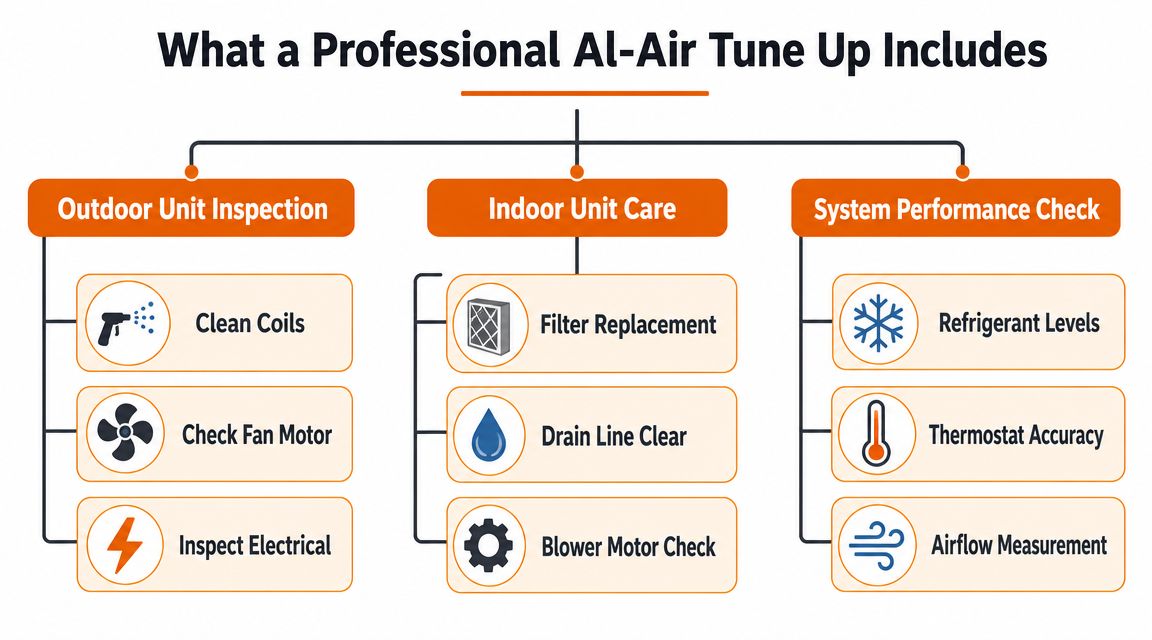
For a quick refresher before service, it helps to know the main parts of a central AC unit. Once you understand what the condenser, evaporator coil, blower, drain system, and electrical components do, the value of each test is easier to see.
Electrical checks that matter in Florida
Heat, moisture, and power fluctuations are rough on AC electrical parts. In Central Florida, we see weak capacitors, pitted contactors, loose connections, and heat-damaged wires long before a homeowner sees a complete breakdown.
A proper tune-up includes electrical testing, not just a look inside the panel. Bryant notes that refrigerant charge should be verified with pressure and temperature readings, and that capacitor and motor testing are part of proper service, as explained in Bryant's HVAC tune-up overview.
That inspection usually covers:
- Capacitors: Weak readings can lead to hard starts, delayed starts, or compressor stress.
- Contactors and wiring connections: Burned or loose connections create heat and cause intermittent operation.
- Voltage and amperage checks: These help spot motors that are working harder than they should.
- Thermostat and control operation: Bad calls from the control side can make a good system act unreliable.
On some visits, these checks also uncover a house wiring problem rather than an HVAC problem. That matters, especially in older homes where panel issues or breaker problems can mimic AC trouble.
Mechanical wear shows up before failure
Motors, fan blades, mounts, and moving parts rarely fail without warning. More often, they get noisier, run hotter, or start to vibrate under load. A homeowner notices longer cycles or weaker airflow, but the source is hidden inside the equipment.
A tune-up looks for wear in places that take a beating through a Florida cooling season:
- Blower components: Dirt buildup on the blower can cut airflow and reduce moisture removal.
- Condenser fan operation: Weak outdoor fan performance raises system pressure and adds strain.
- Motor condition: Bearings and windings can degrade while the system still appears to run normally.
- Mounts and vibration points: Loose hardware gets worse fast when the unit runs day after day.
Near the coast, salt exposure adds another layer. Corrosion slowly eats away at hardware, terminals, and exposed metal. The unit may still cool, but parts age faster and electrical reliability drops.
Airflow, coils, and drainage deserve close attention
Humidity control depends on airflow and clean heat-transfer surfaces. If either side of that equation is off, the house can feel sticky even while the thermostat reading looks fine.
That is why we spend time on the indoor coil, outdoor coil, blower condition, filter condition, and condensate drain. In Florida, a partially clogged drain line or an airflow restriction is not a small housekeeping issue. It can lead to water backup, float switch trips, microbial growth around the air handler, and poor dehumidification.
Here's what we look for most often:
- Dirty condenser coils: The system struggles to reject heat outdoors.
- Dirty evaporator coils: Cooling and moisture removal both suffer.
- Restricted airflow: Rooms stay uneven, and the system runs longer than it should.
- Slow or clogged drain lines: Water backs up and can shut the system down.
If the AC cools but the home still feels damp, that is a warning sign. In our climate, comfort depends on moisture removal just as much as temperature.
Refrigerant verification is based on readings, not guesswork
Refrigerant should never be added because the air "feels" a little warm. Proper service means checking pressures, temperatures, and system performance against manufacturer targets, then figuring out why the readings are off.
In practice, that means the technician:
- Checks system pressures and temperatures.
- Compares those readings to equipment specifications.
- Confirms whether the system is transferring heat correctly.
- Determines whether the issue comes from charge, airflow, or another fault.
That process matters because low airflow, dirty coils, and charge problems can look similar from the outside. The system may still be producing cool air, but it can be wasting energy, struggling to control humidity, or putting extra stress on the compressor.
That is the difference between a quick once-over and a tune-up that prepares an AC system for a Florida summer.
The Real Benefits of Regular AC Tune Ups in Florida
A lot of Florida AC systems do not fail all at once. They lose ground little by little. The house starts feeling clammy by midafternoon. The unit runs longer after a rainstorm. Salt near the coast starts eating at connections outside. By the time summer settles in, a system that seemed "fine" in spring is working too hard.

That is why regular tune-ups matter here more than they do in milder climates. In Central Florida, AC equipment deals with high humidity, long cooling seasons, heavy runtime, and in some areas, corrosive salt air. A generic checklist may catch the obvious. A Florida-focused tune-up looks for the wear patterns that show up after months of pulling moisture out of the air and running day after day.
Lower utility bills come from correcting hidden losses
An AC can still cool the house and waste power at the same time.
Dirty coils, weak capacitors, airflow restrictions, and off-spec operation all make the equipment run longer than it should. In a dry climate, you might notice that mostly as higher energy use. In Florida, you usually feel it two ways. The thermostat takes longer to satisfy, and the house stays cool but damp.
Tune-ups help by correcting the small problems that add load:
- Cleaner heat transfer surfaces: The system can move heat out more efficiently.
- Better airflow: The coil can remove heat and moisture without getting dragged down by restriction.
- Healthier electrical components: Motors and compressors start and run with less stress.
- Performance checks based on readings: Problems get diagnosed correctly instead of guessed at.
For homeowners trying to plan maintenance around Florida's long cooling season, this guide on how often AC should be serviced gives a useful schedule.
Better moisture control is a comfort issue and a system issue
In this climate, good cooling without good dehumidification is only half a result.
When indoor airflow is off, the evaporator coil is dirty, or the system is short cycling, moisture removal drops. Homeowners usually notice the symptoms before they know the cause. Sticky rooms. Musty smell around supply vents. Lower thermostat settings that still do not make the house feel right.
I see that a lot in Florida homes. People assume the thermostat is the problem, but the underlying issue is often poor latent performance. The AC is lowering temperature without pulling enough moisture out of the air.
Here's a quick visual on what maintenance supports in day-to-day comfort:
Fewer peak-season breakdowns, especially in brutal humidity
The toughest service calls usually land during the hottest, wettest stretch of summer, after the unit has been running almost nonstop for days. That is when weak blower motors, clogged drains, pitted contactors, and stressed capacitors finally give out.
A tune-up does not promise zero breakdowns. Good service is about reducing avoidable failures. In Florida, that includes checking the parts and conditions that suffer most from constant runtime and moisture exposure. Near the coast, salt air adds another layer of trouble because corrosion can damage terminals and outdoor components long before the average homeowner sees anything wrong.
That kind of prevention matters because compressor strain, poor drainage, and electrical wear rarely stay small for long. Regular maintenance gives the system a better chance of making it through summer without an emergency call and can help delay major replacement.
Home maintenance works the same way in other parts of the house. Services like South Mountain Window Cleaning exist for the same basic reason. Equipment lasts longer and performs better when buildup and wear are handled before they turn into expensive problems.
Understanding AC Tune Up Costs in the Orlando Area
A lot of Orlando homeowners ask about price after the first long stretch of ninety-degree days, when the system is already running hard and the house starts feeling sticky by midafternoon. By then, a cheap tune-up that skips real testing can cost more than it saves.
Angi explains in its article on the importance of annual AC tune-ups that tune-up pricing is usually far lower than replacing a full AC system. That is the basic financial case for maintenance. Catch smaller issues early, and there is a better chance of avoiding a major repair or an early replacement.
Why tune-up prices vary around Orlando
In Central Florida, price often comes down to time and scope.
A low advertised special may cover a quick look, a filter check, and a rinse on the outdoor unit. A higher-priced visit usually means the technician is spending enough time to inspect the parts that fail in our climate. That includes drain problems caused by heavy condensate, coil buildup that gets worse in high humidity, electrical wear from long run times, and corrosion on outdoor components, especially in salt-air areas closer to the coast.
A few things usually affect the final cost:
- System type: Heat pumps, straight cool systems, older equipment, and variable-speed units do not all take the same amount of testing.
- Access: Tight attic air handlers, hard-to-reach closets, and blocked condensers add labor.
- System condition: A neglected unit with matted coils, a dirty blower, or a slow drain line takes longer to service properly.
- Number of systems: Each unit needs its own inspection and operating checks.
What cheap service often leaves out
The key question is not just price. It is what the technician is checking.
In Florida, a tune-up has to account for moisture and runtime. If nobody verifies drain performance, checks electrical components under load, inspects for corrosion, measures system operation, and looks at airflow, the visit may do very little to reduce summer trouble calls. The system might still cool that day, but hidden wear keeps building.
Homeowners see the same pattern with other equipment around the house. South Mountain Window Cleaning shows a similar point with solar panel cleaning costs. The price makes more sense once you look at access, condition, and how much real work is included.
One-time tune-up or ongoing maintenance
For some homes, a single tune-up is enough to get through the season. For others, especially older systems or units that run nearly all year, regular service is the smarter budget choice because it keeps maintenance from getting skipped.
If you want to handle the basic homeowner tasks between visits, this guide on house air conditioner maintenance is a good place to start. It covers the upkeep that helps, while leaving the electrical, refrigerant, and performance checks to a technician.
If the system is older, cost planning should include more than the tune-up itself. A unit near the end of its service life may still be worth maintaining, but it also makes sense to compare repair history, current condition, and longer-term HVAC financing solutions before putting more money into it.
DIY AC Maintenance vs a Professional Tune Up
Homeowners should absolutely do some AC maintenance themselves. In fact, some of the best efficiency gains come from simple upkeep. The Department of Energy notes that routinely replacing a dirty air filter can lower an air conditioner's energy use by 5% to 15% on its own, as discussed in Carrier's page on AC tune-up service and maintenance.
That said, DIY care has limits. It helps with cleanliness and airflow. It does not replace electrical diagnostics, refrigerant verification, or deeper component inspection.
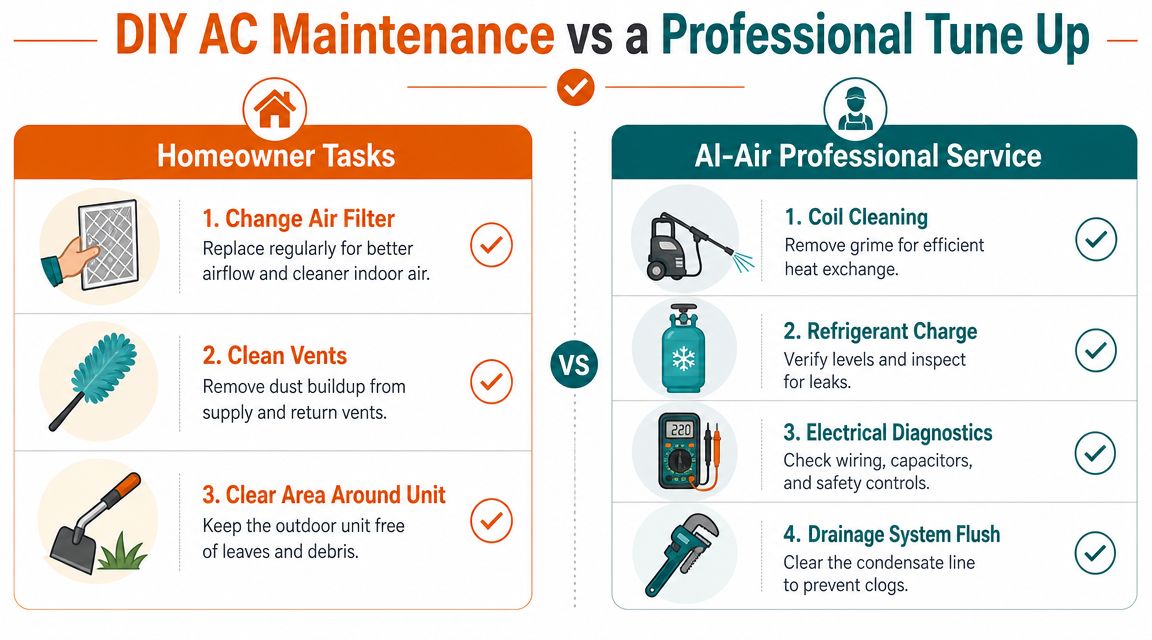
For a homeowner-focused checklist, this guide to house air conditioner maintenance is a good companion to professional service.
What you can handle safely
Some tasks are low risk and worth doing regularly, especially in a Florida yard where pollen, clippings, and storm debris build up fast.
- Change the filter: Check it regularly and replace it when dirty.
- Keep the outdoor unit clear: Remove leaves, weeds, and debris around the condenser.
- Gently rinse outdoor buildup: Lightly wash dirt from the coil surface when appropriate.
- Check supply vents and return grilles: Make sure furniture, rugs, or dust aren't choking airflow.
- Watch for warning signs: Water near the air handler, weak airflow, odd noises, or short cycling all deserve attention.
These steps support system performance and help the professional visit go more smoothly.
What should stay in professional hands
Once a task involves electricity, refrigerant, disassembly of key components, or system performance measurement, it's no longer a casual DIY project.
A technician is equipped to handle work such as:
- Testing capacitors and contactors
- Checking voltage and motor draw
- Inspecting and cleaning the indoor evaporator coil
- Measuring refrigerant conditions
- Verifying temperature split and system operation
- Clearing and evaluating the condensate system thoroughly
The reason isn't just convenience. It's safety and accuracy. A homeowner can accidentally damage equipment, misdiagnose the issue, or create a more expensive repair.
A unit that turns on is not automatically a healthy unit. The risky problems are often the ones hidden behind the panel or buried in the operating readings.
DIY vs. Professional AC Tune-Up Tasks
| Task | DIY Homeowner | Professional Technician |
|---|---|---|
| Replace air filter | Yes | Yes |
| Clear debris around outdoor unit | Yes | Yes |
| Clean visible vent covers | Yes | Yes |
| Flush or evaluate condensate drainage fully | Limited | Yes |
| Inspect indoor evaporator coil condition | No | Yes |
| Test capacitor and contactor health | No | Yes |
| Verify refrigerant charge with proper readings | No | Yes |
| Measure system performance against specifications | No | Yes |
A simple way to decide
Use this rule of thumb:
- If it's basic cleaning, filter care, or keeping airflow paths open, most homeowners can do it.
- If it involves electrical parts, refrigerant, internal coils, or performance testing, call a licensed professional.
- If the system is already showing symptoms, skip trial-and-error and get it diagnosed properly.
That approach saves time, avoids damage, and keeps your DIY effort focused where it provides tangible benefits.
The Al-Air Tune Up Experience From Start to Finish
It is late May in Central Florida. The AC has been running hard all week, the house feels a little sticky by afternoon, and now you want to know one thing before summer settles in for good. Is the system ready?
That is what a tune-up visit should answer.

Before the work starts
The visit starts with access and a quick conversation. We need to see both the indoor and outdoor equipment, because Florida AC problems rarely stay in one place. A drain issue at the air handler, a salt-worn contactor outside, or a blower struggling with coil buildup can all show up as the same complaint from the living room. Weak cooling. Long run times. High indoor humidity.
That first homeowner feedback matters. If the system has been shutting off on float switch, taking longer to pull humidity out of the house, or making a rough startup sound, those clues help us focus fast.
During the tune-up
A proper tune-up in this climate is not just a quick rinse and a filter check. Central Florida systems run long hours, move a lot of moisture, and work through months of heat with very little downtime. Near the coast, salt in the air adds another wear point that a generic checklist can miss.
So the visit is built around the failure points we see all the time here:
- Condensate trouble: slime, sludge, partial clogs, and signs the drain may back up during heavy summer use
- Humidity-related airflow loss: dirt on the blower wheel, coil film, and restrictions that keep the system from pulling moisture out of the air well
- Electrical wear from constant cycling: weak capacitors, pitted contactors, loose or heat-stressed connections
- Outdoor corrosion: rust and salt-air damage on terminals, cabinet components, and exposed electrical parts
- Performance drift: readings that show the system is still cooling, but not doing it efficiently or safely under Florida load
That last part is where experience matters. A unit can still produce cool air and be heading toward a July breakdown. I see that a lot with systems that are just barely keeping up, especially in homes with older ductwork, high indoor humidity, or outdoor equipment exposed to coastal conditions.
After the inspection
At the end of the call, the goal is simple. You should know what condition the system is in, what we corrected today, and what deserves attention before peak summer.
That summary usually covers:
- What was cleaned, cleared, or adjusted
- What looked normal during operation
- What parts are showing age or wear
- What should be repaired soon versus watched over time
Good service should also be honest about problems that are not strictly an AC issue. Some comfort complaints come from power supply problems, aging panels, or wiring faults that affect how the equipment starts and runs. In those cases, homeowners may need related services such as electrical panel upgrades, electrical service work, or even home rewiring in older properties. If you are updating the home at the same time, projects like lighting installation can also be coordinated cleanly.
The value of the visit is clarity. You leave knowing whether your system is in good shape for summer, where Florida humidity is already taking a toll, and what is worth fixing now before a long hot stretch turns a small issue into a no-cooling call.
Frequently Asked AC Tune Up Questions
When is the best time to schedule an ac tune up in Central Florida
Schedule it before summer runtime gets relentless. In Central Florida, that usually means early spring, before the first long stretch of 90-degree days and heavy afternoon humidity.
If you wait until the first real heat wave, service calendars fill fast. Systems that looked fine in mild weather also start showing the problems Florida exposes quickly. Weak capacitors struggle on hot afternoons, marginal drain lines back up once humidity spikes, and dirty outdoor coils lose efficiency faster when the unit is running almost nonstop.
Twice-yearly service can make sense for older equipment, coastal homes, rentals, and houses with a history of high indoor humidity or drain issues.
Is a tune-up still worth it if my AC is cooling fine
Usually, yes.
A Florida system can still blow cold air while losing capacity, pulling more power, or building up the kind of moisture problem that turns into a clog or ceiling stain later. Near the coast, I also see systems cool normally while salt air is already eating at coil fins, electrical connections, and cabinet metal.
Cooling is only part of the story. A tune-up checks how the system is handling heat, humidity, airflow, drainage, and electrical load under real operating conditions.
What's the difference between an ac tune up and an AC repair visit
A tune-up is scheduled maintenance. A repair visit is for a system that is already showing a fault.
If the unit is not cooling, freezing up, leaking water, tripping a breaker, short cycling, or making harsh new noises, it needs diagnosis and repair work. Maintenance may still be part of the solution later, but the first job is finding the failed part or operating problem.
My system is newer. Do I still need maintenance
Yes. New equipment does not get a pass from Florida weather.
High humidity keeps drain systems busy for months. Heavy use puts steady wear on capacitors, contactors, blower components, and condenser motors. If the home is near the coast, salt exposure can start causing corrosion much earlier than many homeowners expect.
A newer system should be maintained so it stays within proper operating range and so small issues are caught before they shorten equipment life.
Can a tune-up help with musty smells inside the house
It can, if the smell is tied to moisture.
Musty odors often point to condensate drainage trouble, microbial buildup around the coil area, poor airflow, or indoor humidity that is staying too high between cooling cycles. A tune-up can uncover those issues and show whether the smell is coming from the equipment itself or from the duct system. If the problem is deeper in the ductwork, you may also need air duct cleaning.
Will a tune-up solve every efficiency problem
No. It helps with losses caused by dirt, restricted airflow, weak electrical components, drainage problems, and control issues. Those are common in Florida, and they are worth correcting.
It will not fix bad duct design, major air leakage, poor insulation, an oversized or undersized system, or equipment that is worn out. In some homes, maintenance restores a noticeable amount of performance. In others, it confirms that repair or AC replacement options make more financial sense.
What should I do before the technician arrives
Clear a path to the thermostat, air handler, and outdoor unit. If the filter is badly clogged and you have the right replacement, change it.
Then make a quick list of anything you have noticed. Rooms staying sticky, longer run times, water around the unit, a musty smell after the AC starts, rattling outside, or a breaker that has tripped before are all worth mentioning. Those details help narrow down Florida-specific trouble spots fast.
If your AC is heading into another Central Florida summer, don't wait for the first breakdown to find out what condition it's really in. Schedule preventive service with Al-Air Corporation, call (407) 506-5957, or book online at Al-Air's scheduling page.