
Your AC usually doesn’t quit on a mild day. It struggles when Orlando or Tampa is already hot, the house feels sticky, and you notice the thermostat dropping slower than usual. The air is running, but comfort isn’t showing up.
That’s why house air conditioner maintenance matters so much in Florida. Our systems don’t get a long off-season to recover. They deal with heat, humidity, pollen, yard debris, and long run times that expose every weak filter, dirty coil, and clogged drain line.
Why Proactive AC Maintenance is Non-Negotiable in Florida
On a Florida afternoon, an AC rarely gets to coast. It starts early, runs hard, and keeps going. If the filter is loaded up, the coil is dirty, or the drain line is starting to slime over, the system has to fight through problems that were easy to prevent a month earlier.

The biggest mistake I see from homeowners is treating maintenance like an optional add-on instead of normal ownership. Regular professional HVAC maintenance extends the lifespan of residential air conditioners by about 40%, and only 43% of Americans schedule yearly maintenance on their central AC units, according to air conditioning statistics summarized from DOE and industry data. In Florida, where southern households run AC all summer long, that gap matters.
Florida wear shows up fast
A system in this climate doesn’t just collect dust. It deals with:
- Humidity exposure that keeps drain systems wet and encourages buildup
- Pollen and fine debris that plug filters and coat outdoor equipment
- Long cooling cycles that magnify small airflow problems
- Salt air in some areas that can be rough on metal components
Those issues don’t stay isolated. One clogged filter can reduce airflow. Low airflow can affect coil temperature. That can lead to comfort complaints, icing, or strain on motors and compressors.
Practical rule: In Florida, a small maintenance problem rarely stays small for long.
Maintenance beats emergency mode
Homeowners usually call when they notice one of three things. Weak airflow, rising indoor humidity, or a system that runs too long. By that point, the unit has often been working harder than it should for weeks.
Proactive service changes that pattern. A real maintenance visit catches dirt buildup, drainage problems, loose electrical connections, and airflow restrictions before they turn into a no-cooling call on a weekend. For landlords and sellers, it also helps avoid the bad timing of a problem showing up during a tenant turnover or a home inspection.
House air conditioner maintenance isn’t glamorous. But in Florida, it’s one of the few routine tasks that protects comfort, efficiency, and equipment life all at once.
Your Year-Round House Air Conditioner Maintenance Schedule
A Florida AC schedule shouldn’t look like a generic “check it in spring” list. Here, the system runs through long cooling stretches and still has to manage humidity even when outdoor temperatures ease up. The best schedule is simple enough to follow and strict enough to prevent surprises.
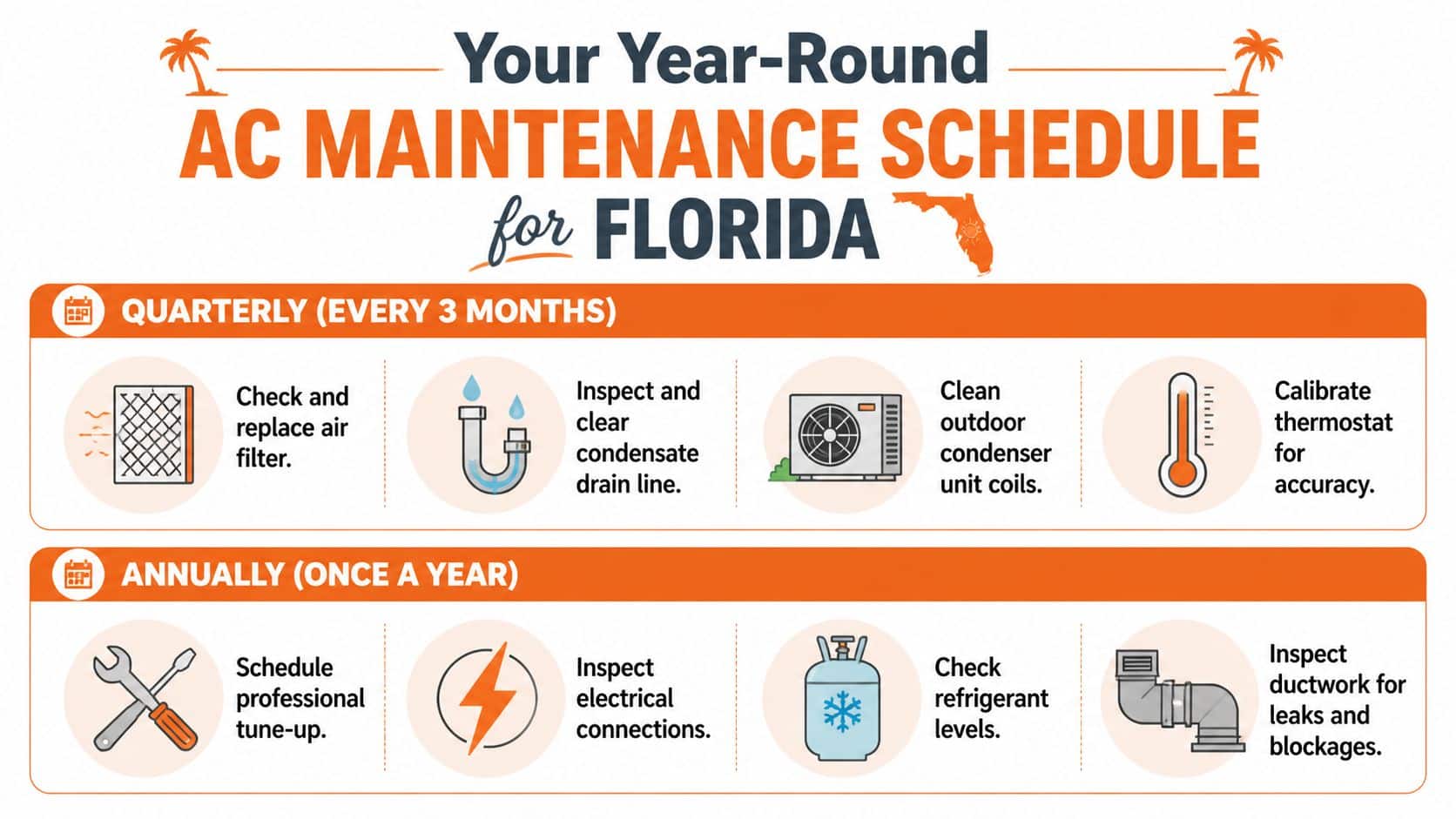
What to handle through the year
Some jobs are quick homeowner tasks. Others need gauges, meters, cleaning products, or access to components that shouldn’t be guessed at.
In Florida’s 70-90% summer humidity, condensate drain lines can clog rapidly with algae and mold. Standard guidance often says annual clearing, but high-humidity areas like Poinciana or Tampa can need quarterly flushing to help prevent overflows and protect indoor air quality, as noted in this Florida AC drain line maintenance discussion.
Florida AC Maintenance Checklist & Schedule 2026
| Task | Frequency | Recommended For | Notes |
|---|---|---|---|
| Check and replace air filter | Every 30 to 90 days | DIY | Homes with pets, dust, or heavy runtime usually need the shorter end of that window. |
| Inspect thermostat settings and response | Monthly | DIY | Make sure cooling mode, schedule, and temperature readings still make sense for the season. |
| Keep supply and return vents open and clear | Monthly | DIY | Furniture, rugs, and dust buildup can reduce airflow through the house. |
| Clear leaves, grass, and debris around outdoor condenser | Monthly | DIY | Keep the unit unobstructed so it can reject heat properly. |
| Flush or inspect condensate drain line | Quarterly | DIY or Pro | Florida humidity makes this more important than many national checklists suggest. |
| Rinse accessible condenser coil surface gently | Quarterly | DIY with caution | Light surface cleaning is fine. Deep coil cleaning is a pro job. |
| Inspect visible insulation on refrigerant line | Quarterly | DIY | If it’s deteriorated, have it replaced so the system doesn’t pick up extra heat. |
| Professional tune-up | Annually | Pro | Best scheduled before the hottest stretch, or sooner if the system is already showing symptoms. |
| Check refrigerant charge and system performance | Annually or as needed | Pro | This is diagnostic work, not a DIY adjustment. |
| Inspect electrical connections and controls | Annually | Pro | Loose or worn electrical components can create intermittent shutdowns and safety risks. |
| Inspect ductwork for leakage or restrictions | Annually or when comfort issues show up | Pro | Uneven rooms and long run times often trace back to airflow issues, not thermostat settings alone. |
A practical seasonal rhythm
I recommend thinking in quarters instead of waiting for one big annual reminder.
- Early spring: Replace the filter, test the thermostat, clear the outdoor unit, and schedule your tune-up before peak demand.
- Mid-summer: Check the filter again, watch the drain line closely, and make sure the outdoor unit isn’t buried in grass clippings or mulch.
- Early fall: Inspect airflow room by room. If the system cooled poorly through summer, don’t ignore it just because temperatures dipped.
- Winter in Florida: You may still use cooling and dehumidification often. Keep filter changes and drain checks on schedule.
If your AC runs most of the year, your maintenance routine should too.
DIY versus pro work
A good rule is simple. If the task involves electrical components, refrigerant, sealed panels, performance measurements, or deep coil cleaning, leave it to a trained technician. Homeowners can do a lot to keep a system healthy, but guessing with HVAC usually creates more expensive problems than the one you started with.
Mastering Essential DIY AC Maintenance Tasks Safely
The most useful DIY work is basic, repeatable, and low risk. You’re not trying to become a technician. You’re trying to keep airflow clean, drainage moving, and the outdoor unit free of the kind of debris that makes it labor.

Always turn off power at the breaker box before opening panels or reaching into any part of the system.
Change the filter the right way
Filter changes are the center of good house air conditioner maintenance. A neglected air conditioner can drive up energy consumption by 20-30%, and properly maintained HVAC units can operate up to 20% more efficiently, according to this HVAC maintenance statistics summary citing DOE and ENERGY STAR.
Most homes should check the filter often and replace it every 30 to 90 days. Don’t just slide in the cheapest one or the densest one without checking fit and system needs. The filter should match the air handler size, point in the correct airflow direction, and seat tightly so air doesn’t bypass it.
A few practical notes matter here:
- Pleated filters usually catch more dust than flat fiberglass filters.
- Higher MERV isn’t always better if the system isn’t designed for the added resistance.
- A dirty return grille can make a new filter less effective.
If you’d like to understand how the filter, coil, blower, and condenser all work together, this guide to the parts of a central AC unit helps homeowners see what’s inside the system they’re maintaining.
Keep the outdoor unit clean without damaging it
The condenser needs open space and clean fins to dump heat outdoors. If shrubs, weeds, palm debris, or dryer lint build up around it, cooling performance drops.
Start with the easiest wins:
- Shut off power to the outdoor unit.
- Remove loose debris by hand around the base.
- Trim plants back so the unit has breathing room.
- Use a garden hose gently on the exterior coil surface if it’s visibly dusty.
What doesn’t work is aggressive cleaning. Don’t use a pressure washer. Don’t jab a screwdriver into the fins. Don’t lean yard tools against the cabinet. The aluminum fins bend easily, and once airflow gets restricted, the condenser can’t do its job well.
Watch the drain line in humid weather
Florida systems remove a lot of moisture. That means the condensate drain line isn’t a side issue. It’s part of normal operation. If the line slows down, water can back up into the secondary pan, trigger a float switch, or leak where you don’t want it.
Look for these homeowner-level warning signs:
- Water near the indoor unit
- Musty smell near the air handler
- Cooling interruptions with no obvious thermostat issue
- Visible slime at the drain outlet
A visual walkthrough can help if you like learning by example:
Know where DIY should stop
You can replace a filter, clear space around the condenser, and monitor drainage. You should not open sealed refrigerant components, test live electrical parts, or force coil cleaning if access is tight.
Homeowner maintenance works best when it supports the system, not when it turns into exploratory surgery.
That line saves a lot of service calls that begin with, “I only took one panel off.”
When to Call Al-Air for Professional HVAC Service
Some AC issues look simple from the outside and aren’t simple at all. Weak airflow might be a dirty coil, a failing blower component, a duct restriction, or an evaporator starting to freeze. Warm air could be thermostat setup, but it could also be low refrigerant, a bad capacitor, or a condenser that isn’t moving heat.

What a real professional tune-up includes
Professional maintenance isn’t just spraying off the outside unit and calling it done. Coil cleaning alone shows why training matters. Even 1/16th inch of dirt can reduce system efficiency by 10%, and a proper technician uses low-pressure sprayers and checks post-clean delta-T in the 15-20°F range to verify performance, restoring up to 95% of original efficiency, based on DOE air conditioner maintenance guidance.
That process matters because both coils are delicate. The indoor evaporator coil often needs careful chemical cleaning and attention to drainage. The outdoor condenser coil needs the correct cleaner, the right rinse direction, and a gentle touch around fins and wiring.
A proper service visit may also include:
- Electrical inspection of contactors, capacitors, wire connections, and disconnects
- Airflow checks at the filter, blower, and duct system
- Refrigerant diagnostics if performance points to charge or leak issues
- Drain system inspection for clogs, algae growth, or safety switch problems
Red flags that mean stop troubleshooting and call
Homeowners can do basic checks. But some symptoms should move straight to a service call.
- Buzzing, humming, or clicking that’s new: Could be electrical or motor-related.
- Airflow got weak across the whole house: That usually isn’t one closed vent.
- The system cools, then stops, then starts again strangely: Cycling problems can point to controls or protection devices.
- Water is showing up near the air handler: In Florida, drain trouble doesn’t wait politely.
- The utility bill jumped without a clear reason: Equipment strain often shows up there first.
- Ice is visible on refrigerant lines or indoor components: Shut it down and get it diagnosed.
Why this isn’t a guessing game
A trained technician has gauges, meters, coil cleaners, static pressure tools, and the experience to tell the difference between a symptom and the actual failure. That’s the value of bringing in a local service company for work that goes beyond filters and yard cleanup. Al-Air Corporation handles residential HVAC maintenance, diagnostics, repairs, and replacements for homeowners in Greater Orlando and nearby service areas, including Clermont, Kissimmee, and Tampa-area communities.
If the fix requires measurements instead of observation, it’s time for professional HVAC service.
Smart Strategies to Lower Your Cooling Costs
Lower cooling bills usually don’t come from one magic change. They come from reducing the system’s workload and making sure the cooling you pay for reaches the rooms you live in.
Start with airflow and humidity control
A clean, maintained system runs more efficiently, but comfort in Florida also depends on moisture removal. If the house feels clammy, many homeowners push the thermostat lower when the actual problem is poor humidity control, airflow, or leakage.
That’s why it helps to understand whether and how air conditioners remove humidity. Once you know what normal moisture removal looks like, it gets easier to spot when the system is cooling the thermostat but not drying the house well.
Cut waste outside the equipment cabinet
One expensive mistake is focusing only on the unit and ignoring the house around it. Duct leaks alone can waste up to 30% of conditioned air, according to the earlier DOE and ENERGY STAR summary already cited. If cool air is escaping into attics, garages, or wall cavities, the AC has to run longer just to keep up.
A few practical ways to lower cost without overcomplicating things:
- Seal obvious air leaks around doors, windows, and attic penetrations.
- Keep interior doors positioned for good airflow if your home’s layout tends to trap return air.
- Use ceiling fans so you feel comfortable at a less aggressive thermostat setting.
- Avoid heat gain from blinds left open on sunny windows during the hottest parts of the day.
Use maintenance thinking from larger buildings
Good building operators think in terms of load, airflow, runtime, and preventable loss. Homeowners can use the same mindset on a smaller scale. If you’re curious how that preventive approach is applied at a larger level, these commercial building HVAC maintenance strategies are useful for seeing how consistent inspection and scheduled service reduce avoidable strain.
That same logic works at home. Don’t wait for a failure to tell you the system needed attention. Pay attention to runtime, humidity, room balance, and filter condition before costs creep up.
Thermostat habits that actually help
A thermostat schedule should match when the house is occupied, not chase the outdoor weather all day. Setbacks can help, but extreme swings often force long recovery cycles that aren’t comfortable in humid climates.
The smarter move is steady, realistic settings plus good maintenance. In Florida, lower cost usually comes from smoother operation, cleaner airflow, and less wasted cooling, not from dramatic thermostat games.
A Homeowner's Guide to Troubleshooting Common AC Issues
When the AC acts up, start with the simple checks that don’t put you in contact with electrical parts or sealed components. A lot of no-cooling calls begin with a thermostat issue, a tripped breaker, or a filter so dirty the system can barely move air.
AC won’t turn on
Check the thermostat first. Make sure it’s set to cool, the setpoint is below room temperature, and the batteries aren’t dead if your model uses them.
Then look at the breaker panel. If a breaker has tripped, reset it once only after giving the system a moment. If it trips again, stop there. Repeated tripping points to an electrical or mechanical problem that needs proper diagnosis.
Use this quick checklist:
- Thermostat mode: Confirm it’s in cooling mode, not fan-only or heat.
- Power at the panel: A tripped breaker can stop either the indoor or outdoor unit.
- Float switch trip: If the drain line backed up, some systems shut down to prevent water damage.
AC is blowing warm air
Warm air doesn’t automatically mean the unit is dead. Sometimes the outdoor disconnect is off, the filter is badly clogged, or the thermostat fan is set to “on” instead of “auto,” which can circulate air even when cooling isn’t active.
Walk through the basics:
- Replace or inspect the filter if airflow has been weak.
- Check the outdoor unit to see whether it’s running while the thermostat calls for cooling.
- Look for ice or water around the indoor equipment.
- Make sure supply vents are open and not blocked by furniture.
If those checks don’t solve it, use this more detailed air conditioner troubleshooting guide to narrow down the next step before scheduling service.
AC is making a strange noise
Noise matters because it often tells you what kind of problem is forming. Rattling can point to loose panels or debris. Buzzing can be electrical. Squealing may involve a motor or moving part. Banging is never a “wait and see” sound.
Shut the system off if a new noise is sharp, loud, or paired with burning smell, poor airflow, or short cycling.
Some rooms are cold and others aren’t
That usually means airflow imbalance, blocked returns, dirty filters, duct leakage, or a system that needs a more complete performance check. Don’t keep lowering the thermostat trying to force one problem room into shape. That often overcools the rest of the house and increases runtime without fixing distribution.
Water around the unit
Treat this as urgent even if the cooling still works. In Florida homes, drain problems can turn into ceiling stains, floor damage, or biological growth if they’re left alone. If you see standing water, shut the system off and inspect the drain setup only if it’s safely accessible.
If these simple checks don’t resolve the problem, it’s time to call the experts at Al-Air for a professional diagnosis to prevent further damage.
If your house air conditioner maintenance has slipped, or your system is already showing signs of strain, schedule service with Al-Air Corporation. We help homeowners across Greater Orlando and nearby communities with AC maintenance, diagnostics, repairs, and replacement planning so the system stays safe, efficient, and ready for Florida weather.
Stay ahead of Florida’s heat with a professional maintenance visit. Al-Air Corporation offers comprehensive AC maintenance plans designed for Central Florida’s year-round climate. Schedule a tune-up, call (407) 506-5957, or book your service online. Issues found during maintenance? Our team handles AC repair on the spot.