
Your air conditioner usually fades into the background. Then one hot Florida afternoon, it stops. The house gets quiet. The vents go still. A few minutes later, you can feel the temperature rising and your stress rising with it.
When that happens, many homeowners jump straight to the worst conclusion. Bad compressor. Dead condenser. Full system replacement. Sometimes the problem is much smaller than that. One possible culprit is the ac fuse box, a part rarely considered until the system loses power.
This guide is for that exact moment. Not to turn you into an electrician, but to help you understand what you’re looking at, what you can safely check, and when to stop and call a licensed pro.
The Silence of a Summer Afternoon
It’s the middle of summer in Central Florida. The AC has been running hard all day, doing what it always does. Then the outdoor unit goes silent.
Inside, the thermostat is still on. Maybe the indoor fan runs. Maybe nothing happens at all. You step outside and look at the condenser. Next to it is a small gray metal box on the wall. Most homeowners have seen it before without really noticing it.
That little box matters more than it looks.

On a service call, I often meet homeowners standing right there, wondering if that box is just a shutoff switch or if it controls whether the AC can run. The answer is yes, it can be a key part of the problem.
Why this small box gets overlooked
Your main electrical panel gets all the attention because it powers the whole house. The ac fuse box feels secondary.
But for the air conditioner, it is a front-line safety device. If something goes wrong electrically, that fuse is designed to fail first so more expensive parts do not.
What homeowners usually get wrong
A lot of people assume a blown fuse is random, like a burned-out light bulb. It usually is not. A fuse often blows because it is doing its job in response to another problem.
Tip: If your AC suddenly stops on a hot day, think of the fuse box as one possible checkpoint, not an automatic DIY repair.
The goal is simple. Stay safe, narrow the problem, and avoid making a bad situation worse.
What Is an AC Fuse Box and Why Does It Matter
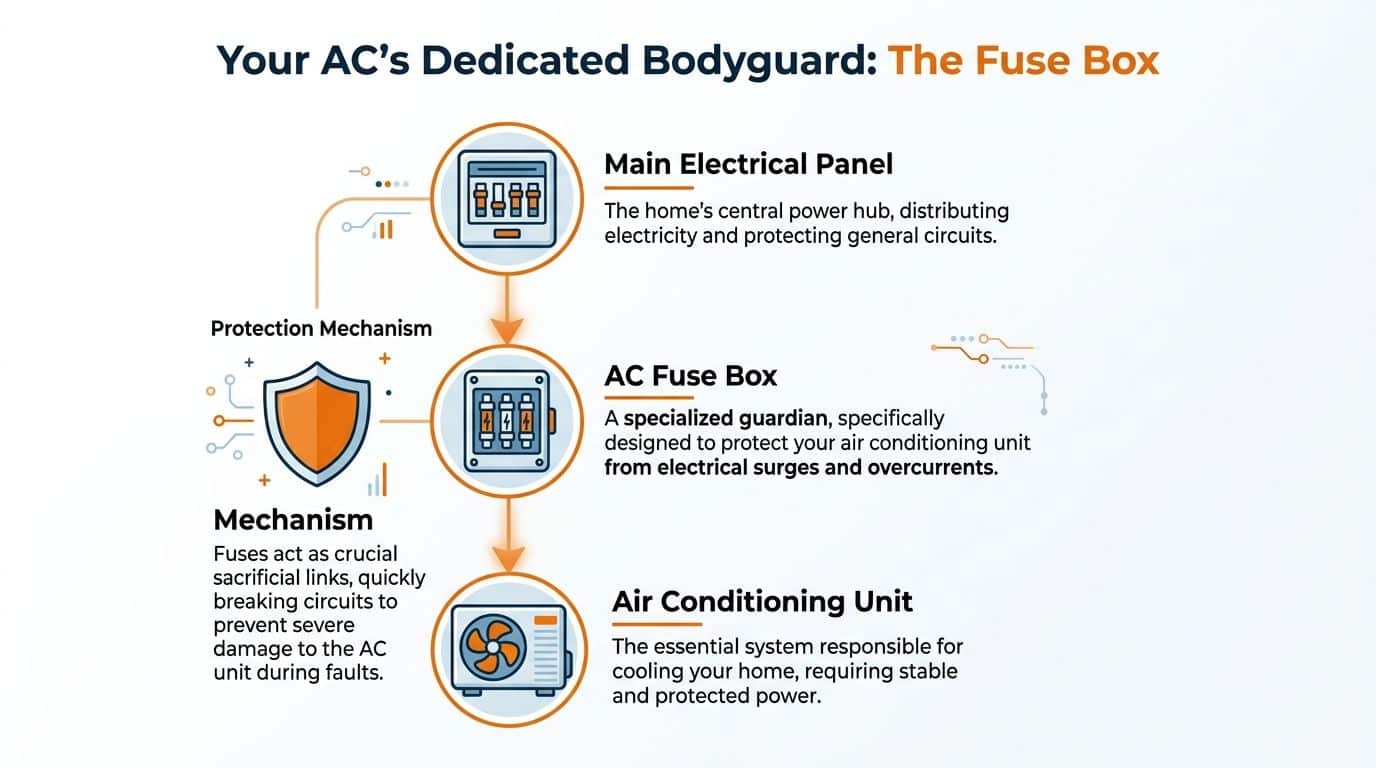
An ac fuse box is a dedicated disconnect and protection point for your outdoor air conditioner. It usually sits on the wall near the condenser. Power flows from the utility to your main electrical panel, then out to this smaller box, and then into the AC equipment.
Think of it as the AC’s dedicated bodyguard.
Your main panel protects the whole house. The AC fuse box protects one expensive machine that starts under heavy load and works hard in Florida weather. In residential HVAC systems, the AC fuse box protects air conditioning circuits from overcurrent, and fuses are typically rated at 15 to 30 amps for standard 3 to 5 ton units common in Greater Orlando homes. Florida heat and humidity can also push electrical demand up by 20 to 30% during peak summer conditions, which is one reason this protection matters so much, according to Lawson Fuses.
What the fuse does
A fuse is a sacrificial link. If current rises too high, the fuse opens the circuit. That stops power before wires or equipment take the hit.
That’s the part many people miss. The fuse is not a nuisance. It is the part that gives itself up to protect the condenser, wiring, and connected components.
Why it is different from the main panel
Confusion often starts here.
Your main electrical panel is the home’s central distribution point. It feeds lights, outlets, appliances, and HVAC circuits. The ac fuse box sits farther downstream and is tied specifically to the cooling equipment.
Here’s the practical difference:
- Main panel: Broad protection for many household circuits.
- AC fuse box: Local protection and shutoff for one high-demand appliance.
- Outdoor location: Built to sit near the condenser so technicians can disconnect power before servicing the unit.
Why Florida homes depend on it
Florida is hard on HVAC systems. Heat, humidity, storms, and outdoor installation conditions all put extra stress on electrical parts.
That means the AC fuse box is not just a technical accessory. It is part of safe operation. If it opens, it may be preventing damage that would cost far more than a pair of fuses.
Key takeaway: The ac fuse box is not the same thing as your household panel. It is a specialized safety device placed close to the outdoor unit because the AC has different electrical demands than most things in your home.
Finding Your Fuse Box and Identifying Fuse Types
If you want to understand your ac fuse box, start with location and appearance. Most homeowners find it in less than a minute once they know what to look for.
Where to look outside
Walk to your outdoor condenser. Look on the wall nearby for a small metal box, usually gray. It is often mounted within sight of the unit.
Open the outer cover only if you are identifying the box and you can do so without touching anything inside. If the cover does not open easily, stop there.
Common signs you found the right box:
- Near the condenser: Usually mounted on the exterior wall beside the outdoor unit.
- Metal enclosure: Often rectangular and weather-resistant.
- Service disconnect style: May have a pull-out handle or internal fuse holders.
What kind of fuses are usually inside
Most residential AC disconnects use cartridge fuses. These are cylindrical, not the little blade fuses you might recognize from a car.
The label on the fuse or disconnect may show the amp and voltage rating. Homeowners often see the numbers but do not know what they mean. The amp rating tells you how much current the fuse is meant to handle before opening. The voltage rating tells you the electrical system it is designed for.
Why AC fuses are not always “regular” fuses
Air conditioners have compressors, and compressors draw a brief surge of current when starting. That startup pulse is different from normal running current.
Just as automotive fuse boxes use time-lag fuses to handle inrush current from blower motors, residential AC units may use specialized fuses that can resist that short, high-energy startup without blowing unnecessarily, as described by Persistence Market Research.
That is why you cannot assume any same-size fuse is interchangeable.
A simple way to think about fuse types
A standard fuse is like a very strict gatekeeper. Current rises too fast, it shuts things down.
A time-delay fuse is more like a gatekeeper who allows a brief crowd at the door because it knows the rush will pass. That makes sense for an AC compressor that needs a hard push to start.
If you want a plain-English primer on different kinds of fuses, that guide does a nice job of showing how fuse designs vary by application.
Tip: Reading the label is useful. Guessing is not. If the writing is faded, the fuse looks mismatched, or you are unsure whether it is time-delay rated, stop before replacing anything.
Symptoms of a Blown Fuse or Failing Fuse Box
When the ac fuse box has a problem, the system does not always go completely dead. Sometimes the symptoms are subtle and misleading.

A homeowner might say, “The thermostat is on, but the outdoor unit won’t kick in.” Another might hear a short hum, then silence. Those details matter.
What a blown fuse can look like
Sometimes the signs are visible without doing any electrical work.
You may notice:
- AC completely unresponsive: Especially if the thermostat calls for cooling and the condenser never starts.
- Starts then stops: The unit tries to engage, then immediately drops out.
- Visible damage: Blackening, cloudiness, or obvious breakage inside a fuse body.
- Heat damage at the disconnect: Melted plastic, discoloration, or charring around holders.
A weak or damaged fuse can fail under load even if it does not look dramatic from the outside.
When the box itself may be failing
The fuse is not always the only issue. The disconnect box can also develop problems from age, corrosion, loose contacts, or moisture.
Listen and look for warning signs:
- Buzzing or humming: This can point to poor contact or arcing.
- Crackling: Never ignore this.
- Rust or water intrusion: Outdoor boxes take abuse in Florida conditions.
- Loose fit or damaged pull-out: Mechanical wear can affect electrical contact.
This quick video helps show the kind of symptoms homeowners often notice first.
What these symptoms usually mean
A single blown fuse might trace back to a one-time fault. Repeated fuse failure usually means the AC is drawing more current than it should, or the disconnect setup is wrong for the equipment.
That is why symptom spotting is useful. It gives you better information for the call, and it helps you avoid the trap of replacing a fuse when the underlying problem is a failing capacitor, motor, compressor, or damaged connection.
Safe Troubleshooting for Common AC Fuse Issues
Homeowners can do a few checks safely. The key word is safely.
You do not need to handle wires, remove energized parts, or test live voltage to gather useful information. In fact, you should not.
Start at the main panel
Before you focus on the outdoor disconnect, check the AC breaker in your main electrical panel.
If the breaker has tripped, reset it once. Push it fully to off, then back to on. If it trips again, leave it alone.
That repeat trip is not bad luck. It is a warning.
What you can check from a safe distance
A good homeowner checklist looks like this:
-
Thermostat setting
Make sure it is set to cool and calling for a lower temperature than the room. -
Breaker status
Check whether the AC breaker is tripped at the main panel. -
Outdoor disconnect condition
Look for visible melting, rust, water, or a damaged cover. Do not reach inside. -
System behavior
Notice whether the indoor blower runs, whether the outdoor unit hums, and whether the issue is constant or intermittent. -
Recent history
Think about recent storms, electrical work, or repeated shutdowns.
Why repeated fuse issues are a red flag
Fuse sizing for AC equipment is not arbitrary. NEC Article 440.12 requires fuses protecting air conditioning equipment to be rated at 125% of the unit’s full load current to help prevent nuisance trips from motor startup, according to this NEC Article 440 explanation.
That matters because if a fuse blows again and again, the problem may be excessive current draw from a failing part. Replacing the fuse without finding the cause can lead to further damage or even a fire hazard, as noted in the same source.
Practical rule: A blown fuse is often a symptom, not a diagnosis.
What not to do
Do not treat the disconnect like a light switch box. The electrical exposure is different, and the consequences are serious.
Avoid these mistakes:
- Do not keep resetting or replacing parts repeatedly
- Do not install a larger fuse
- Do not touch internal metal parts
- Do not assume the power is off just because the AC is silent
If you’ve reached the point where hands-on diagnosis is needed, a scheduled HVAC service call makes sense. A technician can test the circuit, confirm proper fuse sizing, and determine whether the fault is in the disconnect, wiring, or equipment itself.
AC Fuse Box Replacement and Upgrade Options
When an older ac fuse box keeps causing trouble, you usually have two paths. Replace the failed fuses in the existing disconnect, or upgrade the whole disconnect assembly.
Those are not the same decision.
Replacing fuses in the existing box
If the box is in good condition and the problem is limited to a properly matched blown fuse, replacing the fuse may be enough.
That option makes sense when:
- the enclosure is sound
- the contacts are clean and intact
- there is no sign of overheating
- the equipment label and fuse type match correctly
If any of those pieces are in doubt, a simple fuse swap may only buy time.
Upgrading the disconnect box
A full disconnect upgrade is often the better long-term choice when the old box is corroded, brittle, loose, or outdated.
Modern AC disconnect boxes commonly use NEMA 3R/IP65 enclosures for outdoor wet locations and copper bus bars. According to Alibaba’s air-conditioning fuse box technical overview, copper bus bars can reduce voltage drop by 15% over 50 ft runs compared with aluminum.
For Florida homes, that matters because outdoor electrical hardware deals with rain, humidity, and heat year-round.
Fuse disconnect versus breaker disconnect
Here’s a practical comparison homeowners care about most:
| Service | Estimated Cost | Key Benefit |
|---|---|---|
| Professional fuse replacement service call | Varies by contractor, fuse type, and diagnosis needed | Restores operation if the box is in good shape and the underlying cause is minor |
| Full AC disconnect box upgrade | Varies by equipment, wiring condition, and permit requirements | Replaces aging hardware with a modern enclosure and updated protection |
The plan title for this comparison is Cost Comparison: Fuse Replacement vs. Disconnect Upgrade (2026 Estimates), but actual pricing should come from a licensed local contractor because the cost depends on the exact disconnect type, condition of existing wiring, and code requirements. I’m keeping this qualitative because no verified cost figures were provided.
Which option makes more sense
Choose fuse replacement when the box is healthy and the diagnosis is straightforward.
Choose upgrade when the box shows age, damage, corrosion, loose fuse holders, or repeated trouble. In many Florida homes, the box itself is part of the problem.
If your electrician recommends replacing the disconnect during related electrical work, that can also be a good time to discuss broader electrical panel upgrades so the HVAC circuit and the home’s distribution system are working together cleanly.
Key takeaway: A new fuse in a bad box is like putting new tires on a bent wheel. Sometimes the smarter repair is replacing the hardware that keeps failing.
When You Must Call a Licensed Professional
This is the line I want homeowners to remember. If the problem moves beyond observation, call a licensed professional.
Many online videos make AC fuse replacement look routine. They often skip the significant danger. Inside an AC disconnect, both legs are hot at 240 volts, which creates a serious electrocution risk for anyone without proper training and safety equipment, as explained in this DIY hazard discussion on AC disconnect boxes.
Stop and call if you notice any of these
- A fuse blows repeatedly after replacement or reset attempts
- You smell burning plastic or ozone near the disconnect
- The box shows melting, charring, or scorch marks
- Water got inside or the enclosure no longer seals properly
- You hear buzzing or crackling
- The disconnect feels loose, damaged, or corroded
- You are not completely sure the circuit is de-energized
Why recurring issues are not DIY territory
A recurring fuse problem usually means there is another fault behind it. That fault could be in the compressor, contactor, capacitor, wiring, or disconnect itself.
Many homeowners also underestimate the difference between an AC disconnect and the rest of the house. A standard outlet is one thing. An outdoor 240-volt AC disconnect is another.
If you want a checklist for hiring the right person for this kind of work, this guide on choosing the best electricians for residential projects in Orlando is a useful starting point.
Frequently Asked Questions About AC Fuses
Can I use a higher amp fuse if the old one keeps blowing
No. A larger fuse can allow too much current to pass before opening. That can overheat wires and damage equipment.
How long do AC fuses last
Fuses do not wear out like air filters. If one blows, it usually blows for a reason.
Is a fuse box the same as a circuit breaker
No. A fuse is a one-time protective device. A breaker is resettable. Both protect circuits, but they do it differently.
If the fuse looks fine, can it still be bad
Yes. A fuse can fail in a way that is not obvious to the eye. That is one reason visual inspection alone is limited.
Can I replace the fuse myself
If you are not trained to work around HVAC electrical components, I would not recommend it. The shock hazard is too high, especially at the outdoor disconnect.
If your AC has gone silent and you suspect a fuse box or disconnect problem, Al-Air Corporation handles residential HVAC and electrical issues for homeowners across Greater Orlando. Their technicians and licensed electricians can diagnose whether the issue is a blown fuse, a failing disconnect, or a deeper system fault, then walk you through the safe repair or upgrade options.