
You clean the house, change the filter, wipe the furniture, and somehow the dust comes back fast. In Orlando, that gets old. Add spring pollen, summer humidity, and the stale smell that shows up after a heavy storm, and a lot of homeowners start typing air duct cleaning near me and wondering if their HVAC system is part of the problem.
That question is fair. Your ductwork moves conditioned air through the whole house, so when something inside that system is dirty, damp, or clogged, the effects tend to show up everywhere. You may notice more dust on bedroom furniture, rooms that feel stuffy, or a faint musty odor that seems strongest when the AC starts.
A clean bedroom also depends on the basics outside the HVAC system. If you're working on the whole picture, these tips for a dust-free bedroom are worth a look alongside duct and filter maintenance. Good indoor air is usually a combination of housekeeping, filtration, moisture control, and honest HVAC inspection.
Is Your Home's Air As Clean As It Could Be
A common Orlando pattern looks like this. The AC runs hard most of the year, windows stay shut, afternoon rain drives humidity up, and people spend more time indoors than they realize. Then someone notices they're dusting the same surfaces again and again, or that one hallway smells a little off when the system kicks on.
That doesn't always mean the ducts need cleaning. Sometimes the issue is a clogged filter, a dirty coil, leaky return ductwork, or high indoor humidity feeding mildew around registers. But sometimes the duct system really is holding debris, moisture-related contamination, or post-renovation dust that keeps circulating.
Dirty ducts aren't the first thing I suspect in every house. They're one item on the checklist, and they need to be inspected honestly.
Orlando homes also deal with local triggers that don't show up the same way in drier climates. Pollen hangs around for long stretches. Construction dust travels. Tropical weather can expose weak spots in attic ductwork, especially after roof leaks or storm-driven moisture. If you've had water intrusion, remodeling, or a long stretch of neglected HVAC maintenance, your ducts deserve a closer look.
What Air Duct Cleaning Actually Involves
Professional duct cleaning is source removal. That's the trade term for physically loosening debris inside the system and pulling it out under controlled suction. It is not the same as removing a vent cover and sticking a shop vacuum inside for a few minutes.
Air duct cleaning is analogous to purifying your home's lungs. Wiping the vent grilles alone is like brushing your teeth when the problem is in your chest. Real cleaning reaches into the supply runs, return runs, trunk lines, and the parts of the air handler that collect contamination as air moves through the system.

What proper cleaning includes
A legitimate crew usually does several things in sequence:
- Inspects the system first so they know what type of ductwork they're dealing with and whether cleaning is even appropriate.
- Creates negative pressure with professional vacuum equipment so loosened debris moves out of the duct system instead of into your living space.
- Uses agitation tools such as rotary brushes or compressed-air tools to break loose dust and buildup attached to duct surfaces.
- Cleans beyond the visible vents because contamination often sits deeper in the system, not just at the register openings.
- Checks related HVAC components when needed, since airflow problems can also involve the blower section, coil area, or other system parts.
According to NADCA benchmark guidance summarized by Stanley Steemer, air duct cleaning can produce up to a 90% reduction in airborne particles post-cleaning when accumulated contaminants are properly removed.
What doesn't work
The offers that sound suspiciously cheap usually rely on a light vacuum, a fast pass at the vents, and a heavy upsell once the crew gets inside. That's the classic blow-and-go job. It looks active, sounds impressive, and often leaves the actual problem untouched.
Practical rule: If a company can't explain how they create suction, how they agitate debris, and what parts of the system they clean, keep looking.
If you're comparing whole-system care with other HVAC work, it helps to understand how the rest of the equipment fits together too. This overview of residential HVAC services gives useful context for how duct cleaning relates to airflow, cooling performance, and indoor comfort.
The Top Benefits for Your Health and Home
When duct cleaning is warranted and done correctly, the biggest payoff is usually cleaner indoor air. Dust, debris, and other material sitting in the system don't stay politely inside the duct forever. Air movement keeps disturbing what's there, especially in homes with heavy AC use.
For Orlando households, that matters most when people already react to indoor triggers. Pet dander, pollen tracked in from outside, and fine dust can all make a home feel harder to live in. A properly cleaned system can reduce that constant recirculation and make rooms feel fresher and less gritty.
Better airflow and less strain
A second benefit is mechanical. Air needs a clear path. When ducts and related components are dirty, the system may struggle to move air the way it should. That can show up as weak airflow at certain vents, uneven temperatures, or an HVAC system that seems to run longer than expected.
A thorough cleaning can also help with odor problems when the smell is tied to contamination in the duct system. In Florida homes, musty odors often point to a moisture issue somewhere in or around the HVAC setup. Cleaning alone isn't a cure for every smell, but it can be an important part of fixing the source instead of masking it.
Why homeowners notice the difference
The improvements people usually talk about are practical:
- Less settled dust on surfaces shortly after cleaning
- Cleaner-smelling air when the AC starts
- More even comfort from room to room
- A system that breathes easier, especially if buildup was restricting airflow
Some providers also connect cleaner airflow to utility savings when the system no longer has to push through avoidable restriction. The exact result depends on the condition of the equipment, the duct layout, and whether there are other issues such as leaks or failing insulation.
Clear Signs Your Orlando Ducts Need Cleaning
Many aspects of duct cleaning marketing fall short. Some companies act like every house needs the service on a fixed schedule. That's not what the evidence-based guidance says.
The better approach is simple. Inspect first, then decide.
Signs that point to a real need
The EPA and NADCA guidance discussed here recommends cleaning only when specific issues are confirmed, and that same source says a 2023 NADCA study found 70% of marketed cleanings were deemed unnecessary upon pre-cleaning inspection. That should tell you something about how often homeowners get pushed toward work they may not need.
Here are the signs that deserve attention in Orlando homes:
- Visible debris at registers or inside accessible duct openings. If you can see buildup, that moves the conversation from theory to evidence.
- Musty odor when the AC starts. In Central Florida, humidity makes this one important, especially after storms, roof leaks, or extended AC drain problems.
- Visible mold or slime near vents or inside components. That needs professional evaluation, not guesswork.
- Dust that returns unusually fast even after cleaning and filter changes.
- Recent renovation or construction dust. Drywall dust and similar debris can spread through a system quickly.
- Evidence of pests or vermin in the duct system.
- Airflow that seems restricted in parts of the house when debris is confirmed as part of the issue.
If the problem started right after a hurricane, roof leak, flooring job, or drywall work, inspect the duct system sooner rather than later.
When you probably don't need it
If your system is performing well, there are no odors, no visible contaminants, no moisture issues, and no inspection evidence of a problem, routine duct cleaning may not be necessary. That's the honest answer.
A lot of comfort complaints come from other causes:
- An old or incorrect filter
- A dirty evaporator coil
- Leaky return ducts in the attic
- Poor system sizing
- An aging unit that can't keep up
In some cases, the smarter move is to address the bigger HVAC issue first. If your equipment is near replacement age, this guide to AC installation in Orlando can help you sort out whether airflow and indoor air concerns are really pointing to a larger system problem.
Our Step-by-Step Professional Cleaning Process
A good duct cleaning job shouldn't feel mysterious. Homeowners should know what the crew is doing, why they're doing it, and how the house and equipment are being protected along the way.
Step 1 Inspection and setup
The first step is a visual inspection. The technician checks the duct material, layout, register locations, and the condition of accessible HVAC components. This is also when moisture concerns, visible contamination, or signs of damage need to be flagged.
Then the work area gets prepared. Floors and nearby surfaces should be protected. Registers are addressed as part of the setup, and the system is prepared so contamination can be captured instead of released into the home.
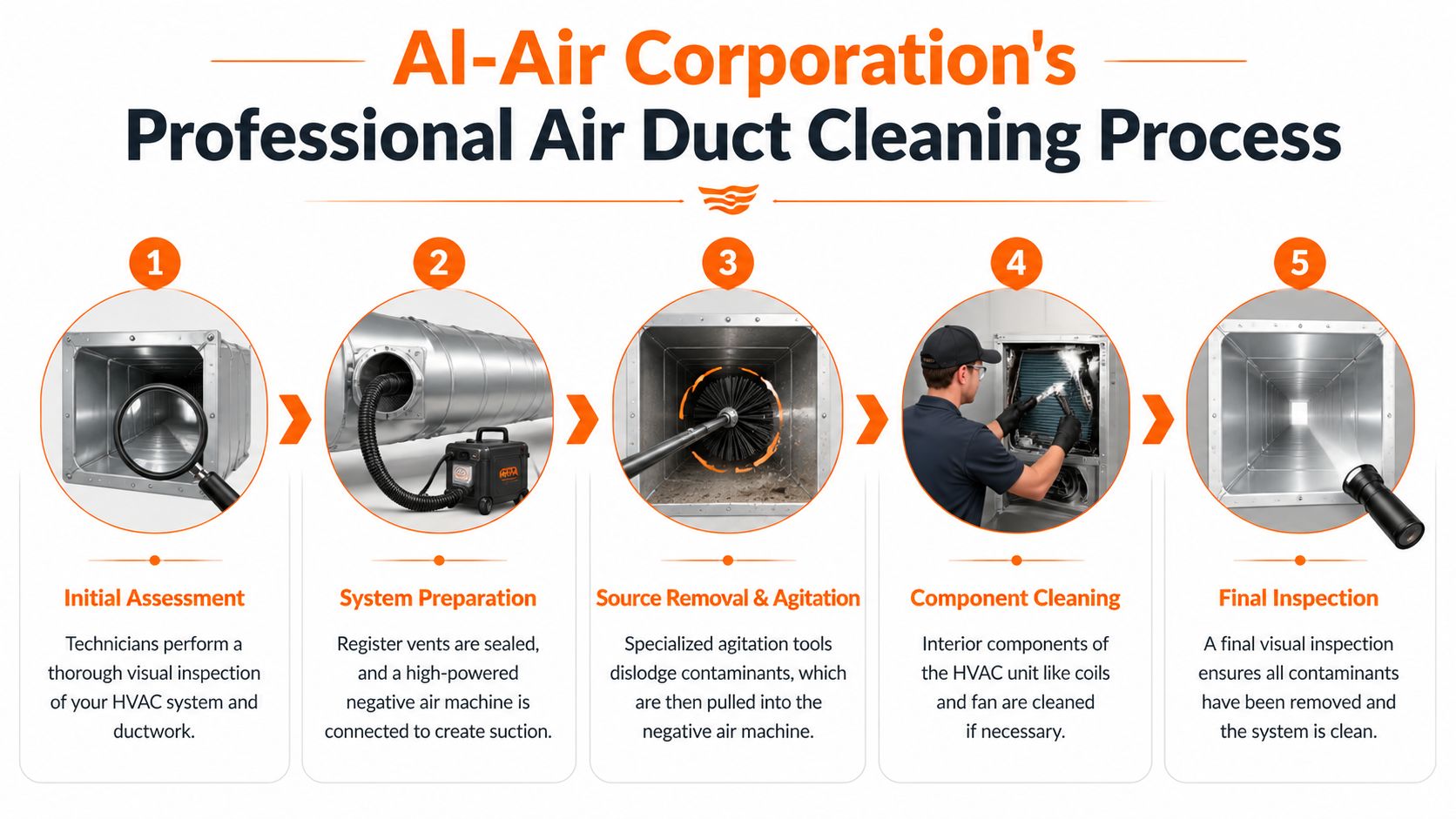
Step 2 Negative pressure and agitation
This is the core of the job. NADCA's standard.docx?t=1541692582283) requires mechanical agitation tools like rotary brushes and HEPA-filtered negative air machines to capture dislodged particles, with the goal that no visible contaminants remain after cleaning as verified by visual inspection.
In plain language, two things have to happen together:
- The debris must be loosened
- The debris must be pulled out under controlled suction
If you skip either part, the cleaning is incomplete. Mechanical agitation matters because dust often clings to duct surfaces. Negative air matters because once that debris breaks loose, you need it moving toward the collection equipment, not drifting through the home.
A vent cover can look clean while the branch line behind it is still holding debris. That's why professionals clean the system, not just the opening.
Step 3 Component cleaning when needed
Ducts aren't always the only place contamination sits. Depending on what the inspection shows, the technician may also need to address accessible HVAC components associated with airflow and cleanliness. In real houses, that's often where hidden buildup affects performance the most.
This step matters because a clean duct system connected to dirty internal components can still leave you with the same comfort complaints. The fix has to match the condition of the whole system, not just the visible parts.
Step 4 Final verification and close-up
When the cleaning is done, access points should be closed properly and the system should be visually rechecked. Homeowners should be able to ask what was found, what was cleaned, and whether any remaining concerns need separate repair work.
A careful contractor won't oversell this part. Cleaning removes contamination. It doesn't repair torn ductwork, stop future moisture intrusion, or solve every airflow problem by itself. If there are leaks, insulation gaps, damaged boots, or a failing air handler, those issues still need their own fix.
Understanding Air Duct Cleaning Costs in Orlando
Price matters. It also confuses a lot of homeowners because the quotes can swing wildly from one company to the next.
The first thing to know is that a real whole-system cleaning takes labor, equipment, and time. The statewide pricing data summarized here says professional air duct cleaning typically ranges from $450 to $1,000 nationally, and warns homeowners to be cautious about prices that are far below that range.
What affects the quote
A proper estimate usually depends on the actual condition and layout of the house. These factors tend to move the price up or down:
| Cost Factor | Description | Impact on Price |
|---|---|---|
| Home size | Larger homes usually have more duct runs and more vents to access | More square footage generally raises labor time |
| Number of ducts and vents | More supply and return points mean more cleaning work | More openings usually increase price |
| Duct type and accessibility | Tight attic access, older duct layouts, or difficult trunk lines can slow the job | Harder access often increases labor cost |
| Level of contamination | Heavy dust, renovation debris, or moisture-related buildup requires more work | Dirtier systems take longer to clean |
| Scope of service | Some jobs include related HVAC component cleaning when needed | Broader service can increase the total |
Why bargain ads are risky
The low-ball special is one of the oldest games in this trade. A company advertises an unrealistically low whole-house price to get in the door. Then the upsells start. Suddenly every vent is an extra charge, every return is a separate fee, and you're told you need expensive add-ons before they'll continue.
A better quote is detailed and boring. That's a good thing. It should explain what's included, what isn't, and what conditions could change the scope after inspection.
If the price sounds impossible for several hours of specialized labor and equipment, it probably is.
You don't need the cheapest duct cleaning. You need the one that does the actual work.
How to Choose a Trustworthy Duct Cleaning Company
A trustworthy company should be easy to verify. If you have to chase basic answers about training, insurance, process, or pricing, that's already a warning sign.

What to check before you book
Use a short screening list when you're comparing companies:
- Certification and training. Ask whether the technicians follow NADCA-style source removal standards and what equipment they use.
- Insurance. They should carry general liability and workers' compensation coverage.
- Written estimate. Get the scope in writing before work starts.
- Recent local reviews. Look for comments that mention punctuality, cleanliness, and whether the final bill matched the quote.
- Real process details. Ask how they protect the home, create negative pressure, and verify the cleaning.
That last point matters more than people think. According to NIH workplace guidance on HVAC duct cleaning, proper cleaning can involve isolating coils and using EPA-registered biocides where necessary, under negative pressure with HEPA filtration, which is a technical process that certified professionals are better equipped to handle safely.
Questions that reveal a lot
Good hiring questions aren't unique to HVAC. The same common-sense screening works for many home services. This checklist on what to ask window cleaners is a useful reminder that professional contractors should welcome questions about insurance, process, and what the quote includes.
Ask the duct cleaning company things like:
- What tools are you using inside the ducts
- Will you inspect before recommending cleaning
- How long should the job take
- Do you show before-and-after conditions when possible
- What happens if you find mold, damage, or standing moisture
This walkthrough can help you compare standards when you're evaluating air conditioning companies in Orlando, because the same traits matter here too. Clear communication, documented work, and no pressure tactics.
A quick video can also help you spot whether a company is talking about real process or just marketing language.
The companies worth trusting
The best contractors don't promise that every house needs cleaning. They inspect, explain, and tell you when another fix makes more sense. If they find a dirty coil, torn duct, poor filtration setup, or moisture issue, they say that plainly.
That's the standard to look for when you search air duct cleaning near me in Orlando. Straight answers first. Service second.
Breathe Cleaner Air with Al-Air Corporation
If your home feels dusty, smells musty when the AC starts, or has been through storms, remodeling, or moisture issues, duct cleaning may be worth a serious look. If none of those signs are present, an honest inspection may tell you to save your money and focus on filters, humidity control, or equipment repair instead.
That kind of straight answer matters. Homeowners in Greater Orlando don't need more scare tactics. They need a contractor who understands Florida humidity, pollen, attic ductwork, and the difference between a real contamination problem and a sales pitch.
Al-Air Corporation serves homeowners across Greater Orlando, including Clermont, Davenport, Kissimmee, Poinciana, Tampa, Hillsborough County, and Pasco County. With more than 14 years of experience, certified technicians, electrical expertise, transparent estimates, and round-the-clock help for urgent issues, the company handles air duct cleaning as part of a broader indoor comfort and home performance approach.
If you're ready for an honest inspection and a no-pressure estimate, contact Al-Air Corporation. They can help you figure out whether duct cleaning is the right move, what else may be affecting your air quality, and the safest path to cleaner air in your Orlando home.