

A standard central AC replacement in Orlando often lands around $4,000 to $7,000 fully installed. That's the typical starting point for many homes here, but the final number can move a lot depending on system efficiency, ductwork condition, electrical needs, and how the job has to be done in a hot, humid Florida house.
When your AC starts short-cycling in July, blowing warm air by mid-afternoon, or struggling to pull humidity out of the house, cost stops being an abstract question. You want to know what a fair quote looks like, what corners shouldn't be cut, and why one estimate can come in far above another for what looks like the same equipment.
That confusion is common because home ac installation cost isn't just about the condenser sitting outside. It's the equipment, the labor, the permit, the setup, the electrical connections, the drain, the line set, and sometimes the duct system that nobody thinks about until it fails inspection or leaks half your cooling into the attic.
Nationally, a useful baseline is that a new central air system usually falls in the mid-thousands. Fixr's 2026 AC installation cost guide puts the average at $6,000, with most homeowners paying $5,000 to $12,000 for a new AC system, which lines up with what many Florida homeowners expect before local conditions change the scope.

Before you sign anything, it helps to think like a contractor instead of a shopper. A good estimate should tell you what system is being installed, what work is included, and what could still change once the crew opens things up. If you want a solid homeowner checklist for vetting any contractor, this guide to questions to ask before hiring a contractor from Trademaster Construction is worth reading.
In Orlando, the cheapest quote often leaves out the exact work that makes the system reliable in August.
Your Guide to Home AC Installation Costs in Orlando
It is 4:30 on an August afternoon in Orlando. The house is climbing past 80, the air feels sticky, and now you need an AC quote fast. That is when homeowners get into trouble, because the lowest number on the page often skips the work that keeps a new system running properly through a Florida summer.
Orlando pricing needs local context. A replacement here is shaped by heat, high humidity, attic conditions, permit requirements, and code corrections that may not show up in a national average. Two houses with similar square footage can price very differently if one has good airflow and clean electrical service while the other needs duct repairs, a new float switch setup, drain line changes, or a disconnect brought up to code.
Humidity is a big part of that equation. A system that is too large can satisfy the thermostat quickly and still leave the home damp. A system that is too small may run all day and struggle in peak afternoon heat. Good contractors in Central Florida do not price by square footage alone. They look at load, insulation, duct condition, attic heat, and how the house handles moisture.
Most homeowners want the same three answers right away:
- What is a reasonable starting point? In Orlando, a straightforward central AC replacement with standard efficiency equipment often starts in the mid-thousands, then climbs based on system size, efficiency, and house conditions.
- What pushes the number up? Duct fixes, electrical upgrades, difficult attic access, condensate drain corrections, pad replacement, and permit-related code work are common cost drivers in Florida homes.
- What should a quote include? The equipment, labor, permit, startup, and the supporting items needed to install the system correctly, not just the outdoor unit and indoor box.
One bad assumption causes a lot of sticker shock. Homeowners often expect a box swap. Many Orlando replacements are not that simple, especially in older homes or houses where the last install cut corners.
A solid estimate spells out what is included, what is excluded, and what could change if the crew finds damaged ductwork, poor airflow, or code issues once the old system comes out. If you want a practical way to compare contractors before you sign, this guide from Trademaster Construction is worth reading.
In Orlando, the cheap quote is often missing the exact work that keeps the house comfortable in August.
Replacing an AC is a system decision, not just an equipment purchase. The sizing, drainage, airflow, electrical, and installation quality all affect how the home feels after the job is done. Get those parts right, and the new system has a fair chance to control both temperature and indoor moisture the way it should.
The Core Components of Your AC Installation Bill
A lot of sticker shock comes from treating the quote like it's only the cost of the box outside. It's closer to buying a car than buying a window unit. The advertised machine is one part of the price. The total includes the work required to make that machine operate safely and correctly in your home.

Equipment is only the first bucket
The equipment usually includes the main cooling components of the system. Depending on the home, that may mean the condenser and indoor air handler or the matched components of a central system.
A broad replacement benchmark helps here. Angi's 2026 HVAC replacement guide lists a total project range of $5,000 to $22,000, with an average of $7,500, and breaks out central air system cost at $3,900 to $7,900, installation labor at about $1,500, and permits at $250 to $400.
That matters because homeowners often assume a quote is padded when it comes in above the raw equipment number. In reality, the quote may include the rest of the job.
Labor is where skill shows up
Labor isn't just carrying old equipment out and setting new equipment in. On a proper install, the crew has to disconnect and remove the existing system, set and connect the new equipment, verify electrical and refrigerant connections, confirm drainage, and start the system correctly.
Some jobs are straightforward. Others involve cramped attics, awkward pad locations, roof exposure, or older homes with access problems. Labor pricing reflects that difference because time, difficulty, and risk all change.
Supporting components often decide whether the system performs well
Many quotes distinguish themselves by their offerings. A complete bill may include items that don't look exciting but make the installation code-compliant and dependable.
Here are the pieces homeowners should expect to see addressed:
- Refrigerant line considerations: Existing lines may be reusable in some situations, but not always.
- Thermostat work: Angi also notes a new thermostat at $120 to $260 in their replacement guide, when that item is part of the project.
- Duct-related work: If ducts are leaking, undersized, damaged, or poorly laid out, replacing the equipment alone won't fix comfort issues.
- Drain and safety components: Florida systems work hard to remove moisture, so condensate handling matters.
- Electrical accessories: Disconnects, whips, breakers, and related hardware can be part of a clean install.
Permits and inspections are not junk fees
Permits aren't glamorous, but they matter. A permitted job means the installation is expected to meet local requirements and be inspected where required. That protects the homeowner more than the contractor.
A quote that skips permit discussion may look cheaper at first and cost more later when a sale, insurance issue, or failed inspection forces the work back open.
Disposal and warranty have real value
A complete quote may also include old equipment removal and proper disposal. Homeowners sometimes overlook that because it isn't a visible upgrade, but it's still part of the contractor's time and responsibility.
Warranty support matters too. The equipment warranty covers the product side. The labor warranty covers the workmanship side. If the install is weak, a strong equipment warranty won't save you from repeat labor charges and comfort issues.
Central Air vs Ductless Mini-Splits What is the Cost Difference
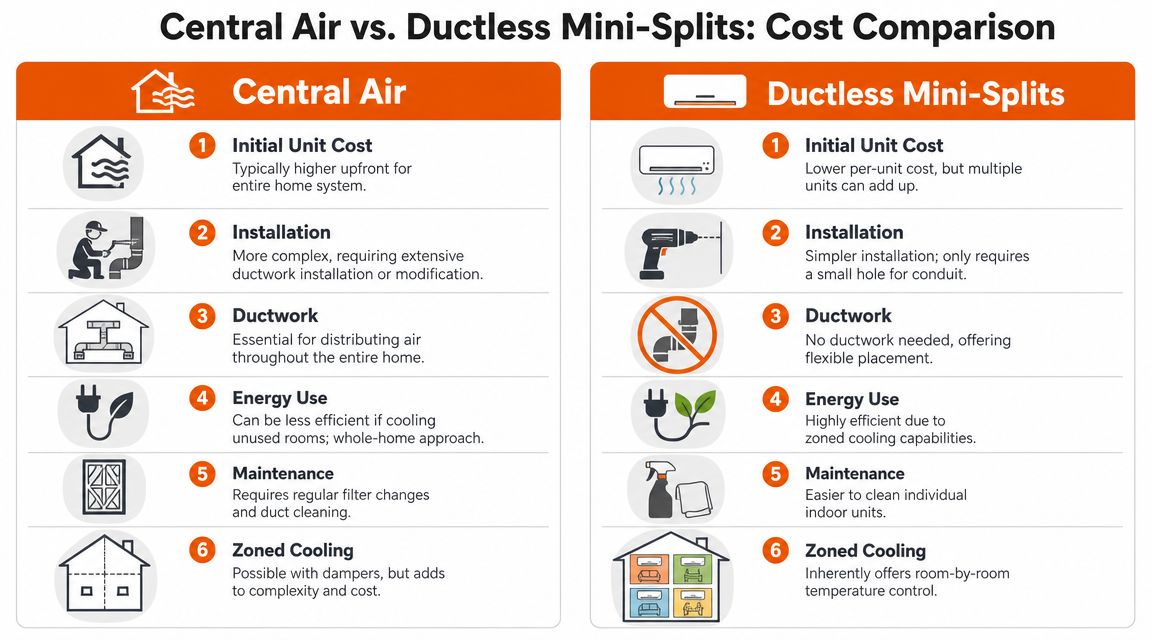
For Orlando homeowners, this choice usually comes down to one question. Are you cooling a whole house that already has usable ducts, or are you trying to cool a space where ductwork is missing, damaged, or too expensive to add?
When central air makes more financial sense
Central air is often the cleaner value when the home already has a sound duct system and you want whole-home cooling from one matched setup. In that case, you're not paying to reinvent air distribution. You're replacing the core equipment and making the supporting connections.
In Orlando, that can keep the project more predictable. Cool Today's Florida mini-split and HVAC pricing guide notes that full HVAC replacement in Orlando averages $7,605, while typical installations span a broader range when more components and modifications are involved.
What raises central-system cost is everything tied to the house itself. Duct modifications, air handler integration, electrical work, and access complexity can all move the job beyond the “simple swap” category.
When ductless is the smarter move
Ductless mini-splits have a very different cost structure. They don't depend on a full duct network, so they can be a practical answer for garage conversions, enclosed patios, additions, older homes, and targeted room-by-room comfort problems.
That's why mini-splits often look attractive for first-time cooling in a space that never had ducts. The system can go in with less disruption than cutting open walls and ceilings to build an entirely new air distribution path.
The same Florida source reports ductless mini-split installation commonly at about $3,000 to $7,000+, with the upper end driven by multiple indoor heads. That “plus” matters. A one-room application is a different project from outfitting several rooms with separate indoor units.
A good overview of system options is this page on types of HVAC systems, especially if you're sorting out whether your home layout fits central, ductless, or a hybrid approach.
This walkthrough can help if you want to see the equipment differences visually.
The crossover point homeowners miss
The cheapest ductless quote often applies to a simple single-zone installation. Once you start adding several indoor units, running more line sets, and covering most of the house, the economics change. At that point, the convenience of ductless may still be worth it, but it's not automatically the lower-cost path.
Here's the practical comparison:
| System choice | Usually works best for | Cost logic |
|---|---|---|
| Central air | Homes with existing, usable ducts | One whole-home system can be more efficient to install than multiple indoor ductless heads |
| Single-zone mini-split | One room, addition, garage conversion, office | Often avoids the cost and disruption of adding ducts |
| Multi-zone mini-split | Several rooms without ducts | Flexible, but cost rises as zones and line routing increase |
If you already have decent ducts, central air is often the cleaner whole-house answer. If you don't have ducts, mini-splits can save a lot of disruption before they save money.
Key Factors That Drive Your Final Price Up or Down
Two homes can need “a new AC” and still get very different proposals. That's because the final price is driven less by the label on the unit and more by the decisions underneath it. In Orlando, the biggest swings usually come from sizing, efficiency choice, duct condition, and electrical scope.
Sizing has to match Florida humidity, not just square footage
A lot of homeowners start with square footage because it feels simple. The problem is that square footage alone doesn't tell you how a Florida home behaves. Window exposure, insulation, ceiling height, leakage, occupancy, and sun load all affect what the system has to do.
That's why rough online calculators should only be a starting point. If you want a plain-language primer, Atomic Exteriors' guide to BTU calculation is a useful way to understand why the house matters as much as the floor plan.
A contractor should size the system based on the actual home, not just the old unit nameplate. If the old unit was oversized, replacing it with the same size can lock the same comfort problems back in. If you want a local reference point for that discussion, this page on what size AC unit you need helps frame the question before you get quotes.
Efficiency changes the equipment price first, then the operating cost later
Homeowners usually feel this trade-off immediately. A higher-efficiency system costs more up front. The reason some people still choose it is comfort and long-term operation, especially in a climate where cooling season is not short.
The mistake is assuming higher efficiency is always the right call. Sometimes it is. Sometimes a moderate-efficiency system installed correctly is the better value than paying extra for premium equipment in a house that still has duct leakage or airflow problems.
Ductwork can quietly become the biggest multiplier
This is the item that surprises people most. If the ducts are healthy, central replacement stays closer to the expected equipment-and-labor budget. If the ducts are deteriorated, undersized, disconnected, or missing entirely, the quote can change fast.
Modernize's central AC installation cost guide notes that for homes lacking existing ductwork, central AC with ducts can shift from $5,000 to $10,000 up to $9,000 to $20,000+, making ductwork one of the most significant cost drivers in the project.
That scenario shows up often in older homes, additions, converted spaces, and remodels. Homeowners think they're shopping for a condenser and air handler. What they're really buying is a full cooling distribution system.
Electrical scope can turn a simple install into a coordinated project
A modern AC system depends on safe, code-compliant electrical support. If the existing disconnect, breaker setup, whip, or panel condition isn't right, the installer has to address it. Ignoring that doesn't save money. It delays the job or creates a safety issue.
This is one reason combined HVAC and electrical capability matters on replacement work. Al-Air Corporation handles both HVAC and licensed electrical work for Orlando-area homes, which is useful when a replacement also needs panel-related or wiring corrections instead of handing the homeowner off to a second company.
Access and layout affect labor more than people expect
The same equipment can be easy in one house and miserable in another. Tight attic access, long refrigerant runs, awkward pad placement, second-story air handlers, and older framing all increase labor time. So do homes where previous installations left poor clearances or difficult service access.
A low quote sometimes assumes best-case conditions. Once the crew gets into the attic or opens the closet, the full scope appears. That's why detailed site evaluation matters before a contractor commits to a final number.
What to compare when reviewing estimates
If you're trying to understand why one quote is higher, compare the scope line by line:
- Matched system details: Tonnage and efficiency should be comparable before you compare price.
- Duct assumptions: One contractor may be pricing duct repairs while another ignores them.
- Electrical inclusions: Ask whether disconnects, breakers, or panel-related work are included.
- Permit handling: Confirm whether permit and inspection steps are part of the proposal.
- Startup and testing: The system should be commissioned, not just powered on.
A detailed quote can cost more because it includes the work needed to make the system last, drain correctly, and pass inspection.
Realistic Orlando AC Installation Cost Examples
A homeowner in Orlando gets two quotes for “the same AC job,” and the spread is several thousand dollars. That usually means the homes are not being priced the same way. In Central Florida, humidity load, drain setup, attic conditions, and code corrections change the job fast, even when the equipment size looks similar on paper.
These examples reflect the kind of installs that come up around Clermont, Davenport, and Kissimmee. They are not fixed prices. They are realistic local scenarios that show where the money goes.
Example 1 for a straightforward replacement in Clermont
A single-family home has an older central AC, usable ductwork, and no major comfort complaints beyond poor reliability and rising repair bills. The air handler is accessible, the electrical is serviceable, and the condensate drain can be brought up to current requirements without major rework.
This is the kind of replacement that stays near the lower end of Orlando-area pricing. The homeowner is usually paying for the new condenser and air handler, labor, permit, haul-away, startup testing, and a few small materials that never show up in the first online search, such as a pad, safety switch, drain updates, or refrigerant line insulation.
If the ductwork is in decent shape, this is often the cleanest install a contractor can do.
Example 2 for a garage conversion in Davenport
A garage becomes living space, but there are no ducts in the room and no easy way to add them without opening walls or overloading the existing system. In that case, a ductless mini-split is often the practical answer.
For one room, the price can stay reasonable because the scope is contained. The job usually includes the outdoor unit, one indoor head, line set, electrical connection, condensate management, wall bracket or pad, and permit if required by the local jurisdiction. Costs rise quickly if the line run is long, the panel needs work, or the homeowner wants a cleaner wall finish around the penetration.
Add two or three indoor heads, and the price stops looking like a simple room upgrade. It starts acting more like a small whole-home project.
Example 3 for a larger Kissimmee home with upgrade needs
A two-story home has uneven temperatures, weak airflow upstairs, and an older system that never controlled humidity well. The owner wants the replacement to fix comfort problems, not just restore cooling.
That usually means more than swapping boxes. A better proposal may include higher-efficiency equipment, duct adjustments, return-air improvements, new drain protection, float switches, thermostat upgrades, and some electrical correction work. In Florida homes, that extra scope matters because a system that is oversized, poorly draining, or badly matched to the ductwork can leave the house cool but still damp and uncomfortable.
Homeowners realize why one quote is much higher than another. One contractor is pricing a changeout. The other is pricing the repairs needed for the system to perform properly in an Orlando summer.
Sample Orlando AC Installation Costs
| Home Scenario | System Type | Scope of Work | Estimated Cost Range |
|---|---|---|---|
| Average single-family home with usable ducts | Central AC replacement | Standard replacement with permit, startup, and minor connection updates | Mid-range local pricing for a basic changeout |
| Garage conversion or single room without ducts | Ductless mini-split | One-zone installation with dedicated cooling for the new space | Often less than extending or rebuilding central ducted cooling for one room, but scope-dependent |
| Older home or addition without existing ductwork | Central AC with new ducts | Equipment, new duct system, labor, permits, inspections, and layout work | Usually far above a basic replacement because the house needs cooling infrastructure, not just equipment |
What these examples tell you
“New AC” can mean a basic replacement, a one-room mini-split, or a larger correction project with duct and electrical work tied in.
The smart question is not just price. Ask what the quote assumes about your ductwork, humidity control, drain line, code updates, and electrical setup. In Orlando, those hidden items are often the difference between a fair quote and a cheap one that gets expensive later.
How to Pay for Your New AC and Understand Your Warranty
AC replacement is rarely planned on a convenient timeline. The unit fails during a hot stretch, the house won't recover by evening, and now you're making a several-thousand-dollar decision quickly. That's why payment options and warranty terms matter almost as much as the equipment itself.
Financing changes the decision from emergency to plan
A quality installation costs real money. For many homeowners, financing is what turns the project from a stressful lump-sum expense into a manageable monthly obligation. That doesn't make the system cheap, but it does make it easier to choose the right scope instead of the bare minimum.
When you review financing, focus on clarity. Ask what the payment structure is, whether there are promotional terms, and what happens if additional scope appears once the job starts. The right financing plan gives you room to approve the work the home needs.
The manufacturer warranty and labor warranty are not the same thing
Many homeowners often struggle with this distinction. The manufacturer warranty generally relates to the equipment itself. The labor warranty relates to the installation work.
If a part fails, the manufacturer side may help with the component. If the issue comes from workmanship, setup, or related installation problems, labor coverage is what protects you. That distinction matters because a poorly installed system can create repeat service calls even when the equipment is technically under warranty.
A long parts warranty sounds good on paper. A clear labor warranty is what tells you whether the installer stands behind the job.
Ask what can void coverage
Warranty problems often come from preventable issues. Homeowners should ask whether registration is required, whether maintenance expectations apply, and whether repairs must be handled by qualified technicians. The goal isn't to catch anyone in fine print. It's to understand how to protect the investment.
Cheapest today can be more expensive later
A lower bid may save cash up front, but if it comes with weak labor coverage, unclear permit handling, or missing scope, it can turn into the most expensive path. Good warranty terms and realistic payment options usually point to a contractor who expects the system to hold up, not one who wants to move on after install day.
Your Checklist for Getting an Accurate AC Installation Estimate
If you want a quote you can trust, treat the estimate appointment like an interview. The contractor should examine the home, ask about comfort issues, and explain what the proposal includes. If they only glance at the old model number and start writing, you're not getting much analysis.
What to ask for in writing
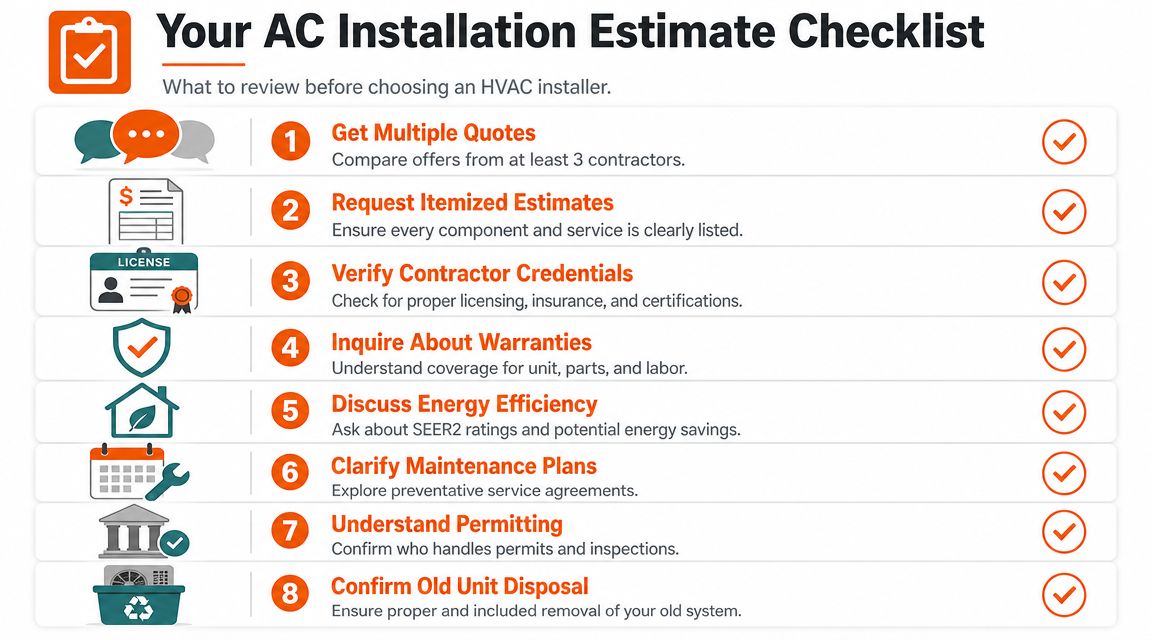
The easiest way to avoid confusion is to insist on a written, itemized proposal. You should be able to see what equipment is being proposed, whether permit handling is included, and what assumptions are being made about ductwork and electrical conditions.
A local search can help you build a shortlist before you start comparing. This page for finding an HVAC contractor near you is one example of where homeowners begin.
The checklist that keeps quotes honest
- Verify licensing and insurance: Ask directly. A serious contractor should be ready to provide credentials.
- Request proper sizing work: Don't accept a pure rule-of-thumb replacement based only on the old unit.
- Compare matched systems: Price comparisons only make sense when tonnage, efficiency, and included scope line up.
- Ask about duct assumptions: If the quote says nothing about duct condition, ask what happens if problems are found.
- Confirm permit handling: You should know who pulls permits and who schedules inspections.
- Clarify electrical scope: Ask whether disconnects, breakers, and needed wiring corrections are included.
- Review warranty terms carefully: Separate equipment coverage from labor coverage.
- Check old-unit removal: Make sure disposal is part of the proposal and not added later.
Signs the estimate is probably too thin
A weak estimate usually has a few tells:
- One total with no breakdown
- No mention of permits
- No discussion of sizing
- No questions about comfort problems
- No written warranty explanation
Good HVAC estimates answer the questions homeowners don't yet know to ask.
A fair AC quote in Orlando should leave you with fewer unknowns, not more. You should know what system is going in, what the job includes, and what conditions could affect the final bill before the crew arrives.
If you want a clear, written quote for your Orlando-area home, Al-Air Corporation provides residential HVAC installation estimates along with HVAC and licensed electrical service when a replacement project needs both. That's useful for homeowners who want the system, the supporting electrical work, and the permit-related details reviewed together before making a decision.