
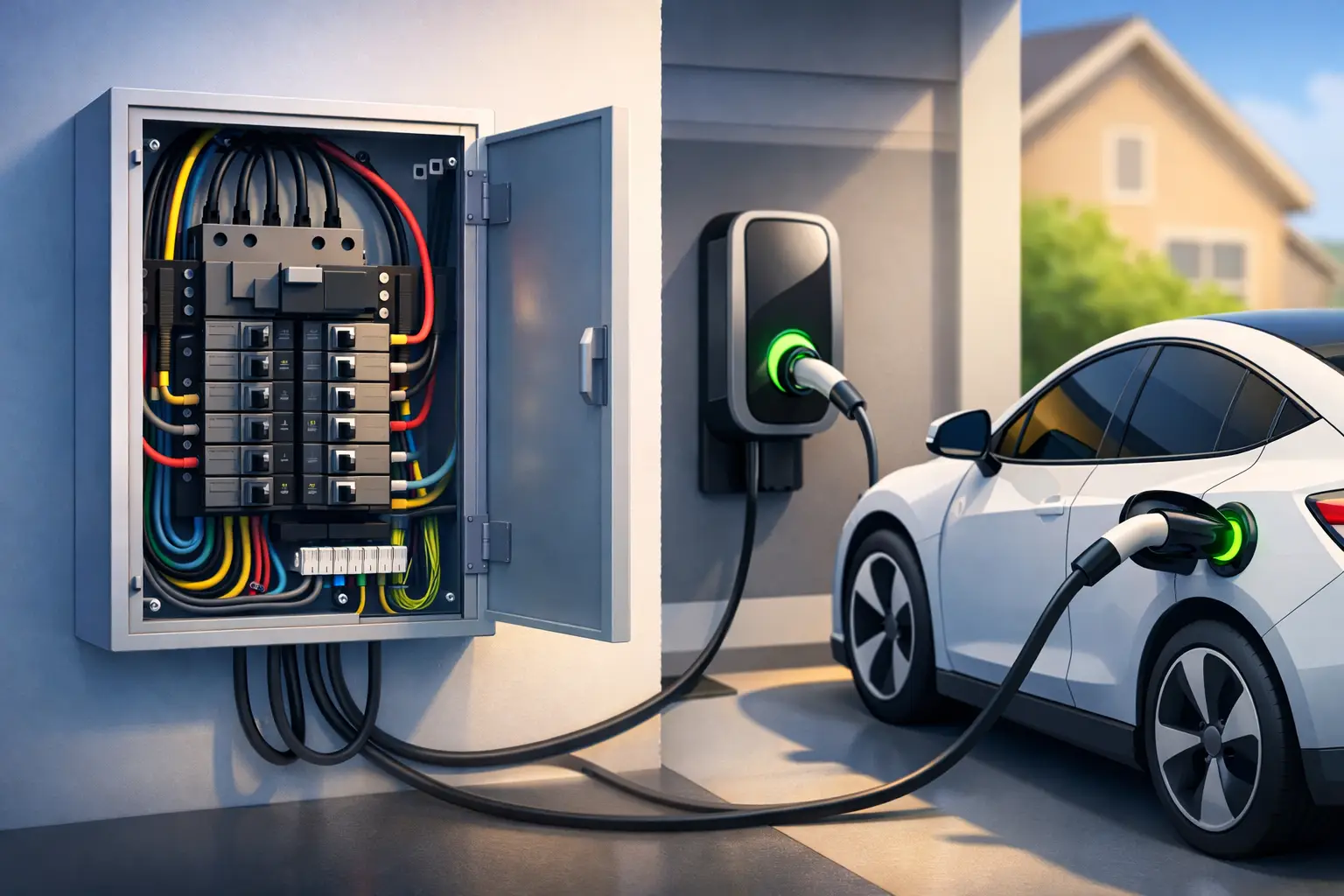
That question usually comes up right after someone buys the car – not months earlier when it would have been convenient. If you are asking, can my panel support EV charger installation, the short answer is maybe. Some homes are ready for it with minor electrical work. Others need a closer look at panel capacity, existing loads, and the condition of the equipment already in place.
In Central Florida, this comes up a lot in homes with older panels, heavy AC use, pool equipment, electric water heaters, or a garage that was never wired with future upgrades in mind. An EV charger is not just another outlet. It is a continuous load, and that changes the conversation fast.
Can my panel support EV charger installation?
The answer depends on three things – your panel size, your actual electrical demand, and whether there is physical and code-compliant space to add the circuit.
A lot of homeowners start by checking the number printed on the main breaker. If it says 100 amps, 150 amps, or 200 amps, that is useful, but it is not the whole story. A 200-amp panel does not automatically mean you are ready for a Level 2 charger. A 100-amp panel does not automatically mean you are not. What matters is how much of that capacity is already being used and how your home is set up.
A typical Level 2 EV charger often needs a 240-volt dedicated circuit. Depending on the charger and how fast you want the car to charge, that could mean 30, 40, 50, or 60 amps. Because EV charging is treated as a continuous load, the circuit and panel have to be sized correctly. That is where homeowners get tripped up. It is not just about fitting a new breaker into the panel. It is about whether the whole system can handle the added demand safely.
What usually determines if your panel can handle it
If your home already has a modern 200-amp panel and no major overload issues, there is a decent chance you can add a charger without a full service upgrade. That is especially true if the home has gas appliances for cooking, water heating, or heating.
If your home has a 100-amp panel, things get more case-by-case. Plenty of Florida homes with 100-amp service are already carrying central AC, an electric range, a dryer, and a water heater. Add pool pumps or a hot tub, and available capacity gets tight quickly. In those homes, an EV charger may still be possible, but not always at the charger size the homeowner originally wanted.
The age and brand of the panel matter too. Even if the amp rating looks workable, an old or problematic panel may not be a good candidate for expansion. If the equipment is outdated, corroded, double-tapped, or showing signs of heat damage, the conversation shifts from Can I add a charger? to Should I trust this panel with more load at all?
There is also the simple issue of space. Some panels are full. Others may technically have room, but not the right configuration for a two-pole breaker required for a 240-volt charger. Physical space alone does not prove capacity, but it does affect cost and options.
The difference between Level 1 and Level 2 matters
If you plan to charge from a standard 120-volt outlet, that is Level 1 charging. It is slow, but it uses far less power and may avoid major electrical changes. For drivers with short daily commutes, this can be enough.
Level 2 is what most homeowners want because it charges much faster. It is also where panel limitations start to matter. A faster charge rate usually means a larger dedicated circuit, and larger circuits put more pressure on panel capacity.
That trade-off is worth understanding. Sometimes the smartest answer is not a panel upgrade right away. Sometimes it is installing a lower-amperage charger that fits the home safely and still meets the household’s actual driving needs.
Why a load calculation matters more than guesswork
The clean way to answer can my panel support EV charger work is with a proper load calculation. That is how an electrician determines whether your existing service can safely carry the new load under code.
This is where online advice gets messy. You will see people say, “I have a 200-amp panel and I was fine,” or “I added a 50-amp charger with no problem.” That may be true for their house. It does not mean it applies to yours.
A load calculation looks at the real electrical demands of the property, including square footage, fixed appliances, HVAC equipment, electric heat, water heating, laundry, cooking equipment, and other major loads. In Florida, HVAC can be a big piece of the picture because AC systems run hard for much of the year. If your electrical and cooling systems are both heavy users, that needs to be accounted for before adding an EV charger.
This is also why working with a contractor who understands both electrical demand and home comfort systems can save you time. If your panel upgrade and HVAC plans are likely to overlap, it makes more sense to evaluate them together instead of solving one problem now and creating another expense later.
Signs your home may need a panel upgrade first
Sometimes the answer is straightforward. If breakers trip regularly, lights dim when large appliances start, or the panel is already packed, your system may not be in good shape for an EV charger.
Other warning signs are more obvious. Rust, buzzing, scorch marks, loose breakers, warm spots, or an outdated panel brand should not be ignored. An EV charger is a steady, repeated load. If the panel is already struggling, adding more demand is the wrong move.
Homes with major future upgrades should also think ahead. If you are planning a new AC system, electric water heater, induction range, hot tub, or workshop equipment, those changes may affect what makes sense today. You do not want to pay for a small workaround now, then pay again for a full panel replacement six months later.
When you might not need a full upgrade
Not every EV charger project turns into a big electrical job. Some homes only need a new dedicated circuit, a breaker, and the charger installation itself. Others may benefit from load management equipment that helps balance usage and avoid oversizing the service.
There are also cases where stepping down the charger size makes the most sense. If you only drive moderate daily miles, you may not need the fastest charging option available. Slower overnight charging can still fully support your routine while keeping installation simpler and more affordable.
That is the part homeowners appreciate once the options are explained clearly. It is not always yes or no. Sometimes it is yes, but with the right charger size. Sometimes it is yes, but only after a panel upgrade. Sometimes it is no, not safely, and that answer can save you from bigger problems later.
What to expect during an evaluation
A proper evaluation should be direct and practical. The electrician should inspect the panel, confirm service size, look for open breaker space, review major electrical loads, and determine what charger size is realistic. If an upgrade is needed, you should get a clear explanation of why.
The goal is not to oversell you on the largest possible job. The goal is to give you a safe path that fits how you actually use the house. For some homeowners, that means a straightforward charger install. For others, it means planning a panel upgrade that also sets the home up for future HVAC or electrical improvements.
If you are in the Tampa or Central Florida area, that local context matters too. Heat, storm exposure, older housing stock in some neighborhoods, and heavy year-round AC use all affect electrical demand. A charger installation should be sized for real life, not best-case assumptions.
At Al-Air, this kind of job is handled with the same approach as any other electrical upgrade – no referrals, no runaround, and no guessing from a photo sent by text. You need a real assessment of the equipment, the load, and the safest next step.
The cost question homeowners are really asking
Most people asking can my panel support EV charger installation are also asking a second question they may not say out loud – how expensive is this about to get?
The honest answer is that cost ranges a lot. A simple install on a newer panel is one price. A panel replacement, service upgrade, permit work, and charger circuit are another. Distance from the panel to the garage or driveway also affects labor and material cost.
What matters is getting the scope right the first time. A cheap shortcut on EV charging can turn into nuisance tripping, failed inspections, or a panel that is overdue for replacement anyway. Good electrical work is about safety first, but it is also about not paying twice.
If you are not sure whether your panel can support an EV charger, that uncertainty is normal. The right next step is not guessing from the label on the door. It is having the panel, the load, and the home’s future needs looked at together so you can make a decision with your eyes open.