
The breaker always seems to trip at the worst time. Dinner is half cooked, the AC is running hard, a bathroom goes dark, or the garage outlet suddenly quits while you're in the middle of something simple. Most homeowners reset the switch and hope it was a fluke.
Sometimes it is. Often, it isn't.
A circuit breaker that keeps tripping is your electrical system telling you something important. The question isn't just how to get the lights back on. It's whether the trip came from a harmless overload, a failing appliance, moisture in the wrong place, or a wiring problem that needs quick attention. In Florida homes, that question matters even more because heavy air conditioning use and year-round humidity change the way electrical problems show up.
Your Guide to a Constantly Tripping Circuit Breaker
If you're searching for what causes a circuit breaker to keep tripping, you're probably dealing with one of two situations. Either the breaker trips once in a while when too many things are running, or it trips repeatedly and you're starting to wonder if your home is safe.
That second concern is the right one to have.
A breaker is supposed to trip when conditions become unsafe. It cuts power before wires overheat, before insulation gets damaged further, and before a fault turns into a shock or fire hazard. So while a tripping breaker is frustrating, it's also doing exactly what it was built to do.
Most repeat trips come from a few root causes:
- Too much demand on one circuit
- A short circuit somewhere in the wiring or appliance
- A ground fault, especially in damp areas
- A problem tied to HVAC equipment or seasonal electrical strain
- A breaker or panel issue that needs professional diagnosis
Practical rule: A breaker that trips once after you plugged in too many things is usually a load problem. A breaker that trips instantly, smells hot, or won't reset is a safety problem.
Florida homeowners run into a pattern that many national articles barely mention. Air conditioning often becomes the biggest electrical load in the house, and moisture doesn't just show up in storms. It hangs around all year in bathrooms, garages, outdoor circuits, pool areas, condensate lines, and equipment near the air handler.
You'll see how to tell these problems apart, what you can safely test yourself, and where the line is between basic troubleshooting and licensed electrical work.
Understanding Your Electrical Panel's Protective Role
On a hot Florida afternoon, your panel is doing quiet safety work the whole time the house is fighting heat and humidity. The air conditioner starts, the blower kicks on, maybe a dehumidifier is running too, and each breaker is standing guard over one circuit at a time.
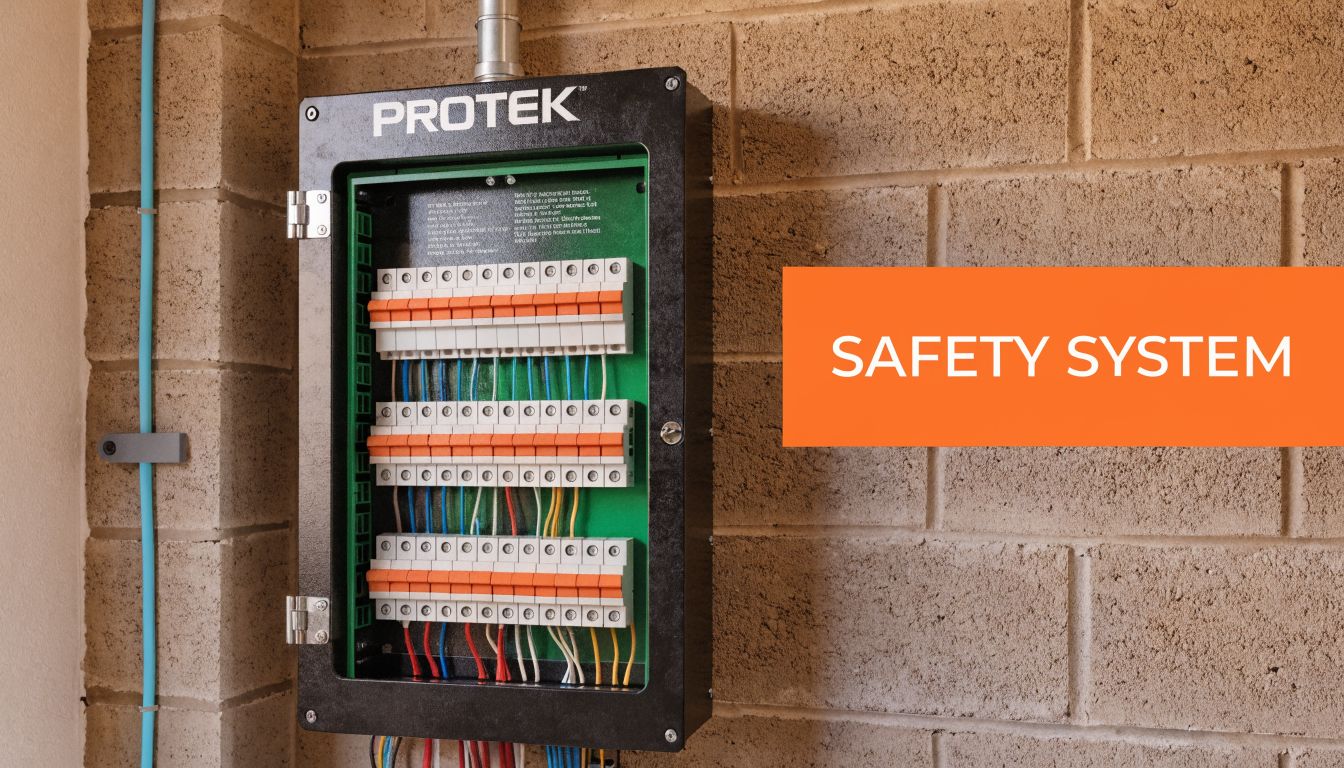
Your electrical panel works like a traffic control point for the whole house. Each breaker protects one path of wiring, and it opens that path when current or fault conditions become unsafe. The breaker is there to protect the wire in the wall, the devices on the circuit, and the people in the home.
What a breaker actually does
A breaker does not push electricity through the house. It acts more like a shutoff gate with a safety brain built in. Branch circuits in homes are commonly protected by 15-amp or 20-amp breakers, as explained by the National Fire Protection Association's overview of home electrical safety and overcurrent protection.
If a circuit carries more current than the wiring can handle, or if electricity takes a dangerous path because of a fault, the breaker trips and cuts power. That interruption can prevent overheated conductors, damaged insulation, and, in the worst cases, fire.
Why some trips are delayed and others are instant
Inside many residential breakers are two different protective responses.
- Thermal protection responds to heat that builds up over time.
- Magnetic protection responds almost instantly to a severe fault current.
That difference helps explain a pattern homeowners often notice. If the breaker trips after the AC has been running for a while, heat buildup from sustained load may be part of the story. If it trips the moment a unit starts or the instant you reset it, that points more toward a fault that needs careful diagnosis.
The U.S. Consumer Product Safety Commission notes that circuit breakers are designed to trip when circuits are overloaded or shorted, which is why repeated tripping should be treated as a warning sign instead of a nuisance to work around. See the CPSC's guidance on electrical safety hazards in the home.
Why this matters so much in Florida homes
Florida puts unusual stress on electrical systems. Air conditioning runs longer, compressors draw heavy startup current, and moisture shows up where homeowners do not always expect it. Around air handlers, condensate drains, outdoor disconnects, pool equipment, garage receptacles, and exterior lighting, humidity can contribute to corrosion or leakage paths that make protective devices trip more often.
Older homes can struggle even more. Many were built before today’s cooling demands, electronics, and added appliances became normal. If your home starts tripping breakers during heat waves, after storms, or every time major HVAC equipment cycles on, the panel may be revealing a larger capacity or condition problem. In that case, it helps to review the warning signs that point to electrical panel upgrades instead of repeated resets.
One last safety point matters here. A breaker that keeps tripping is usually doing its job. The danger begins when someone forces it to keep carrying a problem it was trying to stop.
Circuit Overloads The Most Common Culprit
You plug in the coffee maker, start breakfast, the AC kicks on, and a breaker trips ten minutes later. That pattern points to the most common cause homeowners deal with. One circuit is being asked to carry more electricity than it was built to handle.
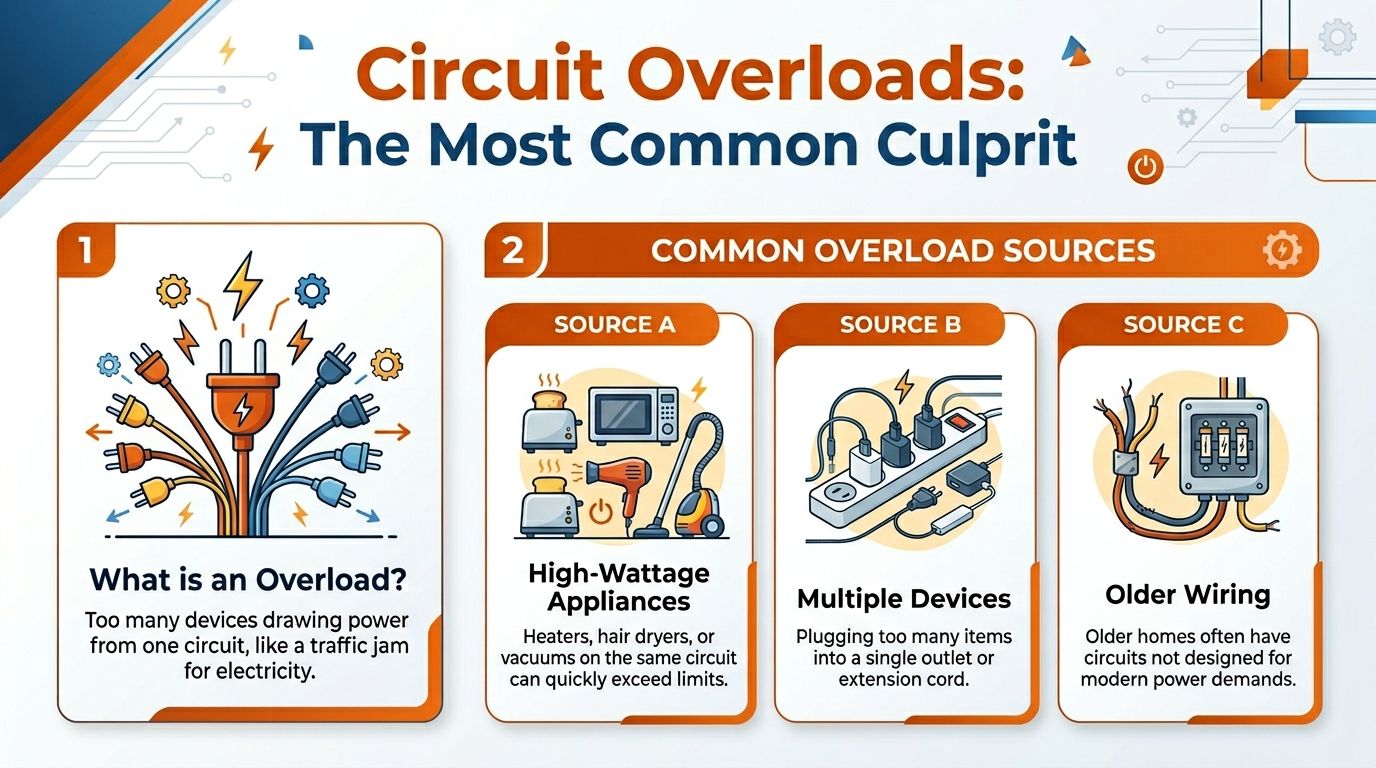
That is an overload. In plain terms, too many devices are drawing power from the same electrical path at once, or one appliance is drawing enough current that there is not much room left for anything else. The breaker opens the circuit before the wire gets dangerously hot.
How an overload actually develops
A good way to picture it is water flowing through a pipe. The wire can carry only a certain amount of current safely. Once too much current flows for too long, heat builds inside the wire and at connections. The breaker senses that rising heat and trips to stop the problem.
That timing matters.
An overload often does not trip instantly. You may run several devices together for a few minutes before the breaker flips. That delayed trip is one clue that the issue is load-related, not necessarily a direct fault in the wiring.
A simple example from everyday life
Say a 15-amp circuit is already serving countertop appliances. If you add a microwave, toaster oven, and coffee maker during the same morning routine, the combined demand can exceed what that circuit can safely supply.
In that situation, nothing has to be broken for the breaker to trip. The circuit is overloaded.
The same thing happens in bathrooms with hair dryers and space heaters, in garages with a freezer plus power tools, and in bedrooms where portable heaters, gaming equipment, and window units end up sharing one older branch circuit.
Signs you're dealing with an overload
An overload usually follows a repeatable pattern:
| Sign | What it usually suggests |
|---|---|
| Breaker trips after several devices run together | One circuit is carrying too much demand |
| Breaker resets normally after unplugging items | The breaker may be responding correctly |
| Trips happen during cooking, grooming, laundry, or heater use | High-draw appliances are stacking on one circuit |
| The problem shows up at certain times of day | The load pattern matters more than the breaker itself |
Why overloads show up so often in Florida homes
Florida homes live under a kind of electrical stress national articles often gloss over. Air conditioning runs longer here, humidity keeps air handlers and condensate equipment working hard, and many homeowners add dehumidifiers, portable AC units, or extra fans to stay comfortable in rooms that never seem to cool evenly.
That combination changes the load on a house.
A central AC system usually has its own dedicated breaker, but the supporting equipment around comfort and moisture control often does not. Portable AC units, window units, dehumidifiers, air purifiers, ceiling fans, and condensate pumps can end up sharing general household circuits. In older homes, especially ones that have had rooms converted, additions enclosed, or garages turned into living space, that extra demand can push a circuit over the limit during hot, humid months.
Humidity also creates a second problem. It makes HVAC systems run longer cycles. Longer cycles mean more fan use, more blower operation, more condensate removal, and more temptation to plug in supplemental cooling devices. From a breaker's point of view, that is like asking the same road to carry heavy traffic for more hours every day.
Overload does not automatically mean a bad breaker
Homeowners often suspect the breaker first because it is the part they can see. Many times, the breaker is doing exactly what it should.
Ask yourself:
- What changed recently? A new dehumidifier, garage refrigerator, portable AC, or air fryer can be enough to tip a circuit over.
- What else is running when it trips? The answer is often more useful than the room where the breaker is located.
- Does the trip happen after the AC has been working hard for a while? In Florida, cooling-related demand often exposes circuits that were already close to their limit.
If spreading devices across different outlets changes the pattern, that points toward a circuit capacity problem, not random breaker failure.
Older homes often have a circuit layout problem
Many older Florida homes were wired for a very different lifestyle. Fewer kitchen appliances. Fewer electronics. Less cooling equipment. Lower overall demand in converted porches, workshops, utility rooms, and spare bedrooms.
So the issue is often planning, not panic.
If one area of the house keeps overloading during normal daily use, the long-term fix may be adding circuits or updating aging branch wiring rather than living with extension cords and guesswork. In homes with recurring load problems, especially where additions or older conductors are involved, professional electrical rewiring for overloaded circuits may be the safer answer.
If a breaker trips when a certain combination of appliances runs together, start by looking at what that circuit is being asked to do. The breaker may be warning you that your home's usage has outgrown that circuit.
Identifying Short Circuits and Ground Faults
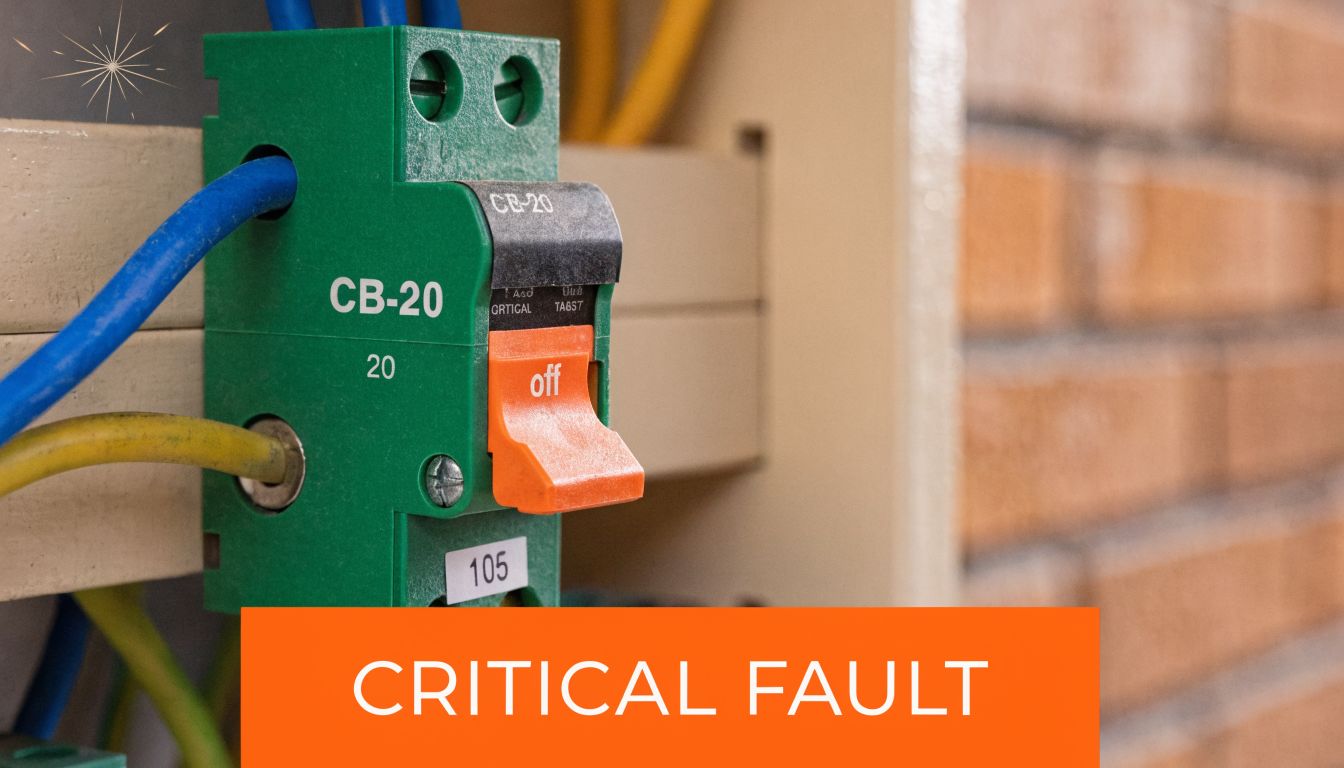
A breaker that trips the moment you reset it is sending a different warning than a breaker that trips after several appliances have been running. That fast trip often points to a fault condition, and faults deserve more caution because they can create both fire risk and shock risk.
The timing matters. An overload is often like a lane of traffic slowly filling up until everything backs up. A short circuit or ground fault is more like a direct collision. Current rushes where it should not, and the breaker reacts almost instantly to stop damage.
What a short circuit is
A short circuit usually happens when a hot wire touches neutral or another unintended conductor. That creates a very low-resistance path, so current spikes fast and the breaker trips through its instantaneous magnetic protection, as Eaton explains in its overview of how circuit breakers respond to short circuits and overloads.
In a home, the cause may be damaged wire insulation, a loose connection, a failed appliance, or wiring that has been pinched behind a device. In Florida, I also tell homeowners to pay attention to equipment that lives in hot, damp spaces. Air handlers in garages, condensate leaks near wiring, corroded disconnects, and outdoor components exposed to salt air can all set the stage for fault conditions that national articles often gloss over.
What a ground fault is
A ground fault is a little different. The hot conductor touches ground, metal equipment, or another grounded path. If that metal is part of an appliance cabinet, electrical box, or HVAC equipment housing, someone touching it can become part of the path to ground.
That is why wet locations raise the concern. The National Fire Protection Association explains that ground-fault protection is especially important where people are more likely to contact electricity and ground at the same time, such as bathrooms, kitchens, garages, crawl spaces, outdoors, and other damp areas, as described in its guidance on why GFCI protection matters in wet and grounded locations.
Florida homes deal with this more often than many other states. Long cooling seasons mean AC systems run hard for much of the year. That creates condensation, especially around air handlers, drain lines, condensate pumps, attic equipment, and older garage installations. Add humidity, wind-driven rain, pool equipment, or coastal corrosion, and a nuisance trip can start looking a lot like a wiring fault. Sometimes it is nuisance moisture. Sometimes it is insulation breakdown or a deteriorating connection that needs professional repair.
Warning signs that should change your response
Stop resetting the breaker and treat the problem like a fault if you notice any of the following:
- Immediate re-trip after reset
- Burning smell near the panel, outlet, switch, appliance, or AC equipment
- Scorch marks on a receptacle, plug, disconnect, or panel area
- Buzzing, snapping, or popping on one circuit
- A trip that started after a leak, flooding, or heavy condensation
- A GFCI that will not stay reset in a bathroom, kitchen, garage, laundry area, outdoor outlet, or near pool equipment
A breaker that trips instantly is asking you to stop and investigate, not keep trying.
Why Florida moisture makes faults harder to spot
Homeowners can understandably find this confusing. Humidity by itself does not always mean the wiring is failing, but moisture can create leakage paths, speed up corrosion, and expose weak spots that stayed hidden during drier weather.
We see this around condensate lines, exterior receptacles, pool circuits, patio outlets, and AC disconnects. We also see it in older homes where insulation has become brittle or where prior repairs were never done cleanly. If the same circuit keeps tripping during storms, after AC run time, or whenever humidity climbs, the house may need more than a reset. It may need targeted repair or even electrical rewiring for aging or fault-prone circuits.
If the breaker serving your cooling system is the one acting up, do not keep forcing it on. Start with safe basic checks and review how to reset an AC breaker, but call a licensed electrician or HVAC professional if it trips again, trips instantly, or shows any sign of heat, water exposure, or burned components.
What Homeowners Can Safely Check and Do
You don't need to stand helplessly in front of a tripped breaker. There are a few safe checks that can help you narrow the problem down without opening panels, removing cover plates, or touching wiring.
Start simple. Your job is not to repair the electrical system. Your job is to learn whether the trip behaves like an overload, an appliance problem, or something more serious.

A safe step-by-step reset and test process
If there's no burning smell, no visible damage, and no sign of water at the panel, use this process:
-
Turn off or unplug everything on the affected circuit.
Lamps, countertop appliances, space heaters, chargers, TV gear, portable AC units, dehumidifiers. Get the load off the circuit before resetting. -
Reset the breaker once.
Move it fully to the off position first, then back to on with a firm motion. -
Wait and observe.
If it holds with nothing plugged in, that's useful information. If it trips immediately with no load, stop there and call a licensed electrician. -
Reconnect items one at a time.
Start with smaller loads. Add the big loads last. -
Watch for the trigger.
If the breaker trips when one appliance starts, that appliance may be faulty or too demanding for that circuit.
Safe to do and never do
Here's the line I want homeowners to keep in mind.
| Safe to do | Never do |
|---|---|
| Reset a tripped breaker once after removing loads | Keep resetting a breaker over and over |
| Unplug appliances to isolate the issue | Replace a breaker with a higher-amp breaker |
| Note whether trips happen during AC use, cooking, or bathroom routines | Remove the panel cover to inspect wiring yourself |
| Check visible cords and plugs for damage | Ignore burning odors or scorch marks |
| Move portable appliances to a different circuit when practical | Use extension cords as a permanent fix for heavy loads |
Use load balancing before you assume the worst
A lot of nuisance tripping improves when homeowners spread demand across circuits more thoughtfully. That's called load balancing.
Examples:
- Move the space heater to a different room on a different circuit.
- Don't run the microwave and toaster oven together on a smaller kitchen circuit.
- Separate garage loads if a freezer, power tools, and charger are sharing one branch.
- Avoid stacking summer loads like a portable AC, fan, and dehumidifier on one outlet group.
For high-draw appliances such as Florida HVAC units or a 1500W space heater, installing a dedicated 20 to 30A circuit can reduce appliance-related trips by 80% per electrician benchmarks, and it aligns with NEC 210.23 guidance that continuous loads should be at 80% of circuit rating, according to this explanation of dedicated circuits for high-draw appliances.
AC breaker confusion is common
Homeowners often mix up a tripped house breaker with an AC shutdown at the disconnect or air-handler side. If your issue seems specific to cooling equipment, this guide on how to reset an AC breaker gives a useful homeowner-level walkthrough of the reset sequence and what to watch for before trying again.
A quick visual refresher can help too:
What your notes should include before calling a pro
If the problem continues, the best thing you can provide is a pattern.
Write down:
- Which breaker trips
- What was running at the time
- Whether it tripped instantly or after a delay
- Whether rain, humidity, AC runtime, or a certain outlet seems connected
- Whether one appliance causes repeat trouble
The more specific the pattern, the faster an electrician can separate a load issue from a hidden fault.
When to Call a Licensed Al-Air Electrician
Your breaker trips again. The AC is running hard, the house feels sticky, and now you are standing at the panel wondering whether one more reset will fix it or make things worse.
That is the point to stop guessing.
A breaker that keeps tripping is doing its job, but repeated trips usually mean the circuit is under stress from heat, moisture, damaged wiring, failing equipment, or too much demand. In Florida homes, that pattern often shows up during long cooling stretches because air conditioning can become the heaviest electrical load in the house for months at a time. High humidity adds another layer. Moisture around outdoor equipment, air handlers, condensate drains, disconnects, or aging connections can create fault conditions that do not show up in drier climates.
Red flags that mean stop and call
Call a licensed electrician if you notice any of the following:
- The breaker will not reset
- It trips immediately, even with devices unplugged
- The panel feels warm or hot
- You smell burning plastic, melting insulation, or a sharp electrical odor
- You see scorch marks on the panel, outlets, switches, or cords
- The problem started after rain, flooding, roof leaks, storm damage, or AC service
- More than one breaker is acting up
- The trips began after a remodel, appliance installation, or HVAC replacement
Those warning signs point to problems that need testing, not trial and error. A licensed electrician can measure actual current draw, inspect terminations, check breaker condition, test for hidden faults, and separate an HVAC problem from a house wiring problem.
Florida homes make that distinction especially important. An outdoor condenser with a struggling compressor may pull more current as temperatures climb. An air handler in a humid garage or attic may develop moisture-related issues around controls or connections. Sometimes the AC gets blamed when the underlying issue is a tired breaker, a loose lug in the panel, or a circuit that was never sized for today's equipment.
If you want help choosing qualified residential help, our guide to choosing the best electricians for residential projects in Orlando the 2026 checklist explains what credentials and experience to look for. You can also review outside advice on finding the right electrician near you, especially if you are comparing companies.
What professional solutions usually look like
The repair depends on the cause. One home may need a failed breaker replaced. Another may need a loose connection repaired, a moisture-related fault corrected, an HVAC circuit separated, or a panel evaluated for added capacity. The right fix is the one that removes the cause of the trip, not the one that gets the breaker to stay on for another day.
A good electrician treats a tripping breaker like a warning light on a dashboard. Resetting it without diagnosis can hide the problem for a few hours. Finding why it tripped is what protects your wiring, your equipment, and your home.
Your Top Circuit Breaker Questions Answered
Is a frequently tripping breaker a fire hazard
It can be. The breaker itself is a safety device, but repeated trips mean it is reacting to something abnormal. If that abnormal condition is overheating, a short circuit, damaged wiring, or moisture around energized parts, the risk is real. A breaker that trips once from a temporary overload is different from one that trips repeatedly for no clear reason.
Can I just replace a 15-amp breaker with a 20-amp one
No. That's one of the most dangerous shortcuts a homeowner can take.
The breaker size must match the circuit design, including the wire size and intended load. Installing a larger breaker can allow the wire to carry more current than it was meant to handle before protection kicks in. If you need more capacity, the proper fix is usually a new dedicated circuit or a broader electrical upgrade.
How do I know if I need a full panel upgrade
A full panel upgrade becomes more likely when your home shows a combination of signs. Breakers trip during normal daily use. Major appliances compete for limited capacity. Cooling equipment strains the system. The panel is older, crowded, or no longer suited to the home's current electrical habits.
An electrician should make that call after testing. Homeowners can spot the pattern, but they shouldn't guess at panel sizing.
Why does my breaker trip more in summer
In Florida, summer often means long AC runtimes, plus added demand from fans, dehumidifiers, ice makers, pool equipment, and other warm-weather loads. Even if the electrical system barely gets by in mild weather, cooling season can expose overloads and weak points fast.
If the breaker resets and stays on, am I in the clear
Not necessarily. If it only tripped because you overloaded one circuit once, you may be fine after changing how the load is distributed. But if it trips again under similar conditions, starts tripping faster, or does so with fewer devices running, don't assume the problem solved itself.
Should I repair a bad outlet or wiring issue myself
For anything beyond unplugging devices, checking visible cords, and resetting a breaker once, the safe answer is no. Faults behind walls, inside boxes, at the panel, or near HVAC equipment need licensed work.
If you're comparing providers, this guide on finding the right electrician near you is a practical resource for evaluating qualifications, communication, and fit before you book service.
What if my AC keeps tripping the breaker
Treat that as an HVAC and electrical issue together, not as two separate mysteries. The cause might be equipment-related, circuit-related, or panel-related. Repeated AC breaker trips deserve prompt diagnosis because cooling systems place such heavy demands on the electrical system in Florida homes.
If your breaker keeps tripping and you want a clear answer instead of repeated resets, Al-Air Corporation can help. Their licensed electrical and HVAC team serves Greater Orlando and surrounding areas with troubleshooting, rewiring, panel upgrades, dedicated circuits, and coordinated AC-electrical diagnostics, so you can solve the underlying problem safely and restore reliable power with confidence.