
Mini split repair versus replacement is rarely a simple parts question. For homeowners in Central Florida, Al-Air sees that the real money decision usually comes down to system age, the size of the repair, energy efficiency, and whether the unit is likely to need more work soon.
TL;DR: Summary
- Mini split repair saves more when the unit is fairly young, the problem is isolated, and the rest of the system is in good condition.
- Replacement usually saves more long term when a mini-split heat pump is older than 10 years, needs repeated repairs, or has a major failure like a compressor or coil problem.
- Al-Air’s Florida-specific rule of thumb is useful: under 8 years often supports repair, 8 to 12 years needs a closer look, and 12 to 15 years often tilts toward replacement.
- ENERGY STAR says equipment over 10 years old, frequent repairs, and rising utility bills are signs replacement may make sense, and a properly installed high-efficiency system can cut heating and cooling costs by up to 20%.
- EPA rules do not force replacement of existing R-410A mini splits; homeowners can still service legacy equipment, even though new split systems installed after January 1, 2026 must use refrigerant with a GWP below 700.
A ductless mini split can often be repaired successfully, especially when the issue is small and the unit still cools and dehumidifies well. Once the system is older, less efficient, or repeatedly failing in Florida’s long cooling season, replacement often becomes the lower-cost choice over the next several years.
Is it cheaper to repair or replace a mini split right now?
Repair is usually cheaper today, but replacement often saves more over time when a mini split is older, inefficient, or facing a major component failure. ENERGY STAR and EPA both support looking beyond the immediate invoice.
If your unit has a clogged drain, a bad thermostat, or a failed electrical part, the repair bill will almost always be lower than installing a new system. That makes repair the short-term winner. The mistake is stopping the math there. If the same unit is already old, has high run times, or has needed multiple service calls, a low repair bill can still lead to a higher total spend.
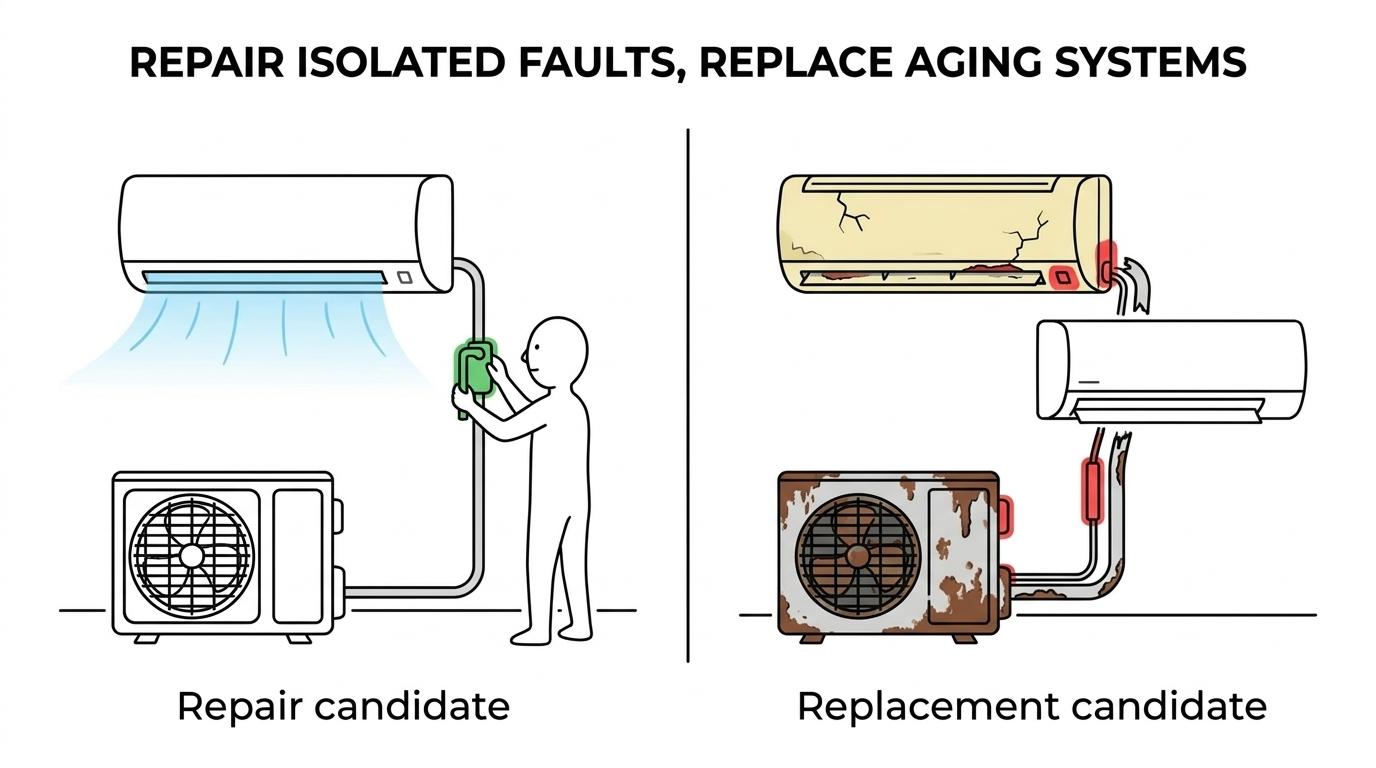
A good test is this: if the repair solves a single fault and returns the system to stable operation, repair makes sense. If the repair only gets you through one more season while efficiency stays poor and other parts are wearing out, replacement usually saves more.
“Al-Air treats mini splits under 8 years old with isolated faults as repair candidates, while Florida systems past 12 to 15 years often deserve a replacement estimate.”
Common misconception: a working mini split is automatically a good mini split. A system can still run while wasting electricity, struggling with humidity, or hiding a refrigerant or compressor problem that will soon become expensive.
When does mini split repair make more financial sense?
Mini split repair makes more sense when the system is relatively young, the fault is isolated, and core components like the compressor and coils are still in solid condition.
This is the repair-friendly profile: the unit is under about 8 to 10 years old, the breakdown is limited to one part, and the equipment has not had a string of major issues. In that case, paying for a repair often preserves a lot of useful life at a modest cost.
Typical repairable issues include controls, drainage, sensors, contactors, capacitors, and some blower-related problems. These faults can interrupt cooling without meaning the entire mini-split heat pump is worn out. If airflow, temperature split, refrigerant condition, and electrical readings are otherwise normal, repair is often the rational choice.
Another point that gets missed is comfort consistency. If the room has been cooling evenly, humidity has stayed under control, and energy bills have been stable, a focused repair is easier to justify. A single failure in an otherwise healthy system is not the same as a system-wide decline.
What mini split repair vs replacement benchmarks matter most?
The best mini split decision uses a short list of benchmarks: age, repair size, repair history, efficiency, and refrigerant pathway. These factors say more than the failed part alone.
Use these benchmarks together rather than one at a time:
- Age of the system: Under 8 years often favors repair; 8 to 12 years is a gray area; 12 to 15 years in Florida often pushes the case toward replacement.
- Size of the repair bill: If the repair cost is close to half the cost of a new system, replacement is usually the stronger long-term choice.
- Repair frequency: Frequent repairs and rising energy bills are classic signs that the unit is losing efficiency and reliability.
- Efficiency gap: ENERGY STAR says a properly installed high-efficiency replacement can save up to 20% on heating and cooling costs.
- Refrigerant and parts path: EPA allows servicing of existing R-410A equipment, but new split systems installed after January 1, 2026 must use refrigerant with a GWP below 700.
A pro tip here is to score all five. Age by itself can mislead you. A 7-year-old unit with a compressor problem may be a worse repair candidate than an 11-year-old unit with a simple drain issue.
How can you decide in three steps before approving any work?
Al-Air frames the choice around age, fault size, and total ownership cost, which fits closely with ENERGY STAR and EPA guidance for residential heat pump decisions.
Step 1 is to confirm the system’s age and history. A mini split that is under 8 years old and has been dependable starts from a repair-friendly position. A unit past 10 years, with rising bills or repeat breakdowns, starts much closer to replacement.
Step 2 is to classify the failure. Small electrical or drainage problems are very different from compressor failure, coil leaks, or severe corrosion. If the failed part is isolated and the rest of the system tests well, repair remains reasonable. If the failed part points to broader wear, the repair may only postpone a larger expense.
“Al-Air uses a simple financial trigger: if a repair estimate approaches half the price of a new system, replacement is usually the stronger long-term spend.”
Step 3 is to compare future costs, not just today’s cost. Take the repair estimate, then ask what happens if the same system needs more work next summer and keeps drawing more power every month. If the next two to five years look expensive, replacement usually wins even when the first repair quote looks tempting.
How do repair costs compare with replacement costs over the next 5 to 15 years?
Replacement often wins over a 5 to 15 year window when the old mini split is inefficient. DOE data for hot-humid climates shows why operating cost matters as much as repair cost.
The Department of Energy’s FEMP example for a hot-humid Southeast home shows a best-available residential air-source heat pump with a 15-year energy cost of $9,202, compared with $14,735 for a less efficient model. That is a projected lifetime difference of $5,533. Even if your home does not match that exact example, it makes the point clearly: efficiency can outweigh a modest repair bill over time.
The same DOE example compares efficiency levels of 24/11 SEER2/HSPF2 versus 14.3/7.5. If your current mini split is older and closer to the lower end of that range, replacement may cut operating cost enough to change the math quickly.
A common myth is that replacement is always the expensive choice because the upfront invoice is bigger. That ignores the cost of electricity, future parts, and the chance that an older unit never fully solves comfort problems after the repair.
How do refrigerant rules affect mini split replacement after 2026?
EPA rules change new split-system installations after January 1, 2026, but they do not force homeowners to scrap existing R-410A mini splits. Existing systems can still be serviced over their useful life.
This point matters because many homeowners hear “refrigerant change” and assume replacement is mandatory. It is not. EPA says faulty components in existing R-410A systems can still be replaced with similar R-410A components. That means repair remains a valid option for a legacy system that is otherwise worth keeping.
The trade-off shows up when the unit is already near end of life. If parts are harder to source, maintenance costs are climbing, and efficiency is poor, a lower-GWP replacement may be the cleaner long-term move. If the unit is still healthy and the repair is isolated, the refrigerant issue alone should not push you into a new system.
Pro tip: ask whether the quote is for servicing existing equipment only or for a full new split-system installation. The regulatory path is different, and that difference affects timing, equipment choices, and total cost.
How should you check age, efficiency, and electric bills step by step?
Start with the install date, then compare utility trends, then measure the efficiency gap against current equipment. Those three checks often clarify whether mini split repair still makes sense.
Step 1 is to verify age from the model and serial data or past invoices. ENERGY STAR says equipment more than 10 years old is a sign replacement may be worth considering. That is not a hard cutoff, but it is a strong screening point.
Step 2 is to review electric bills from the same season over the last few years. Compare summer to summer, not August to January. If cooling costs are climbing while your household habits are roughly stable, the mini split may be losing efficiency.
Step 3 is to compare your current system with newer options. DOE case work in Central Florida found projected energy savings of 37% for cooling and 59% for heating from a supplemental ductless mini-split heat pump, plus projected energy cost savings of $280 per year. If your existing unit is far behind current performance levels, replacement becomes easier to defend financially.
How can you tell whether a major component failure changes the answer?
Major failures usually shift the math toward replacement, especially when the compressor, indoor coil, outdoor coil, or refrigerant circuit is involved. Small control or drain issues usually do not.
The reason is simple: those major repairs are expensive, labor-heavy, and often tied to the overall health of the system. A compressor failure can point to age, overheating, electrical stress, or refrigerant problems. A leaking coil can turn into an ongoing reliability issue rather than a one-time fix.
“Al-Air notes that capacitor, contactor, thermostat, drain line, and some blower motor issues can often be fixed without replacing the whole mini split.”
Common misconception: replacing a compressor makes an older mini split “like new.” It does not. The indoor fan, control board, valves, wiring, insulation condition, and overall efficiency remain the same age they were before the repair.
If the failed part is one of the system’s most expensive components, ask a second question right away: will this repair restore both reliability and efficiency, or only restore operation? If the answer is operation only, replacement usually has the better financial case.
How do Florida humidity and usage patterns change the math step by step?
Florida conditions make efficiency and moisture control more important, so replacement can save more here than in milder climates. Long cooling seasons punish older mini splits.
Step 1 is to look at runtime and humidity performance. If the mini split runs for long stretches yet rooms still feel damp, the issue may be more than a repairable part. It may be poor sizing, declining capacity, or weak dehumidification.
Step 2 is to consider system fit. A ductless unit that is oversized can short cycle, shut off too quickly, and leave moisture behind. A unit that is undersized may run constantly and drive bills up. Repair does not fix bad sizing.
Step 3 is to connect comfort to cost. DOE’s Building America work in Central Florida found ductless mini-split heat pumps had at least a 15% efficiency advantage over the standard systems studied, with a projected simple payback of 12 years in that case. If your current unit struggles with both comfort and power use, the Florida climate tends to make replacement pay back faster.
What mistakes cause homeowners to overspend on mini split repair?
Most overspending comes from using one-factor logic. The expensive mistakes happen when people focus only on the failed part, only on age, or only on the cheapest quote.
A better decision looks at equipment condition, efficiency, repair scope, refrigerant path, and whether the unit still solves the comfort problem it was installed to solve. If even one of those categories is badly off, the repair may not deliver real value.
Some of the most common mistakes are easy to spot:
- Comparing only today’s invoice: A $700 repair can still be the wrong choice if the system is old and utility costs stay high.
- Assuming age alone decides it: An older mini split with a minor fault may still be repairable, while a younger unit with a compressor failure may not be.
- Treating refrigerant rules as a replacement order: EPA still allows service of existing R-410A equipment.
- Ignoring comfort symptoms: High humidity, uneven cooling, and nonstop runtime often point to problems a basic repair will not solve.
If you ask for both a repair estimate and a replacement estimate on the same visit, the decision usually gets clearer fast. You can weigh near-term cash flow against the next several years of operating cost, reliability, and comfort instead of guessing from one number.