
The AC kicks on. It blasts cold air for a while. One room feels fine, another still feels sticky, and by the end of the month the power bill lands like bad news you were already expecting.
That pattern is familiar in Orlando homes. A lot of older systems cool in short, hard bursts. They lower temperature, but they do not always make the house feel comfortable. In Florida, that difference matters because heat is only half the problem. Moisture is the other half.
A 2 stage ac is built for that exact problem. Instead of running at one speed all the time, it can run lower when the day is milder and ramp up when the heat gets serious. That sounds like a small change. In practice, it can change how your whole house feels.
Is Your AC Struggling with the Florida Heat
By late afternoon in Central Florida, a lot of homes follow the same script.
The system has been cycling all day. The living room is cool enough. The back bedroom feels warm. The hallway feels clammy. Then the AC shuts off, and a few minutes later it roars back on again. You are not just cooling the house. You are chasing comfort.
That is one reason people start searching for simple relief first. They close blinds, add ceiling fans, and look up guides on how to cool a room without AC just to make one hot room livable. Those tricks can help at the edges. But when the whole system is fighting the weather, the underlying issue is often the type of AC itself.
Why the old on off pattern feels so uncomfortable
A standard single-stage unit has one answer to every problem. Full power. Then off.
That works, but it is not subtle. The house gets a blast of cold air, reaches the thermostat setting, and stops. During that stop, humidity can start to creep back in. The result is a house that looks fine on the thermostat but still feels muggy.
Key takeaway: In Florida, comfort is not just about hitting the set temperature. It is about controlling moisture and avoiding those constant swings between too cold and not cool enough.
The smarter option many homeowners overlook
A 2 stage ac is easier to understand than it sounds. Think of it as an air conditioner with a normal gear and a heavy-duty gear.
Most of the time, your home does not need maximum output. It needs steady cooling. A two-stage system is built to spend more of its life doing exactly that. It can cool more gently, more evenly, and with less of the start-stop drama that makes some homes feel uneven.
If your house feels loud, damp, or inconsistent every summer, the problem may not be that your AC is too weak. It may be that it only knows how to run one way.
How a 2 Stage AC Works
A two-stage air conditioner operates on two levels. It uses a lower cooling setting for the many hours when your home needs steady temperature control, and a full-power setting for the hardest part of a Florida afternoon.
That is the whole idea.
Instead of running like a simple on-off switch, the system has a lower gear and a high gear. In day-to-day use, that matters because your house rarely needs maximum cooling every single cycle. In Central Florida, the bigger comfort problem is often heat plus humidity, not just heat alone.
The two operating levels
A two-stage system has two cooling settings.
- Low stage: a reduced output mode for regular cooling
- High stage: full output for heavier demand
On a fairly typical warm day, the unit may stay in low stage for longer stretches. When outdoor heat builds, more people are home, or the sun is hammering one side of the house in late afternoon, it can shift to high stage to catch up.
Carrier explains that many two-stage systems run at about 65% capacity in low stage and 100% in high stage, with longer cycles that improve moisture removal and efficiency in the right conditions. Carrier’s overview of one-stage, two-stage, and variable-speed AC systems
Here is a quick visual explainer before we go deeper:
Why longer runtimes can feel better
Many homeowners hear “runs longer” and assume that means higher bills. With a two-stage system, longer runtime at lower output is often part of why it feels more comfortable.
Here is why.
Your AC removes heat and moisture while air passes over the indoor coil. If the system blasts on, cools the thermostat fast, and shuts off, it may satisfy the temperature setting before it has done much drying. In Florida, that can leave the house at 75 degrees and still a little sticky.
A two-stage unit in low stage cools more gradually. That longer cycle gives it more time to pull moisture out of the air. The result is often a house that feels drier, more even from room to room, and less drafty.
A plain-English example
Set the thermostat to 75 on a humid Orlando day that is hot, but not record hot.
A single-stage system often starts at full power, drops the temperature quickly, and shuts off. Then the indoor humidity starts creeping back while the system waits for the next call.
A two-stage system can stay in low stage and keep working at a steadier pace. It is similar to driving through town with smooth pressure on the gas pedal instead of stomping on it at every green light. The trip is calmer, and the equipment is not constantly jumping from zero to full output.
That operating pattern is a big part of its practical value in Florida. You are not only paying for colder air. You are paying for better humidity control during the long cooling season, which is where many homeowners start to see the comfort payoff.
What usually confuses people
Homeowners usually ask a few fair questions here.
Does low stage mean weaker cooling?
No. It means the system is matching the home’s cooling load more closely. If conditions change, it can still switch to high stage.
Will it handle a brutal summer afternoon?
Yes. High stage is there for peak demand.
Does it need the right thermostat and setup?
Usually, yes. Proper staging depends on correct installation, controls, airflow, and refrigerant charge. In Florida, that part matters because a poorly configured two-stage system can give up some of the humidity-control benefit that justified the upgrade in the first place.
Tip: The value of a 2 stage ac is not just the second setting. The value is how often it can stay in the lower setting and keep your home comfortable without the harsh on-off cycling of a basic system.
Two-Stage vs Single-Stage vs Variable-Speed AC Systems
Once you understand how a two-stage unit works, the next question is where it fits among the three main system types homeowners usually compare.
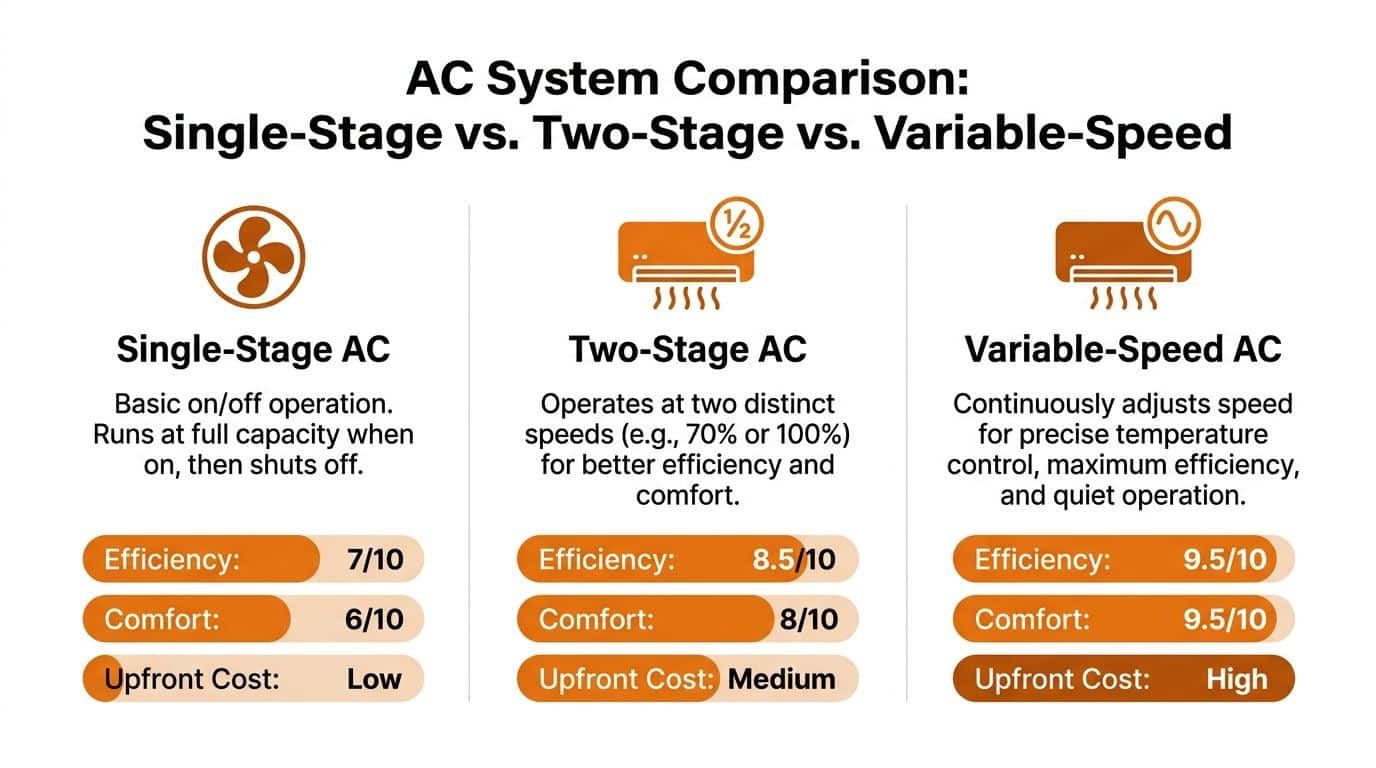
The short version is simple. Single-stage is basic. Two-stage is the middle ground. Variable-speed offers the most precision.
For many Florida homes, the key decision is not “Which one is best on paper?” It is “Which one gives me the comfort I want at a price I can live with?”
The biggest practical difference
According to Bryant’s two-stage overview, two-stage air conditioners run at a low stage of 60 to 70% capacity during about 80% of operating hours. Bryant also notes that this reduces energy spikes and allows longer, more effective dehumidification cycles, which matters a lot in Florida.
That one detail explains much of the difference between the three system types.
- A single-stage unit does one thing. Full output.
- A two-stage unit can stay in a lower, steadier mode much of the time.
- A variable-speed unit makes even finer adjustments.
Side by side comparison
| Feature | Single-Stage | Two-Stage | Variable-Speed |
|---|---|---|---|
| Operation style | Full on or off | Low stage or high stage | Continuously adjusts output |
| Comfort feel | More temperature swings | More even indoor comfort | Most precise temperature control |
| Humidity handling | Basic | Better moisture removal | Best moisture control |
| Noise | Louder starts and stops | Usually quieter in low stage | Often the quietest |
| Upfront cost | Lowest | Mid-range | Highest |
| Best fit | Budget-focused replacement | Balanced upgrade | Premium comfort and efficiency |
Comfort in real life
A single-stage system can cool a house. No question. But it tends to do it in bursts.
That can mean:
- cold air near the vents
- warmer spots farther from the thermostat
- more noticeable starts and stops
- a house that reaches the number on the wall but still feels damp
Two-stage systems smooth that out. They do not offer the minute-by-minute precision of variable-speed equipment, but they solve many of the comfort complaints that drive people crazy with older single-stage units.
Variable-speed systems go even further. They can make extremely fine adjustments and often feel almost invisible in operation. For some homes, that is worth the extra cost. For others, two-stage lands in the sweet spot.
Cost and complexity
Many buying decisions hinge on cost and complexity.
Single-stage usually wins on sticker price. It is straightforward equipment and often the least expensive way to replace a failed unit.
Two-stage costs more upfront, but it brings meaningful gains in comfort and efficiency without jumping all the way to the price and complexity of top-end variable-speed systems.
Variable-speed can be excellent, but it is not automatically the right answer for every home. Some homeowners want the best available technology. Others want a strong middle option that improves comfort without pushing the budget too far.
Who tends to like each type
Single-stage often fits:
- rental properties
- tight replacement budgets
- homes where basic cooling is the main goal
Two-stage often fits:
- family homes with comfort complaints
- homeowners tired of humidity issues
- people who want a noticeable upgrade without going all the way to premium equipment
Variable-speed often fits:
- homeowners chasing top-tier comfort
- larger homes with more complex cooling demands
- buyers comfortable with a higher initial investment
Simple rule: If single-stage feels like the budget option and variable-speed feels like the luxury option, a 2 stage ac is often the practical upgrade in the middle.
Benefits of a Two-Stage AC in Central Florida
In Central Florida, temperature is only part of the comfort problem. The primary struggle is often humidity.
In this context, a two-stage system starts to make sense in a way that feels very local, not just theoretical.
Better moisture control where it matters most
When the air feels sticky indoors, homeowners often blame insulation, windows, or the thermostat setting. Sometimes those things play a role. But often the AC is not running in a way that removes moisture well.
Advanced two-stage compressors such as the Copeland Scroll UltraTech can operate at 67% capacity in low stage using internal bypass ports, according to Lennox’s glossary entry on two-stage operation. That design is especially useful in humid areas like Orlando because it allows longer dehumidification cycles.
Lennox also notes that this setup can remove 20 to 30% more latent heat and operate 3 to 5 dB quieter than single-stage units in humid environments.
That matters on those days when your house is technically cool, but the air still feels heavy.
A house that feels more even
Hot and cold spots are common in Florida homes.
One room gets morning sun. Another room sits over the garage. One side of the house cools quickly, while another never seems to catch up. A two-stage setup helps because it avoids the hard blast, hard stop pattern that exaggerates those differences.
Longer, gentler operation gives air more time to circulate. In many homes, the result is not dramatic in a flashy way. It is better than that. The house just feels more settled.
Quieter cooling is a real quality-of-life upgrade
Noise gets overlooked until you live with less of it.
A system that starts at full output every time makes itself known. You hear it kick on during dinner. You hear it while watching TV. You hear it in the middle of the night.
A two-stage system running in low stage much of the time is often noticeably calmer. That does not just change comfort. It changes how the home feels to live in.
Why this matters for energy-minded homeowners
Homeowners thinking about a 2 stage ac are usually not looking for gadget features. They want comfort that makes sense financially.
That is why energy performance matters. If you are comparing system options and want broader advice on lowering cooling costs, Al-Air has additional reading on energy efficiency topics that can help you think through the whole house, not just the equipment.
Practical takeaway: In Central Florida, the best feature of a two-stage unit is often not lower temperature. It is drier air, steadier comfort, and less noise.
Understanding the Costs and True ROI for Your Home
A lot of Orlando homeowners reach this point with the same question. “I understand why a two-stage AC feels better. Will it be worth the extra money?”
That is the right question to ask, especially in Florida.
A two-stage system usually costs more up front than a basic single-stage replacement. The return depends on how long you plan to stay in the home, how uncomfortable your house feels now, how high your summer electric bills run, and whether you qualify for rebates or tax credits.
What the savings picture can look like in Orlando
Hot, humid weather gives a two-stage system more chances to show its value, but the payback is not automatic. Analysts at MSA Cooling & Heating say two-stage systems in climates like Orlando can deliver 15 to 22% annual savings, and they note a typical 8 to 10 year payback without incentives.
That deserves a plain-English translation. A two-stage AC is often a better long-term buy, but it is not a magic shortcut to fast savings.
Florida adds a wrinkle that many articles skip. On very hot days, your system may spend more time in high stage just to keep up. When that happens, the efficiency gap between single-stage and two-stage can shrink. The system can still earn its keep through better humidity control and steadier comfort, but the financial return may build more gradually than a sales brochure suggests.
Rebates can change the math quickly
In many cases, incentives are what turn a “maybe” into a smart upgrade.
Local utility rebates, including programs such as Duke Energy, plus federal tax credits for qualifying higher-efficiency models, can reduce the effective purchase price enough to shorten the payback period. That is why a quote should never be judged by equipment price alone. The true cost is the installed cost after every available incentive is applied.
If you are comparing proposals, ask for all of this in writing:
- Equipment model numbers
- SEER2 rating and tax-credit eligibility
- Available utility rebates
- Matched indoor and outdoor components
- Total installed price after incentives
That last item matters most. A system that looks expensive at first glance can become much more reasonable once rebates and credits are included. For a closer look at what should be included in a replacement quote, this Orlando AC installation buying guide helps break it down.
True ROI is bigger than the electric bill
Homeowners sometimes focus on one line item. Monthly power savings.
That matters, but it is only part of the picture.
In Florida, the full return also includes how the house feels in July, how often the system runs in a harsh full-on, full-off pattern, and whether you still need to keep lowering the thermostat just to feel dry. A cheaper system can win on day one and lose over the next several years if it leaves you with clammy rooms, more noise, and higher operating costs.
Here is a practical way to evaluate it. If you plan to sell soon and your main goal is the lowest possible upfront price, a single-stage unit may still fit. If you expect to stay in the home, deal with long cooling seasons, and want a better balance of comfort and operating cost, a two-stage system often lands in the sweet spot.
A simple Florida test
Ask yourself three questions:
- Do I expect to stay in this home for several more years?
- Are humidity and uneven comfort already a daily annoyance?
- Would rebates or tax credits reduce the upgrade cost enough to make the monthly savings more meaningful?
If you answered yes to most of those, a two-stage system is often easier to justify.
Money tip: Ask this exact question before you decide. “What is my out-of-pocket price after every rebate and tax credit for this exact system?” In Florida, that answer often matters more than the sticker price on the first quote.
Installation and Maintenance What Orlando Homeowners Must Know
You can buy a better AC system and still end up with a house that feels sticky at 3 p.m. in August.
That usually happens because the equipment got all the attention, while the setup around it did not. A two-stage AC has more control than a basic single-stage unit, but it still depends on the same fundamentals. Correct sizing. Steady airflow. A thermostat that can call for both stages properly. Ductwork that can carry the air where it needs to go.
Installation details decide whether a two-stage system pays you back
A two-stage system works a lot like a truck with two usable gears. If the controls, ductwork, or sizing are off, it cannot stay in the right gear for the conditions inside your home.
For Orlando homeowners, three parts matter most:
- System sizing: An oversized unit can still cool too fast and shut off before it removes enough humidity. An undersized unit may run hard for long stretches during peak heat.
- Thermostat compatibility: The thermostat has to support staging correctly, or the system may behave more like a basic unit than the one you paid for.
- Airflow through the duct system: Restricted ducts, weak returns, or poor balancing can choke performance and reduce comfort room to room.
That last point gets overlooked all the time. Homeowners compare SEER ratings and brand names, but the duct system is the road the air has to travel on. If the road is narrow, leaky, or blocked, the trip is still slow.
Older Orlando homes often need duct and control updates
This shows up often in homes with older flex duct, patched return air setups, or thermostat wiring that was fine for an older single-stage system but not ideal for staged cooling.
In practical terms, that means a contractor should inspect more than the outdoor unit and air handler. They should check static pressure, confirm airflow, review thermostat wiring, and look at whether the return side is adequate. As noted in WK Mechanical’s overview of two-stage AC benefits, older homes with undersized ducts can lose efficiency, and Florida’s humid, sometimes salty air can add wear that affects repair frequency over time.
That does not make two-stage equipment a poor fit for Central Florida. It means the return on your investment depends heavily on the quality of the installation and on whether the rest of the system is ready for it.
Maintenance in Florida is about moisture as much as cooling
In a dry climate, homeowners can get away with paying attention mainly to temperature. In Orlando, moisture control matters just as much. A two-stage AC often helps with that because it can run longer at a lower output, but only if it stays clean and properly adjusted.
A good maintenance plan should focus on:
- Evaporator and condenser coil condition: Dirty coils reduce heat transfer and force longer, less efficient run times.
- Condensate drainage: If the drain line backs up, water problems and shutdowns can follow fast in summer.
- Electrical parts: Heat and long cooling seasons are hard on capacitors, contactors, and wire connections.
- Airflow checks: Filters, blower settings, and duct restrictions all affect how well stage one and stage two perform.
- Corrosion watch: Homes closer to the coast or exposed to salty air need closer inspection of coils and outdoor components.
This is one place Florida homeowners should think beyond the first year. A lower-priced install can get expensive later if maintenance is harder, airflow was never verified, or corrosion protection was ignored.
If you are comparing bids, this Orlando AC installation buying guide can help you sort out which questions matter before you sign.
Questions to ask before you hire anyone
Ask these before the job starts, and get the answers in writing if you can.
- Will you inspect and evaluate the ductwork, not just swap equipment?
- Will the thermostat support true two-stage operation?
- How will you verify airflow and static pressure after installation?
- What maintenance schedule do you recommend for Orlando humidity, drain lines, and corrosion risk?
- Are there any local rebates, utility incentives, or tax credits that change my real out-of-pocket cost?
Best practice: A good installer talks about the whole system, the home’s humidity load, and long-term service needs, not just the condenser sitting outside.
Is It Time to Upgrade Your AC? Your Next Steps with Al-Air
A lot of homeowners wait for a complete breakdown before making a change. Sometimes that is unavoidable. Often, the warning signs show up much earlier.
If several of these sound familiar, your current system may be nearing the point where replacement is worth serious consideration:
- Frequent repairs: You keep putting money into the unit and confidence keeps dropping.
- Uneven comfort: Some rooms stay muggy or warm even when the thermostat says things are fine.
- High energy bills: The cost of staying cool feels harder to justify each summer.
- Aging equipment: If your system is in that older range where failures become more common, planning ahead usually beats making a rushed decision in peak heat.
- Noise and short cycling: The unit seems to hammer on and off instead of running smoothly.
For homeowners comparing replacement options, a 2 stage ac often makes sense when you want more comfort than a basic system offers, but you are not ready to jump to the highest-priced variable-speed equipment.
If you are already thinking about a full changeout, it helps to review what a swap-out process involves and what choices affect long-term performance. This page on residential HVAC swap-outs is a useful starting point for understanding the replacement path.
The smartest next step is not picking a brand from an ad. It is getting your home evaluated as a system. That includes comfort complaints, humidity, duct condition, thermostat compatibility, and available incentives.
Frequently Asked Questions About 2 Stage AC Systems
Will a 2 stage ac run all the time
It may run longer than a single-stage unit, but that is usually by design.
Longer low-stage cycles are part of how the system keeps temperatures more even and removes more moisture. Longer runtime does not automatically mean something is wrong.
Do I need a special thermostat
In most cases, yes.
A two-stage system works best when paired with a thermostat that can control the different stages correctly. Without that, you may not get the comfort or efficiency benefits you paid for.
Is two-stage always better than single-stage
Not always.
If your top priority is the lowest purchase price, a single-stage system may still be the right fit. Two-stage tends to make more sense when humidity, uneven temperatures, and comfort complaints are part of the problem.
Is variable-speed better than two-stage
Variable-speed is more precise, but it also costs more.
For many homeowners, two-stage is the middle option that improves comfort in a noticeable way without reaching the highest equipment price.
Can a good two-stage unit underperform
Absolutely.
Poor sizing, weak airflow, bad duct design, or the wrong thermostat can hold the system back. That is why installation quality matters as much as the equipment itself.
Is two-stage a good fit for Florida
Often, yes.
Florida homes benefit from better moisture control and steadier cooling. But the right answer still depends on your house, your budget, and how long you plan to stay.
If you want a clear answer on whether a 2 stage ac makes sense for your home, Al-Air Corporation can help you sort through the practical details. Their team serves Greater Orlando homeowners with free estimates, straightforward recommendations, and practical guidance on repairs, replacements, maintenance, and full system upgrades. If your current AC is loud, uneven, expensive to run, or wearing out, this is a good time to get an expert opinion before the next heat wave puts it out of commission.