
You might be dealing with it right now. The AC is running, but the house still feels a little muggy. One bedroom smells musty after the afternoon rain. You dust the furniture, and two days later it looks like a light film settled all over again. Someone in the house wakes up stuffy, especially during oak pollen season or after a remodel.
That’s indoor air quality in real life.
In Central Florida, air problems inside the home rarely come from one single cause. They usually come from a mix of humidity, filtration, airflow, and whatever your house is holding onto from daily life. Cooking fumes. Pet dander. Dust in return vents. Moisture in ducts. Chemical smells from paint, flooring, cabinets, or cleaners. In an older Orlando home, or in a house with an aging HVAC system, those issues can stack up fast.
A lot of articles talk about indoor air quality solutions as if every home starts with a clean slate. Most Orlando homeowners don’t have that situation. They’re working with an existing AC, existing ductwork, existing insulation, and Florida weather that pushes moisture into every weak point. That changes what is effective.
Why Your Orlando Home's Air Might Be Unhealthy
Indoor air quality, or IAQ, is the condition of the air inside your home. Good IAQ means the air is reasonably clean, balanced, and comfortable to breathe. Poor IAQ means pollutants, moisture, stale air, or particles are building up faster than your home can remove them.
That matters more than commonly understood. Americans spend approximately 90% of their time indoors, where air pollution levels are often 2 to 5 times higher than outdoors. For people with asthma and children, the risk is even greater. Over 28 million U.S. adults and nearly 5 million children have asthma, and children breathe 50% more air per pound of body weight (asthma and allergy statistics).

Humidity is the first problem
If you live in Orlando, you already know the air outside can feel heavy before lunch. That same moisture pressure affects the inside of your house.
When humidity stays high indoors, mold and mildew get a head start. Dust mites like it too. Closets on exterior walls, supply vents, air handlers, and duct interiors can all become trouble spots if air isn't moving properly or if condensation is forming.
That’s one reason Florida homes can smell “clean but musty” at the same time. The house may be tidy, but moisture is feeding growth you can’t always see. If you want a plain-English look at how mold can affect a building and the people in it, this guide on the dangers of mold is useful background.
Practical rule: In Orlando, if your air feels damp, your IAQ problem usually isn’t just about dust. It’s about moisture management.
Pollen doesn’t stay outside
A lot of homeowners think of pollen as an outdoor problem. In reality, it rides in on shoes, clothes, pets, and outside air. Once it gets indoors, your AC system can either help remove it or keep recirculating it.
Central Florida has long stretches of pollen exposure. Oaks, grasses, and later seasonal weeds can all contribute. If your filter is basic, your return duct is leaky, or your blower compartment is dirty, those particles don’t leave the house very efficiently.
You feel that as itchy eyes, throat irritation, or that “I’m fine when I leave the house” pattern.
Heat can make chemical pollutants more noticeable
Another common source of bad indoor air is VOCs, or volatile organic compounds. These come from paint, flooring, furniture, cleaning products, adhesives, cabinets, and plenty of other everyday materials.
Florida heat can make those smells stronger. A home that just had a kitchen update or new flooring may hold onto that chemical smell longer if ventilation is poor and the AC system isn’t moving and filtering air the right way.
Here’s where people get confused. They assume indoor air quality solutions always mean buying a portable gadget. Sometimes the better move is fixing the house system first. Better filtration, better ventilation control, cleaner ducts, and proper HVAC setup usually do more than a random plug-in device.
If you’re trying to understand whether your existing system may be part of the problem, it helps to look at how the full home HVAC system works rather than treating IAQ as a separate issue.
Identifying the Signs You Need Professional IAQ Help
Some IAQ problems are obvious. Others show up as little annoyances you keep brushing off. A room that always feels stale. Dust that keeps coming back. That one return vent with a faint dark ring around it.
Those details matter.
The bigger picture is easy to see too. The U.S. indoor air quality market was valued at $10.2 billion in 2023 and is projected to reach $12.9 billion by 2029, reflecting rising awareness of health risks and stronger focus on particulate control after the EPA’s 2024 PM2.5 update (U.S. IAQ market outlook). Homeowners are paying attention because these issues affect comfort, health, and resale appeal.
Clues you can see, smell, and feel
Walk through your home and look for patterns, not one-off events.
- Dust that returns quickly: You clean surfaces, then a fine layer shows back up fast. That can point to poor filtration, leaky ducts, or dirty returns.
- Musty or stale odors: If the smell improves briefly after cleaning but returns when the AC runs, moisture or biological buildup may be involved.
- Condensation on windows or supply grilles: That often suggests humidity imbalance or air leakage.
- Visible spotting: Small dark marks around vents, on closet walls, or near bathrooms can signal mold or mildew activity.
- Irritation that improves outside the home: Sneezing, headaches, or a scratchy throat that settles down when you leave the house is a classic red flag.
Patterns homeowners often miss
A lot of people focus on the room that smells bad. The actual problem may be somewhere else.
For example, the guest room may feel stuffy because the return airflow is weak. The upstairs hallway may smell musty because the system short cycles and doesn’t remove enough moisture. A remodeled kitchen may seem fine, but the VOC smell drifts into bedrooms at night because air circulation is uneven.
If symptoms follow the house instead of the person, the building is telling you something.
A quick visual explainer can help if you’re trying to connect symptoms to common causes:
When it’s time to call a pro
You probably need professional IAQ help if one of these is true:
- The smell keeps coming back after cleaning, filter changes, or airing out the house.
- Allergy or asthma symptoms seem tied to time spent indoors.
- You’ve remodeled recently and the home still smells chemical or stuffy.
- Some rooms feel clammy even when the thermostat says the house is cool.
- Your HVAC system is older and you’re not sure it can support better filtration or added IAQ equipment.
The key is this. Don’t wait for a problem to become visible mold or a system breakdown. Indoor air issues usually start subtly.
A Homeowners Guide to Air Quality Solutions
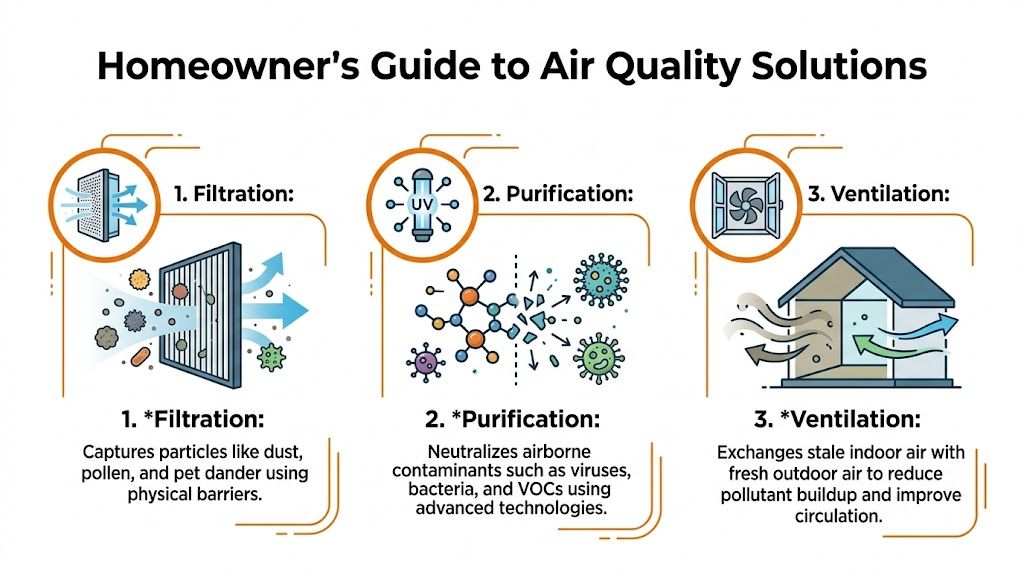
Most indoor air quality solutions fit into three buckets. Filtration catches particles. Purification targets biological contaminants and odors. Ventilation replaces stale indoor air with cleaner outdoor air under controlled conditions.
If you think of your house like a screened porch during lovebug season, the concept gets easier. One tool works like a tighter screen. Another works like a treatment step. Another brings fresh air in and pushes stale air out.
Filtration catches what’s floating
Filtration is the most direct upgrade for many homes. Air passes through a filter, and that filter captures particles before they keep circulating.
The most useful thing many homeowners can do is upgrade to MERV-13 filtration when the system can handle it. A MERV-13 filter traps 90% or more of particles sized 0.3–1.0 µm, and field studies show it can cut indoor PM2.5 by 50–80% in homes like the ones we see in Florida (MERV-13 performance details).
That matters in Orlando because fine particles often include pollen fragments, smoke residue, bioaerosols, and the tiny stuff you don’t notice until your nose and eyes do.
Filtration is often the best first move when the problem is:
- Seasonal allergies
- Pet dander
- Visible dust
- General particle control
The catch is simple. A better filter creates more resistance than a cheap one. If the blower, duct design, or filter rack isn’t right, airflow can suffer. That’s why “just buy a denser filter” sometimes backfires in older systems.
Purification helps with odors and biological issues
Purification adds another layer. Instead of physically trapping particles, these systems target contaminants in different ways. Homeowners usually hear about UV-C lights, in-duct air purifiers, or activated carbon options.
UV-C is commonly installed near the indoor coil or inside the air handler. In a humid climate, that location matters because the coil area is one of the places where moisture and buildup can become a recurring issue. Carbon-based options are more useful when odors and VOCs are a major complaint.
Purification tends to make the most sense when the problem sounds like this:
- The house smells musty
- You recently painted or remodeled
- There’s an odor issue even after cleaning
- You want more than particle capture
A purifier isn’t a replacement for fixing moisture or airflow. If humidity is still out of control, no add-on device will solve the root issue.
Ventilation replaces stale air carefully
Ventilation sounds simple. Open the house up and let fresh air in. In Florida, it’s not that simple.
Outdoor air here often carries moisture, pollen, and sometimes poor air conditions of its own. That’s why controlled ventilation matters more than casual ventilation. Systems such as ERVs, HRVs, exhaust strategies, and sensor-based controls bring in outside air in a more deliberate way.
This is especially helpful in tighter homes, remodeled homes, and houses where people notice stale air, cooking odors, or lingering chemical smells.
A few homeowners also like the natural route of adding houseplants. Plants won’t replace filtration or ventilation, but they can support comfort and make a home feel fresher. If you enjoy that approach, this guide to the best plants for air purification is a good companion read.
Comparing Indoor Air Quality Solutions
| Solution Type | Primary Target | Typical Cost | Maintenance |
|---|---|---|---|
| Filtration | Dust, pollen, pet dander, fine particles | Varies by filter type and system setup | Regular filter replacement |
| Purification | Odors, biological contaminants, VOC-related concerns | Varies by equipment and installation complexity | Lamp or media replacement, periodic inspection |
| Ventilation | Stale air, indoor pollutant buildup, air exchange | Varies by ductwork, controls, and unit type | Filter service, control checks, airflow balancing |
Which approach usually comes first
For most existing homes, the order matters.
Start with source control and HVAC basics. Then improve filtration. Then add purification or ventilation if the symptoms call for it. If you skip that order, you risk spending money on equipment while the underlying problem stays untouched.
A common remodel example makes this clear. A homeowner replaces flooring and cabinets, then notices odors and dust. The wrong move is buying a single-room gadget and hoping for the best. The better move is checking the AC system, the duct condition, the filter setup, and whether fresh air is being managed properly. If replacement is already on the table, this Orlando AC installation guide helps explain what to think about before tying IAQ upgrades into a new system.
Choosing the Right Solution for Your Florida Home
The right fix depends on what’s bothering you most. Not every home needs the same package, and in Florida, combining the right tools usually works better than chasing a single miracle product.
If pollen and allergies are your main problem
Go first to filtration.
If your home feels worst during heavy pollen stretches, or if everyone starts sneezing when the AC kicks on, higher-efficiency filtration is usually the cleanest answer. A properly matched filter upgrade helps remove more of what’s already moving through the system. In many homes, that step produces the most noticeable day-to-day difference.
You may also need return-side sealing, filter rack improvements, or duct cleaning if particles are bypassing the filter.
If the house smells musty
That usually points to a moisture-related issue, not just a smell issue.
The solution often includes checking the indoor coil area, blower compartment, drain setup, and duct condition. Depending on what’s found, homeowners may benefit from purification equipment near the air handler, better dehumidification, or cleaning and correcting airflow problems so the system removes moisture more effectively.
Don’t treat a musty odor like a candle problem. In Florida, it’s usually a moisture problem wearing a smell disguise.
If a remodel left behind chemical odors
Fresh paint, flooring adhesives, cabinetry, and new furnishings can all release VOCs. In that case, the best answer may be controlled ventilation, not just stronger filtration.
Demand-Controlled Ventilation, or DCV, uses CO2 sensors to adjust fresh air intake based on occupancy. In humid climates like Orlando, this approach can reduce ventilation energy costs by 20–40% while keeping CO2 below the 1,000 ppm threshold linked to cognitive impairment (DCV and CO2 control). The practical benefit is that you don’t have to over-ventilate the house all day just to flush out stale air when people are home.
That matters in Florida because unmanaged outdoor air can dump extra humidity into the house. DCV gives you a smarter middle ground.
If pets are part of the picture
Pets bring two different issues. One is dander. The other is odor.
Filtration handles the first part better. Purification and targeted cleaning strategies often help with the second. If the home has carpeting, upholstered furniture, and low airflow rooms, pet-related IAQ problems tend to linger longer because those materials hold particles and smells.
If your system is older
An older AC may still cool the home but struggle with air quality upgrades. Maybe the blower can’t support a higher-efficiency filter well. Maybe the ductwork leaks. Maybe the unit short cycles and leaves the house cool but damp.
In that case, the best “indoor air quality solution” might be a package of smaller changes, not a giant add-on. Better filter design, duct cleaning, airflow correction, humidity control, and selective purification often outperform a one-size-fits-all device.
A good rule for Florida homes is this:
- Dust and allergies: Start with filtration.
- Musty smells and microbial concerns: Investigate moisture, coil cleanliness, and purification.
- Renovation fumes and stale air: Consider controlled ventilation.
- Mixed complaints: Build a layered solution.
Integrating IAQ Upgrades with Your Existing HVAC System
Retrofitting is where indoor air quality solutions get real. It’s one thing to choose a product from a list. It’s another to fit that product into an existing Orlando home without creating new problems.
That’s why this topic gets overlooked so often. Most homes already have constraints. Existing return sizes. Existing blower capacity. Existing duct contamination. Existing humidity issues. You can’t ignore those and expect the upgrade to work.

Why add-on equipment can fail in Florida homes
A key gap in homeowner guidance is the retrofit side of IAQ in humid climates like Orlando. There’s limited practical advice on combining duct cleaning with dehumidification or HRVs in homes where humidity can run 70–90%, even though poor integration can encourage microbial growth in ducts (retrofit IAQ challenge in humid climates).
That’s a big deal here. Bring in outdoor air without handling the moisture properly, and you may solve one problem while creating another. Add a stronger filter without verifying fan performance, and airflow can drop. Install a UV light in the wrong place, and it may do far less than expected.
What a proper retrofit usually includes
A solid retrofit starts with the system you already have.
- Duct inspection: If ducts are dirty, damaged, or sweating, the upgrade plan needs to address that first.
- Airflow review: The blower, returns, and static pressure should support the filter or accessory being added.
- Moisture control: In Florida, every ventilation or purification decision needs to account for humidity.
- Electrical compatibility: Many IAQ devices need safe, code-compliant power and controls integration.
This is one reason remodelers and homeowners often benefit from coordinated HVAC planning during system changes. If a full replacement or major equipment update is already under consideration, it helps to understand residential HVAC swap-outs before adding IAQ accessories one by one.
The best retrofit is the one that works with the house you actually have, not the house a product brochure assumes you have.
Why DIY often falls short
DIY fixes can help at the surface level. Portable purifiers, regular housekeeping, and timely filter changes all have value. But once you’re modifying the central system, installation quality matters a lot.
Florida homes punish shortcuts. Poor sealing lets humid attic air get pulled into ducts. Incorrect UV placement limits effectiveness. Oversized or restrictive filters can affect airflow. Ventilation without proper balancing can leave some rooms damp and others uncomfortable.
A good retrofit solves the original complaint without creating side effects. That takes system knowledge, not just product knowledge.
Partner with Al-Air for Clean Air and Peace of Mind
A lot of Orlando homeowners reach this point after trying the obvious fixes. The filter gets changed. The house gets cleaned. A portable unit shows up in the bedroom. Yet the home still feels damp after an afternoon storm, smells musty in one hallway, or leaves everyone sneezing when oak pollen is heavy outside.
Those mixed signals usually point to a house problem, not a single product problem. In Florida, indoor air quality often ties back to how the air conditioner, ductwork, moisture levels, and ventilation are all working together inside an existing home. That matters even more during a remodel, where new finishes, changed room layouts, or added square footage can throw off the balance an older HVAC system was barely holding in the first place.
A contractor who understands both HVAC performance and retrofit work can help sort out what is causing the problem. Al-Air Corporation works with homeowners across Greater Orlando, including Clermont, Davenport, Kissimmee, Poinciana, Tampa, Hillsborough, and Pasco counties. The company handles AC repair, maintenance, full system replacements, duct-related air quality improvements, and licensed electrical work that often supports IAQ upgrades in older homes.
That combination matters.
Adding an IAQ device to an existing system is a little like adding a new gutter to a roof during Florida rainy season. The part itself matters, but the connection points decide whether it works well or creates new trouble. A good contractor looks at the whole system, explains the tradeoffs clearly, and helps you choose upgrades that fit the house you already own.
Clear communication helps too. Al-Air offers transparent options, punctual service, free estimates before work begins, and 24/7 help for urgent problems. Whether you are trying to solve comfort complaints before summer hits hard or planning cleaner indoor air as part of a renovation, that kind of guidance can make the process easier to understand.
If your home stays dusty, smells stale, or never feels as comfortable as it should, a professional IAQ evaluation can help turn a vague frustration into a workable plan.
Frequently Asked Questions About Home Air Quality
Do indoor air quality solutions help with pet odors and dander
They can, but the fix depends on what is floating in the air and what has already settled into the house.
Dander behaves like fine dust, so better filtration often helps capture it as air moves through your HVAC system. Odors are trickier. In many Florida homes, smells cling to carpet, furniture, and even damp areas around return vents, especially after a stretch of rainy afternoons and high humidity. That means the best answer may include filtration, airflow corrections, humidity control, and some targeted cleaning outside the HVAC system.
Are these systems noisy
Usually, no. Whole-home IAQ equipment is installed as part of the central system, so it tends to run unobtrusively in the background.
If the house suddenly sounds louder after an upgrade, that points to an airflow or installation issue that needs attention. A properly fitted retrofit should improve air quality without making your home sound like a storefront or office suite.
How often do they need maintenance
Maintenance depends on the equipment and on how hard your system works through Orlando heat, pollen season, and long cooling cycles.
Filters need regular replacement. UV lamps and other purification components need inspection and periodic replacement. Ventilation accessories may need their filters, drains, and controls checked during routine HVAC service. In retrofit situations, this matters even more because new IAQ equipment has to work with older ductwork, blower settings, and control wiring. If one part gets ignored, the whole setup can lose effectiveness.
A simple way to remember it is this. If air passes through it, maintenance matters.
Will a better filter fix every air quality problem
A better filter helps with particles. It does not solve moisture, stale air, or every odor issue.
That is a common point of confusion for Florida homeowners. A high-quality filter can catch dust, pollen, and some pet dander, but it cannot dry out a humid house or bring in fresh air if the home is sealed too tightly after a remodel. If your home feels muggy, smells musty, or gets stuffy after showers or cooking, the problem usually goes beyond filtration.
Is a portable air purifier enough
Portable units can help in one room, such as a bedroom, nursery, or home office.
For whole-house problems, they are usually only part of the answer. They do not correct duct leakage, poor central filtration, humidity imbalance, or ventilation problems tied to your existing HVAC system. A portable unit works like a box fan in one corner during a Florida summer storm. Helpful in one spot, but it does not change what is happening throughout the house.
What’s the first step if I’m not sure what I need
Start by noticing patterns in the home.
Write down what you feel, where it happens, and when it gets worse. Dust in one bedroom, musty air after afternoon rain, condensation around vents, or irritation during heavy pollen days all give useful clues. That helps a technician sort out whether the main issue is filtration, moisture control, ventilation, or a retrofit problem where the current HVAC system is not handling the house the way it should.
If your Orlando-area home feels stuffy, damp, dusty, or just less healthy than it should, Al-Air Corporation can help identify the cause and recommend practical indoor air quality solutions that fit your existing system. Reach out for a no-pressure estimate and clear guidance on cleaner air, better comfort, and smarter HVAC upgrades for your home.